Field Service Management Software UK: The 2026 Buyer’s Guide

Quick answer: Field service management (FSM) software is the system a service organisation uses to plan, schedule, dispatch and complete work carried out by mobile technicians — the scheduling engine, the dispatch board, the work-order records and the mobile app the engineer carries. For UK buyers, the right choice depends on scale, the compliance you have to evidence (Gas Safe, UK GDPR), and how well it integrates with what you already run. But almost every FSM platform leaves one gap unaddressed: the experience of the customer waiting at home. That gap is where a dedicated customer-experience layer earns its keep — and it sits on top of any FSM system rather than replacing it.
Key takeaways
- FSM software runs the operation behind the appointment: scheduling, dispatch, work orders and the technician’s mobile app. The global market is worth around USD 5.10 billion in 2025, heading for USD 9.17 billion by 2030.
- UK buyers have specific needs most generic comparisons skip: Gas Safe certification workflows, UK GDPR and data-residency, and genuine UK-hours support.
- The landscape splits into two broad camps — enterprise platforms (Oracle, IFS, SAP, Salesforce, Microsoft, ServiceMax) and trade/SME tools — and the right answer depends entirely on your size and complexity.
- Most FSM tools are built for the dispatcher, not the customer. The result is a flawless schedule the customer never sees and a contact centre fielding “where’s my engineer?” calls.
- You don’t have to replace your FSM system to fix that. A customer-experience layer adds tracking, self-service and feedback on top of the platform you already own.
The field service management market is large and growing fast. It is worth roughly USD 5.10 billion in 2025 and is forecast to reach USD 9.17 billion by 2030, a compound annual growth rate of 12.5% (MarketsandMarkets, 2025). Most of that spend flows into the engine room of field service: better scheduling, smarter routing, mobile apps that put job details in the technician’s hand. For an operation running hundreds of engineers across the UK, those are not optional.
This guide is for the person evaluating field service management software in the UK and trying to separate what matters from the marketing. It covers what FSM software actually does, what UK buyers specifically need to check, how the landscape divides, and the one capability most platforms quietly leave out: the experience of the customer at the other end of the appointment. For the wider discipline behind the software, see our complete guide to field service management. We will be even-handed about the platforms themselves; the strongest field-service stacks are usually a good FSM platform plus a deliberate customer-experience layer, and it is worth understanding why.
Already running an FSM platform and just need to fix the customer side? On My Way adds real-time tracking, self-service rescheduling and instant feedback on top of your existing system — no rip-and-replace. Request a quote or book a 30-minute working session (no slide deck).
What is field service management software?
Field service management software is the platform that plans, schedules, dispatches and records work performed by engineers away from a fixed site. If your business sends people to homes or premises — to install a boiler, restore a broadband line, service a meter, repair an appliance — FSM software is the system that decides who goes where, when, and with what information.
At its core it does five things. It schedules appointments against technician availability, skills and location. It dispatches — assigning the right engineer and optimising the route. It manages work orders, the digital record of each job from booking to sign-off. It gives technicians a mobile app for job details, customer history, forms, photos and signatures, so they aren’t phoning the office between visits. And it produces reporting and analytics on the metrics that run the operation. The major enterprise platforms in this space include Oracle, Microsoft, Salesforce, IFS and SAP (MarketsandMarkets, 2025). This page is about choosing the software; the discipline itself is covered in the pillar guide linked above.
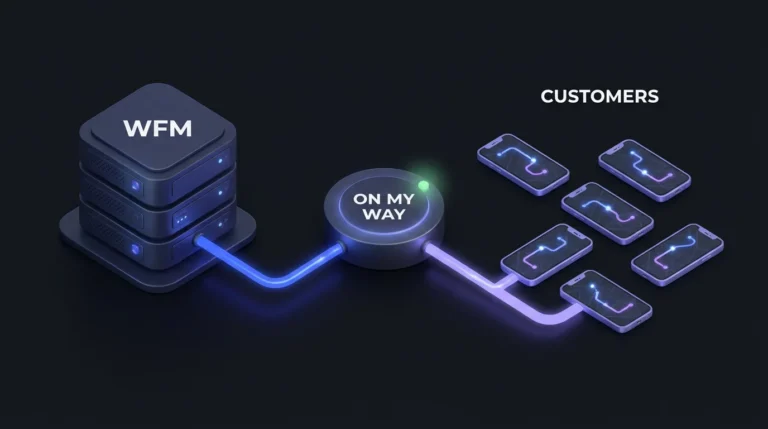
On My Way runs as a customer portal and notifications layer on top of IFS Field Service Management, SAP Field Service Management, Oracle Field Service, Salesforce Field Service, Microsoft Dynamics 365 Field Service and ServiceMax — the scheduling system stays, the customer experience is added on top.
What UK buyers should look for in FSM software
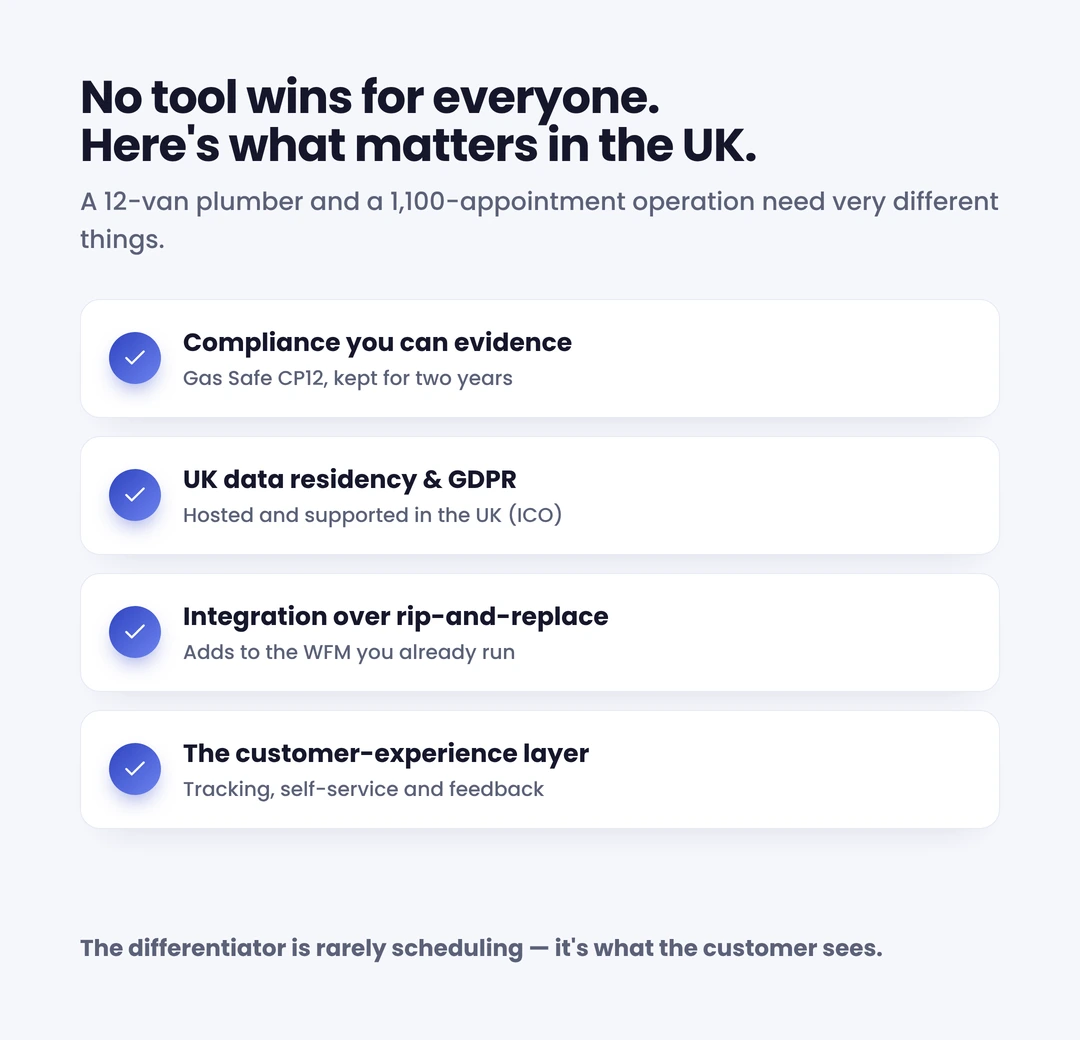
The generic feature checklists you’ll find online miss the things that actually matter when you’re choosing field service software in the UK. Start with these.
Compliance you can evidence. UK field service carries legal paperwork with real consequences. A gas engineer must issue a Landlord Gas Safety Record (the CP12) after an annual check, and those records have to be kept for at least two years (Gas Engineer Software, 2025). Your FSM software should capture, store and produce that evidence on demand — not leave it on a clipboard. The same applies to electrical certification, asbestos records and lone-worker safety.
UK GDPR and data residency. You are processing customer addresses, phone numbers and appointment histories at scale. UK GDPR, enforced by the Information Commissioner’s Office, governs how that data is stored, who can see it, and how subject-access and deletion requests are handled. Ask where the data physically sits and whether the vendor supports regional data residency.
Integration over rip-and-replace. Most enterprise operations already run a workforce-management platform. The expensive mistake is assuming better capability means ripping it out. The better question is whether a tool integrates cleanly with what you have, via API, so you add the capability you’re missing without a multi-year migration.
Genuine UK support. Field service doesn’t keep office hours, and neither should your support line. Check that support is UK-based or at least UK-hours, and that implementation help understands the UK market rather than treating it as a footnote to a US product.

The field service management software UK landscape: enterprise platforms vs trade tools
The UK market for field service software broadly splits into two camps, and the right answer depends entirely on which side of the line your operation sits.
Enterprise field service platforms — Oracle Field Service, IFS, SAP, Salesforce Field Service and Microsoft Dynamics 365 among them — are built for complexity: hundreds or thousands of technicians, sophisticated scheduling constraints, deep integration with asset and ERP systems, and the security and governance a large organisation requires. They are powerful and they are a serious commitment, in both cost and implementation time.
Trade and SME tools sit at the other end. They are built for smaller field operations, a few engineers up to a few dozen, and they prioritise speed of setup, job management, invoicing and (in the UK) trade-specific compliance like gas certification. They are quicker to deploy and far cheaper, but they don’t carry the scheduling depth or integration breadth a large enterprise needs.
There is no universally “best field service management software” — only the best fit for your scale, your compliance burden and your existing systems. A 12-engineer plumbing firm and a 1,100-appointment-a-day national HVAC operation need fundamentally different tools, even though both might search for “FSM software UK” and land on the same comparison page. The honest comparison sites understand this; treat any roundup that crowns a single winner with suspicion.
| Platform | Built for | The customer-experience gap | Add the customer layer |
|---|---|---|---|
| IFS Field Service Management (with PSO) | Scheduling and optimisation at enterprise scale; deep asset and ERP integration | Native customer experience is limited — tracking, rebooking and notifications need adding | On My Way for IFS |
| SAP Field Service Management | Operations already committed to the SAP stack | Customer-facing layer is basic out of the box | On My Way for SAP FSM |
| Oracle Field Service | Robust scheduling and route optimisation for large mobile workforces | Native customer layer is comparatively basic and platform-bound | On My Way for Oracle |
| Salesforce Field Service | Organisations running service on Salesforce CRM | Self-service, branding and feedback usually need Experience Cloud build effort | On My Way for Salesforce |
| Microsoft Dynamics 365 Field Service | Microsoft-centric estates using the Power Platform | Limited out-of-the-box self-service and branding | On My Way for Dynamics 365 |
| ServiceMax | Asset-centric field service with complex equipment | Customer communication is not its focus | On My Way for ServiceMax |
| Trade and SME tools | A few engineers to a few dozen; fast setup, invoicing, UK trade compliance | Lack the scheduling depth and integration breadth an enterprise needs | — |
The customer-experience gap most FSM tools leave
Here is the pattern we see across enterprise field service. The platform is excellent at running the operation. It schedules tightly, routes efficiently, and gives the engineer everything they need. And then it goes quiet at exactly the moment the customer is paying most attention — the wait for the appointment.

That matters because the customer never sees the schedule. They see whether anyone told them the engineer was running late. And their expectations have moved: people now expect to track a technician’s arrival the way they track a food delivery, and to handle routine service tasks through a self-service portal when one is offered. FSM platforms are built for the dispatcher, not the homeowner, so that expectation goes unmet by default.
The cost of the gap is concrete. In a typical enterprise operation, 30–40% of appointments are changed by the customer and 10–15% are cancelled, and each of those changes tends to generate a five-to-seven-minute call to the contact centre, frequently outside business hours (On My Way deployment research). Add the customers who simply ring to ask when the engineer will arrive, and a large slice of contact-centre volume turns out to be questions the customer could have answered themselves — if the system had let them. That is the “where’s my engineer?” problem, and no amount of scheduling sophistication fixes it, because it lives on the customer’s side of the glass. We unpack it in full in our guide to the field-service customer experience.
How a customer-experience layer completes the stack
The fix is not a better FSM platform. It is a layer that sits on top of the FSM platform you already run and turns the appointment into something the customer can see and control.
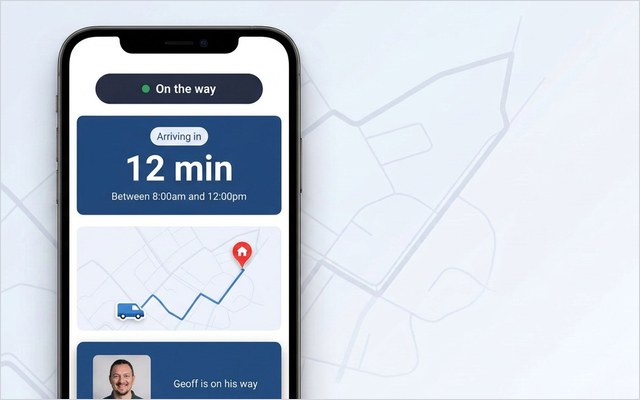
That is what On My Way does. It reads from your existing scheduling system and gives the customer the things the FSM platform doesn’t: appointment confirmations and reminders, a live ETA so they can watch the engineer approach, the ability to reschedule or cancel without phoning anyone, and a quick way to give feedback the moment the visit ends. The operation underneath is unchanged. The experience around it changes markedly. You can see how On My Way works and the self-service appointment features that deliver it.
The results from enterprise deployments are consistent, and they show up regardless of sector:
- Bosch UK, a UK HVAC field operation with around 350 engineers, cut ETA-related calls to its contact centre by 53%, and reached 79% engagement with its appointment communications.
- Foxtel, an Australian telecom operator, reduced customer no-shows by 38% by giving customers reminders and easy rescheduling.
- E.ON, a UK energy and utilities provider, improved appointment-based first-time job completion by 19% by getting the right information to the engineer before arrival.
The mechanism behind every one of those numbers is the same. When the customer can see the appointment coming and act on it themselves, the chase calls stop, fewer visits are missed, and the experience scores better even when the repair is identical. Typical call reduction lands in the 40–55% range in the first months, which is why On My Way underwrites a 35% reduction in appointment-related calls within 90 days, or Leadent Digital keeps working at no cost until it’s hit.
UK integration and deployment: keeping your existing WFM
The objection we hear most from IT is that adding a customer-experience layer means another integration headache. In practice it’s the opposite of a platform migration.
On My Way is built to be WFM-agnostic. It integrates with the WFM platform you already run, whether that’s Oracle Field Service, IFS, SAP, ServiceMax, Salesforce Field Service or Microsoft Dynamics 365, through its API rather than asking you to replace anything. Go-live typically takes four to six weeks, not the multi-quarter programme a core-system change would demand, and there’s a six-week pilot option for operations that want to prove it on a subset of their estate first.
For UK buyers the practical points stack up well. Notifications run over SMS and email. Security covers single sign-on via Microsoft Entra ID, role-based access control, encryption and regional data residency, with GDPR and Works Council compliance built in: the things IT will rightly ask about before anything touches customer data. And because nothing about your scheduling, dispatch or compliance workflow changes, the operational risk of adding the layer is low. You keep your FSM system, your processes and your certification records exactly as they are.
How to choose: next steps
Choosing field service management software in the UK comes down to a short, honest sequence. First, size the problem: how many technicians, how many appointments a day, and which compliance regimes you must evidence. Second, decide whether you genuinely need a new platform or whether your current FSM system is doing its job and the real gap is elsewhere, usually on the customer side. Third, insist on integration over replacement wherever you can; the lowest-risk upgrade is almost always the one that adds capability without disturbing what works. For most enterprise operations we speak to, the schedule is fine, and the gap is the silence between booking and arrival.
See it on your own WFM. On My Way adds real-time tracking, self-service rescheduling and instant feedback on top of your existing field service platform — Oracle, IFS, SAP, ServiceMax, Salesforce or Dynamics — with no rip-and-replace and a 35% call-reduction guarantee in 90 days. Request a quote or book a 30-minute working session (no slide deck, just your numbers).
Related reading: what a field service app needs, what a field service CRM holds and fleet management and field service.
Frequently asked questions
What is field service management software? It’s the system a service organisation uses to plan, schedule, dispatch and record work carried out by mobile technicians. Core functions are scheduling, dispatch and routing, work-order management, a technician mobile app, and reporting. It runs the operation behind every service appointment.
What is the best field service management software in the UK? There isn’t a single best option — the right choice depends on your scale and needs. Enterprise operations with hundreds of technicians look at platforms like Oracle Field Service, IFS, SAP, Salesforce Field Service and Microsoft Dynamics 365. Smaller trade firms are better served by lighter, faster-to-deploy tools. Be wary of any comparison that names one universal winner.
How much does field service management software cost in the UK? It varies widely by scale, capability and deployment model, so most enterprise vendors price on a quote basis rather than publishing fixed tiers. For a customer-experience layer like On My Way, pricing is per-technician or by appointment volume — request a quote for a figure scoped to your operation.
Do UK field service teams need Gas Safe and GDPR features? If you do gas work, yes — your software should capture and store Gas Safe records such as the CP12 Landlord Gas Safety Record, which must be retained for at least two years. All UK operations handling customer data must also comply with UK GDPR, enforced by the ICO, so data storage, access control and deletion handling matter regardless of trade.
Can I improve customer experience without replacing my FSM system? Yes, and it’s the lower-risk path. A customer-experience layer such as On My Way sits on top of your existing field service or workforce-management platform — Oracle, IFS, SAP, ServiceMax, Salesforce or Dynamics — and adds live tracking, self-service rescheduling and feedback through its API. Your scheduling, dispatch and compliance workflows are untouched, and go-live takes around four to six weeks.
What’s the difference between FSM software and a customer-experience layer? FSM software runs the operation: it schedules, dispatches and records the work, built for the dispatcher and the technician. A customer-experience layer runs the customer’s side of the appointment: confirmations, reminders, live ETA, self-service rescheduling and feedback. Most FSM platforms do the first well and the second barely at all, which is why the two are complementary rather than competing.
What is the best UK-based field service management software?
There is no single best – the right platform depends on scale, compliance burden and the systems you already run. Enterprise operations with hundreds of engineers shortlist IFS, SAP, Oracle Field Service, Salesforce Field Service, Microsoft Dynamics 365 and ServiceMax; trade and SME operations use lighter UK job-management tools built around invoicing and gas or electrical certification. Whichever you choose, check UK GDPR data residency, UK-hours support and API integration, and plan for the customer-facing layer none of them provides in full.
References
- MarketsandMarkets — Field Service Management Market worth $9.17 billion by 2030 (Report Code TC 3048, November 2025)
- MarketsandMarkets — Field Service Management Market by Solutions — Global Forecast to 2030.
- Gas Engineer Software — The Ultimate Guide to Software for Gas Safe Records & Certificates.
- CompareSoft — What Is First-Time Fix Rate & How to Improve Your FTFR.
- Fieldservicely — 60 Field Service Industry Statistics: Growth, Costs & Trends (2025)
- Information Commissioner’s Office (ICO) — UK GDPR guidance.
- On My Way / Leadent Digital — enterprise deployment data (appointment-change volume; client outcomes).

Keep your WFM. Upgrade what your customers experience.
On My Way is the customer-experience layer for field service: live arrival tracking, self-service rebooking, notes and photos, and feedback, added on top of the scheduling system you already run. No rip-and-replace, live in four to six weeks.