Field service customer experience vs last-mile delivery tracking
Last-mile delivery tracking and field service customer experience look similar — both show a live ETA — but they solve different problems. Delivery tools (Bringg, Onfleet, Descartes) are built for parcels; field service needs appointment self-service. Here is where each fits, and where On My Way sits.
Compared on enterprise field service operations
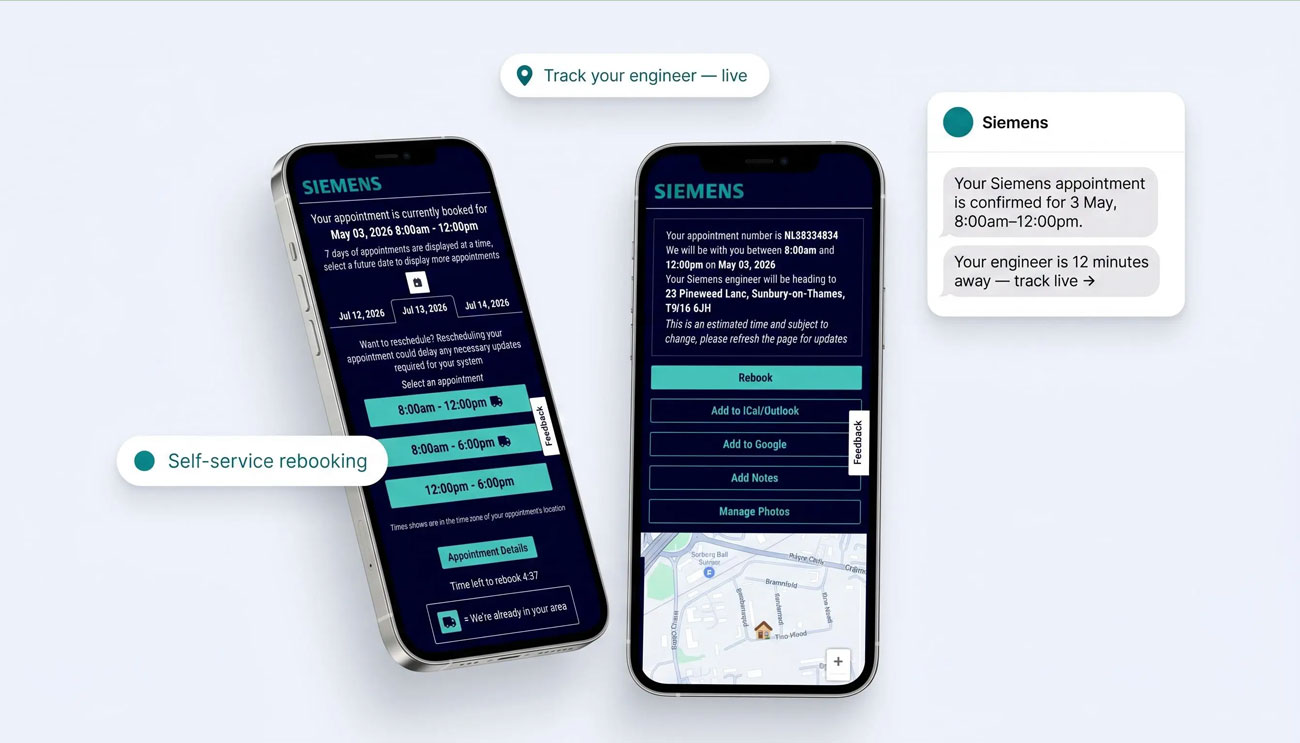
A live ETA is table stakes — field service also needs appointment self-service.
Same live ETA, very different jobs.
It is an easy confusion to make: both last-mile delivery tracking and field service customer experience put a live ETA in front of a customer with no app to install. The map looks the same. The job underneath is not.
Last-mile delivery tracking — tools such as Bringg, Onfleet and Descartes — is built for goods: high-volume, short-duration drops, dense route optimisation, driver dispatch and proof of delivery. For a delivery fleet, that is exactly right, and these are strong products.
Field service is a different shape. A skilled technician attends a home or site for an appointment with a booking window. The value comes from letting the customer confirm, reschedule into an optimised slot, prepare for the visit, rate it afterwards, and reach a contact centre that sees the same status — all on top of a field service scheduler. That is the work On My Way is built for.
Which tool fits which job
Where last-mile tools fit
Parcel and goods delivery — high-volume drops, route optimisation, driver dispatch and proof of delivery. Excellent for a delivery fleet.
What they share
Both surface a live ETA and map to customers with no app to install, and both send day-of notifications. Tracking is table stakes for either.
Where field service CX fits
Skilled appointments — self-service rebooking, confirmations, NPS and a contact-centre view on top of your WFM, with a 35% call-deflection guarantee.
WFM-agnostic by design
Your WFM
Your field service WFM
Keeps doing scheduling, dispatch and work orders — unchanged.
Middleware
On My Way
Syncs appointments via API and surfaces a branded customer layer.
Your customers
Self-service & tracking
Live ETA, rebooking, notifications and feedback — no app to install.
Last-mile delivery tracking vs field service customer experience
| Dimension | Last-mile delivery tracking | Field service CX (On My Way) |
|---|---|---|
| Built for | Parcels & goods delivery | Skilled technician appointments |
| Typical visit | High-volume, short drop | Booked appointment, longer window |
| Live ETA & tracking | Yes — core strength | Yes — real-time, map-based |
| Route optimisation | Yes — core strength | Stays in your WFM scheduler |
| Self-service rebooking into slots | Not the focus | Yes — optimised slots, writes back to WFM |
| Appointment confirmations | Basic | Yes — branded, two-way |
| NPS & feedback per visit | Limited | Yes — every work order |
| Contact-centre agent view | Driver/dispatch-oriented | Yes — appointment-oriented, live status |
| Sits on top of a field service WFM | Not designed to | Yes — WFM-agnostic |
| Best fit | Delivery fleets | Enterprise field service operations |
| Call-deflection guarantee | None | 35% in 90 days |

Why the distinction matters when you choose
Pick the tool built for the job — or you pay for it in the experience.
A last-mile platform pointed at field service can show an ETA, but it has no real model for booking windows, self-service rebooking that respects your scheduler, or feedback per appointment. A field service layer pointed at parcels would miss dense route optimisation and proof of delivery. Each is excellent at its own job and awkward at the other.
On My Way is unambiguously the field service option: a WFM-agnostic customer-experience layer that does the live ETA, then adds the appointment self-service that actually deflects field service calls — on top of Oracle, IFS, Salesforce, SAP, Dynamics 365 or ServiceMax.
What On My Way adds over the native portal
Self-service rebooking
Customers move an appointment to a greener slot themselves — cutting no-shows and inbound calls, writing back to your scheduler.
Real-time tracking & ETA
A live ETA and map so customers stop calling to ask where the engineer is.
Automated notifications
Branded SMS and email confirmations and reminders that lift attendance.
NPS & feedback
Capture satisfaction on every visit and route detractors to your team fast.
In-appointment marketing
Promote services, plans and offers inside the tracking experience customers open.
Contact-centre view
Agents see the same live status as the customer, deflecting “where is my engineer?” calls.
Putting field service CX on top of your scheduler
Connect to your WFM
On My Way connects to your field service scheduler via API — appointments, work orders and technician status sync automatically. No rip-and-replace.
Configure your experience
Brand the customer portal, set notification and rebooking rules, and choose exactly what data flows.
Go live in 4–6 weeks
Launch with live tracking and full appointment self-service — backed by a 35% call-deflection guarantee.
Proven on the largest field service operations in production.
On My Way runs on top of enterprise WFM platforms at scale. Across Bosch, Foxtel and E.ON deployments the field service customer-experience layer delivers the outcomes below — using only each client’s own approved results.
53%
Bosch — ETA call reduction
38%
Foxtel — no-show reduction
19%
E.ON — first-time fix uplift
“
We tried to stretch a delivery-tracking tool across our engineer appointments. It tracked well but could not handle rebooking or feedback. On My Way was built for field service — that was the difference.
Head of Field Service Operations, enterprise HVAC provider
The verdict in four lines
- Last-mile delivery tracking is excellent for parcels — route optimisation, driver dispatch, proof of delivery.
- Field service needs appointment self-service: rebooking, confirmations, NPS and a contact-centre view.
- A live ETA is table stakes for both; the difference is everything around the appointment.
- On My Way is the field service option — WFM-agnostic, with a 35% call-deflection guarantee in 90 days.
The On My Way guarantee
Hit 35% call deflection in 90 days — or we work for free until you do.
We are confident enough in the field service customer experience to put our fee on the line.
Book a demo →Frequently asked questions
What is the difference between field service software and last-mile delivery tracking?
Last-mile delivery tracking (Bringg, Onfleet, Descartes and similar) is built for parcels and goods — high-volume, short-duration drops, route optimisation and proof of delivery. Field service customer experience (On My Way) is built for skilled appointments — a technician attending a home or site, with longer windows, rebooking, confirmations, NPS and a contact-centre view, on top of a field service scheduler.
Can a last-mile tool run a field service operation?
It can show a live ETA, which is valuable. But field service appointments are not parcels: they involve booking windows, customer preparation, self-service rebooking into optimised slots, and feedback per visit. A last-mile tool is excellent at delivery tracking; it is not designed for the appointment self-service that deflects field service calls.
Where does On My Way fit?
On My Way is a WFM-agnostic field service customer-experience layer. It does live ETA tracking like a delivery tool, then adds the field service essentials: self-service rebooking that writes back to your scheduler, branded notifications, NPS and a contact-centre view — on top of Oracle, IFS, Salesforce, SAP, Dynamics 365 or ServiceMax.
We deliver goods and run field service — do we need both?
Often, yes. A last-mile platform is the right tool for your delivery fleet; a field service customer layer like On My Way is the right tool for your engineer appointments. They solve different problems, and trying to force one to do the other usually disappoints on both.
Does On My Way do route optimisation?
Route and schedule optimisation stays with your field service scheduler (your WFM). On My Way reads from it via API and focuses on the customer experience — tracking, self-service rebooking, notifications, NPS and a contact-centre view.
How long does it take to go live?
Typically 4–6 weeks, configured on top of your existing field service scheduler with no disruption to dispatch — backed by a 35% call-deflection guarantee in 90 days.
See the field service customer layer
Compare On My Way against a delivery-tracking tool — live ETA plus appointment self-service, rebooking, NPS and a contact-centre view, on whatever WFM you run.