What a Field Service CRM Actually Holds, and the Record No System Keeps

Search for a field service CRM and the results imply one product that manages the customer relationship and runs the field operation. No such product exists at enterprise scale. A CRM cannot build tomorrow’s schedule for 400 engineers; a scheduling engine has no idea the customer rang twice last month and nearly cancelled. Well-run operations keep the boundary deliberate.
Quick answer: A field service CRM holds the relationship: accounts, contacts, contracts, cases and communication history. The schedule, dispatch and work orders live in a separate FSM or WFM system. Enterprises integrate the two rather than merging them, in a field service management market MarketsandMarkets values at USD 5.10 billion in 2025.
Key takeaways
- The CRM is the system of record for the relationship: accounts, contacts, contracts, cases. The WFM or FSM system owns the work: schedules, dispatch, work orders. Neither does the other’s job well.
- Salesforce and Dynamics 365 operators get CRM and field service natively adjacent; Oracle, IFS and SAP estates typically integrate a separate CRM. Both patterns work when record ownership is explicit.
- Most field service CRM searches decode into one of three needs: field capability, relationship capability, or better appointment communication. The third is the most common at enterprise scale and the least recognised.
- The appointment as the customer lives it is stored in neither system: in On My Way deployments, a third or more of appointments change after booking and default to the phone.
- Brinks Home closed that gap with a communication layer on top of its existing systems: 34% fewer ETA calls and 25% higher appointment-based first-time job completion.
What a field service CRM actually holds
A field service CRM holds the relationship record: who the customer is, what they are entitled to, what has gone wrong before, and every conversation so far. The load-bearing objects are accounts and contacts (addresses, billing entities, vulnerable-customer flags), contracts and entitlements (cover, service level, renewal date), cases, and the communication trail. When an agent takes a renewal call, this is the system that says the customer had three visits and a refund last quarter.
Vendors sometimes badge this a service CRM, meaning the centre of gravity is the case and the entitlement rather than the sales pipeline. The label matters less than the record: CRM for field service is the half of the estate that remembers people rather than jobs, and customer records in field service carry detail a sales CRM never needs, from meter locations to safeguarding flags. What it does not hold is the operation: no route optimisation, no jeopardy monitoring, no shift plans, no technician mobile execution, no van stock. Those records live on the workforce management side.

CRM vs FSM: where each system is the source of truth
Stated as record ownership, the CRM vs FSM boundary is clean: the CRM masters the relationship, the FSM or WFM system masters the work. The scheduling engine is a discipline of its own, covered in our overview of what a workforce management system does; the wider operation of work orders, parts and contracts is mapped in our guide to field service management.
| The CRM masters (the relationship) | The FSM/WFM masters (the work) |
|---|---|
| Accounts, contacts and site details | Forecasts, schedules and shift plans |
| Contracts, entitlements and renewals | Work orders and job status |
| Cases, complaints and escalations | Dispatch, routing and jeopardy management |
| Communication and purchase history | Technician mobile execution and debrief |
| Consent, preferences and segmentation | Parts, van stock and returns |
Blur that boundary and the failure modes are predictable: customer records keyed into both systems drift apart within months, and schedule copies held in the CRM go stale the moment the real engine re-optimises, so agents promise slots that no longer exist. The operational numbers live on the work side too: Aquant’s 2024 benchmark puts the average first-time fix at 76%, and a missed first visit takes 2.7 visits to resolve. No CRM field improves either figure; scheduling, skills and parts do.
CRM integration for field service: the two enterprise patterns
Enterprise estates connect CRM and field service in one of two patterns, usually decided by history.
Pattern one is natively adjacent. Salesforce Field Service runs on the same platform as Service Cloud, so the account, the case and the work order share one data model; the agent-to-dispatcher handoff is a screen change, not an interface. Dynamics 365 Field Service does the equivalent on Dataverse. Operators here rarely need a second CRM; the work is configuration and record-ownership discipline. How On My Way connects on each is documented in our Salesforce Field Service integration and Dynamics 365 Field Service integration guides.
Pattern two is integrate-by-interface. Estates built around Oracle Field Service, IFS or SAP usually pair an operations-lineage scheduling engine with a separately purchased CRM. The contract is well understood: accounts and contacts sync into the field system as job context, a case raised in the CRM generates a work order, status and completion write back, and entitlements are checked at booking. If the completion record never lands, next month’s renewal is quoted against stale history.
Money follows those joins. MarketsandMarkets forecasts the category growing from USD 5.10 billion in 2025 to USD 9.17 billion by 2030, a 12.5% annual rate; in mature estates much of it goes on keeping the two systems honestly synchronised.
What field service CRM buyers usually need
Most searches for a field service CRM decode into one of three requirements, and diagnosing yours is worth more than any shortlist.
The first buyer owns a CRM and needs field capability: scheduling, dispatch, mobile. That is a WFM selection wearing a CRM search term. The second owns a working WFM system and needs relationship capability: a CRM selection plus the integration pattern above.
The third owns both and still hears the same complaint: customers do not know what is happening with their appointment. At 200 to 1,000+ technicians this is the most common version, and a third system of either kind will not fix it, because the gap is not in the records. It is in the conversation. Salesforce puts the stakes plainly: 80% of customers say the experience a company provides matters as much as its products or services (2024).
Not sure which of the three you are? Bring a month of contact-centre reason codes to a 30-minute working session, no slide deck; we map which calls come from the record gap and which from the communication gap. Book the session, or read how On My Way works first.
The record neither system holds
The customer’s experience of the appointment is stored in neither the CRM nor the WFM system, because it happens outside both. The CRM knows a case was opened and closed; the WFM system knows a job was scheduled, dispatched and completed. Neither records the morning lost to an 8am to 1pm window, the where-are-they question at 12:40, or the rearrangement attempted by phone, twice, on hold.
On My Way’s deployment research finds a booked appointment rarely stays still: a third or more are changed before the visit, roughly one in eight is cancelled outright, and nearly all of that movement arrives by phone, tying up an agent for five to seven minutes a call. The contact centre absorbs it; neither system of record ever learns what the experience felt like.
This is why a well-run estate ends up a triangle rather than a pair. The CRM holds the relationship, the WFM system holds the work, and a customer communication layer holds the appointment as the customer lives it: live ETA, tracking view, self-service rebooking, feedback in the moment. We cover the category in our guide to customer communication management software. Signals captured at the doorstep flow back into the operation and the record, so the CRM finally reflects how the visit went, not merely that it happened.
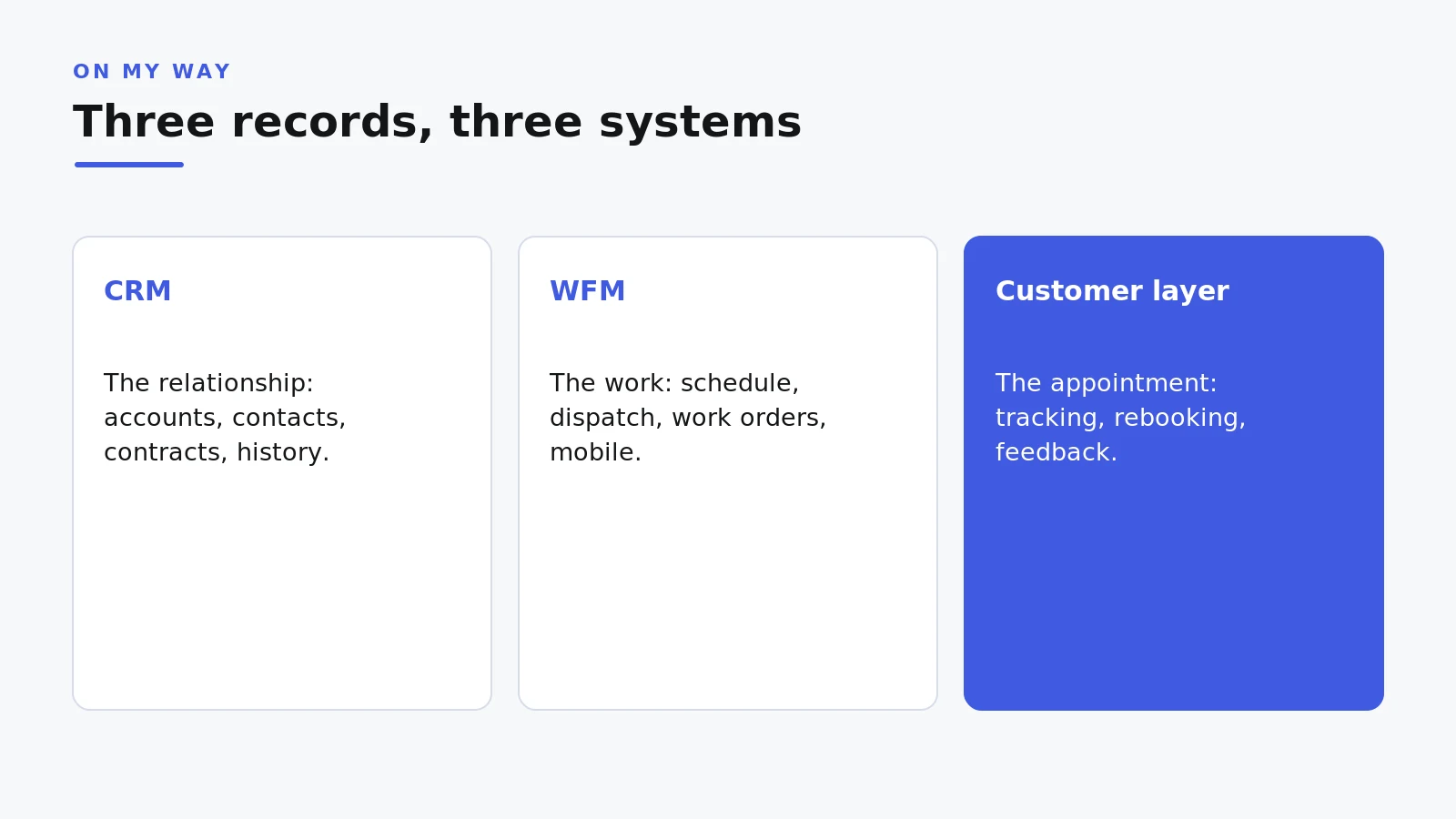
What the communication layer adds alongside CRM and WFM
Start with what it is not: On My Way is not a CRM. It stores no relationship record; the account, the contract and the case stay where they are. It reads appointments from the WFM system and gives the customer a browser-based view, nothing to install: live technician tracking with a real ETA, SMS and email through Twilio, Boomerang or the Leadent SMS Gateway, self-service rebooking and cancellation, real-time NPS or CSAT feeding back to the operation, and in-appointment marketing. A Contact Centre View (Premium) shows agents what the customer sees without consuming a WFM licence. Everything is white-label; the customer sees only the provider’s brand.
For IT, the checklist reads as it should: single sign-on through Microsoft Entra ID, role-based access control, encryption, regional data residency and GDPR compliance. Go-live is typically four to six weeks, with a six-week pilot where the case needs proving first.
The measurable case: Brinks Home added the layer on top of its existing systems and recorded 34% fewer ETA calls and 25% higher appointment-based first-time job completion. Leadent puts a floor under the result: if appointment-related calls have not fallen 35% within 90 days of go-live, the engagement carries on unpaid until they have, with typical deployments landing between 40 and 55%. Pricing is quoted against technician count rather than published, with an appointment-volume model for the largest estates.
Frequently asked questions
Is an FSM system a CRM?
No. An FSM or WFM system masters the work: schedules, work orders, dispatch, mobile execution. Customer names sit in it as job attributes, not relationship records, so contracts, consent, case history and renewals have no proper home there; the gap surfaces at the first renewal cycle or subject access request.
Do Salesforce Field Service or Dynamics 365 users need a separate CRM?
Usually not. Salesforce Field Service shares a platform with Service Cloud, and Dynamics 365 Field Service shares Dataverse with Customer Service; the relationship and the work already sit adjacent. The live questions are record ownership, process discipline, and whether the customer-facing layer above both is any good.
What is the difference between a service CRM and a field service CRM?
Mostly emphasis. A service CRM is organised around cases and entitlements rather than the sales pipeline. A field service CRM, as vendors use the phrase, is usually a CRM suite with a field service module attached, or an FSM product describing itself generously. Ignore the label; ask which record the product actually masters.
How does CRM integration work with Oracle, IFS or SAP field service?
Through a defined interface with explicit record ownership: contacts sync into the field system as job context, cases raise work orders, status and completion write back. Name a master for every record type and audit the write-backs; a completion record that fails to land quietly corrupts the next renewal conversation.
Is On My Way a field service CRM?
No. On My Way stores no relationship record and replaces neither system. It is the communication layer above the WFM engine and beside the CRM: browser-based tracking, notifications, self-service rebooking and real-time feedback, white-labelled, live in four to six weeks.
The bottom line
Judge a field service CRM on the relationship record, and judge the WFM engine on the schedule. Integration between them is a solved pattern on every major platform. The unsolved part is the third record, the appointment as the customer experiences it, and that is a layer you add rather than a system you replace: CRM for the relationship, WFM for the work, a communication layer for the moment they meet.
Put a price on the third record. A 30-minute working session, no slide deck: On My Way running alongside your CRM and your WFM system, with pricing scoped to your operation. Book a demo and request a quote, or read how it works first.
References
- MarketsandMarkets — Field Service Management Market Global Forecast (2025)
- Salesforce — Customer Service Statistics, State of the Connected Customer (2024)
- Aquant — Field Service Benchmark Report (2024)
- On My Way / Leadent Digital — enterprise deployment data (appointment-change volume; client outcomes).