Job Management Software for Tradesmen: The UK Guide

Search for the best job management software for tradesmen and the UK roundups will hand you a single winner, ranked and starred. The premise is wrong. A tool that suits a one-van plumber in Stockport would collapse under a national contractor’s schedule, and a platform built for hundreds of engineers would bury that plumber in setup they never asked for. Size decides what best looks like.
Quick answer: Job management software for tradesmen covers quoting, scheduling, job sheets, compliance certificates, invoicing and basic customer records. No single product wins every size band: sole traders, multi-crew firms and enterprise operations need different things. Segment by size first, check UK compliance fit second, and at scale judge the customer communication layer, where deployments typically cut appointment-related calls by 40–55%.
Key takeaways
- No feature list matters until you have segmented by size: headcount and appointment volume set the shortlist.
- Sole traders should buy speed on quoting and invoicing; multi-crew firms need scheduling discipline and findable compliance records; enterprise operations buy integration, security and customer communication at volume.
- UK compliance is the floor: gas work sits under the Gas Safe regime with landlord records kept at least two years, and electrical work reports against BS 7671, with five-yearly EICRs in England’s private rented sector.
- At enterprise scale the differentiator is the customer’s experience of the appointment. Bosch UK recorded 53% fewer technician-location and ETA-related calls after adding a communication layer over its existing scheduling system.
- Firms outgrow trade tools when the hard problem stops being job sheets and becomes thousands of customers asking where the engineer is.
What does job management software for tradesmen actually cover?
Six things, in practice: quoting, scheduling, job records, certificates, invoicing and a light customer database. Together they replace the duplicate book, the office whiteboard and the WhatsApp thread of boiler photos that passes for a filing system in plenty of profitable firms.
- Quoting and estimating: price the job from the van, send it the same evening, chase it automatically a week later.
- Scheduling: a shared diary that knows who is where, and which annual services and CP12 anniversaries fall due next month.
- Job sheets and records: photos, signatures, notes and materials logged against every visit. If paperwork is the only gap, our guide to job sheet templates covers that ground on its own.
- Certificates: gas safety records, electrical certificates and service reports issued digitally from site.
- Invoicing and payment: invoice before the van leaves the street, take payment by card link, feed the accounts package.
- Customer records: service history, reminders and quote follow-ups. CRM-lite, not a sales machine.
Every product in the category does some version of that list. The differences appear when you ask how many people, vans and appointments it must survive.
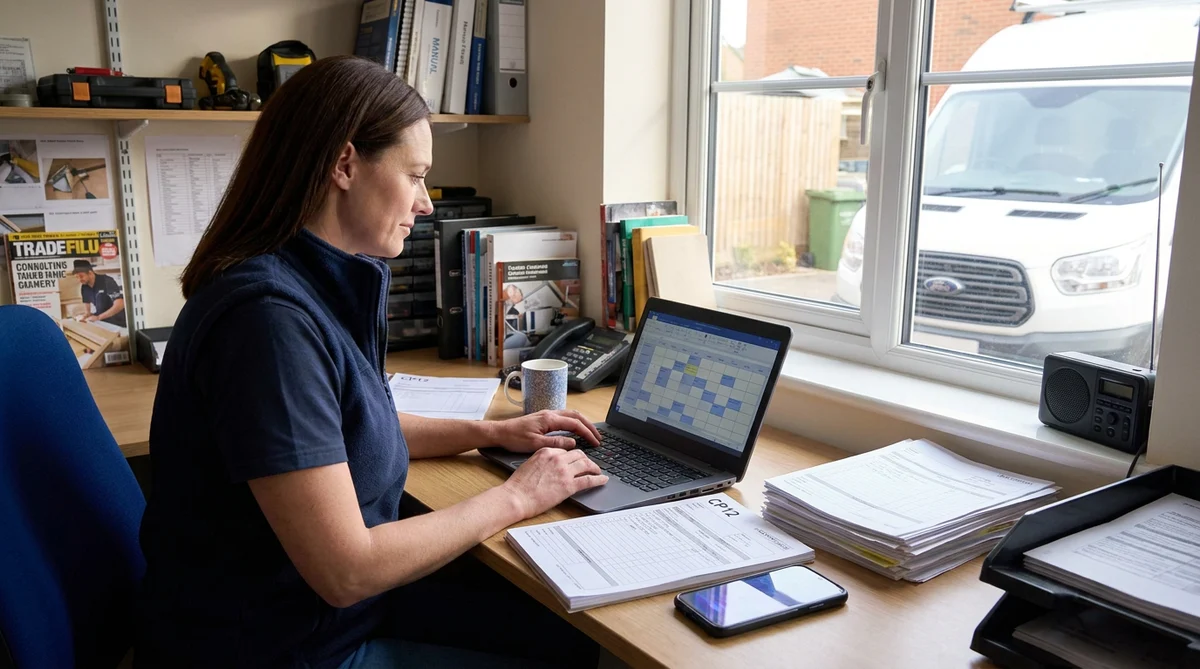
The best job management software for tradesmen in the UK depends on size
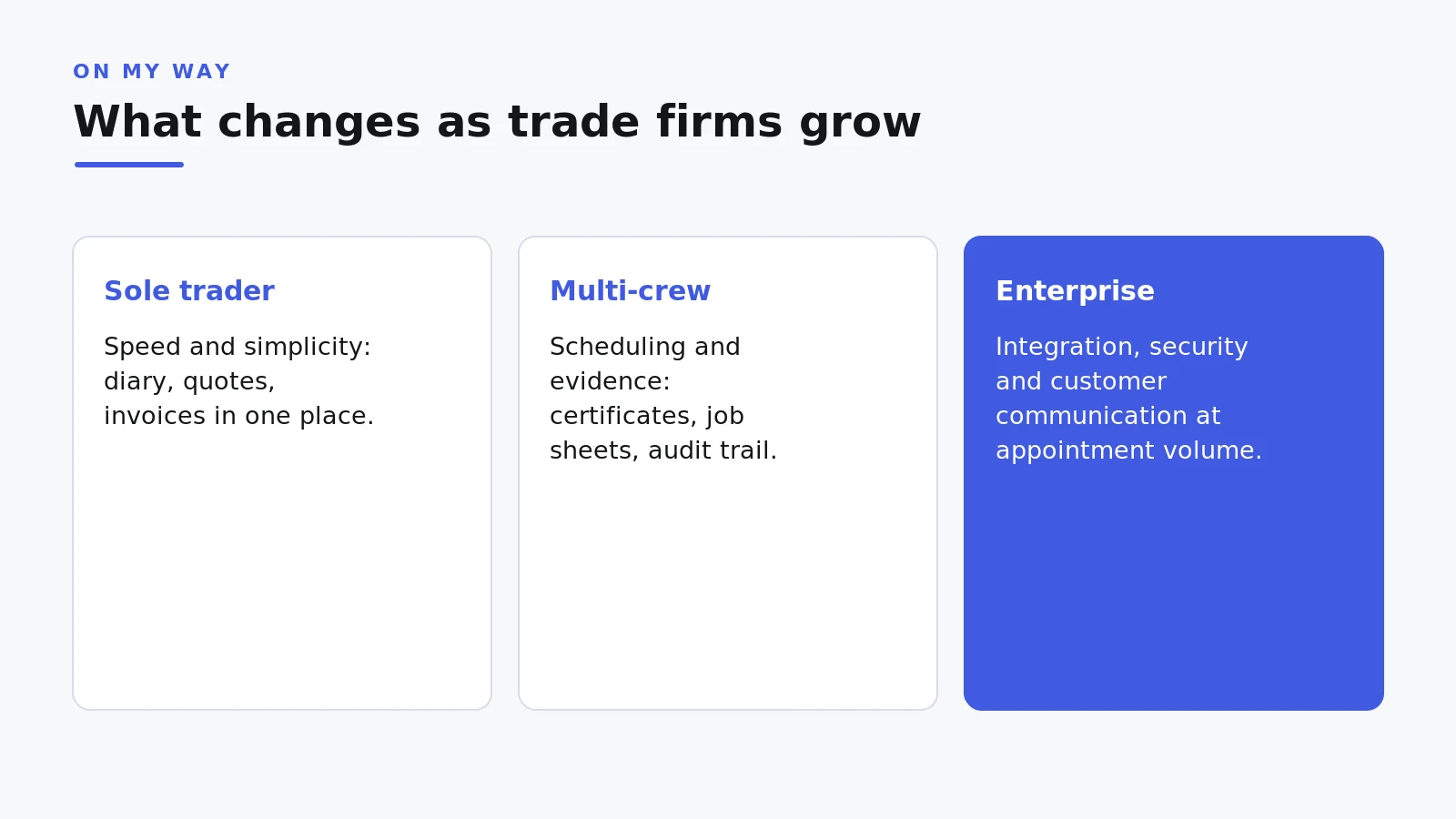
Shortlist by size band first and feature list second. Three bands cover the UK market, and the buying logic changes at each threshold.
Sole traders and one-van firms
Buy speed. A job management app on your phone should let you quote the boiler swap before dinner, invoice the morning’s callout from the van, and get paid without posting anything. Anything that demands an admin day each week has failed at the only test that matters. Skip enterprise features entirely; you pay for them in setup time even when they cost nothing.
Growing firms: two crews to around fifty engineers
Somewhere past the second crew, the whiteboard breaks. Double-bookings creep in, van stock stops matching job sheets, and a second visit waits a fortnight because nobody logged the missing part. This is the band most trade job management software is built for, and the category is genuinely strong. The buying test is scheduling discipline plus evidence: when a letting agent asks for a gas safety record from eighteen months ago, the office should produce it in a minute, not an afternoon.
Enterprise service operations
A firm becomes an enterprise operation when scheduling moves into a dedicated workforce management platform. National contractors and manufacturers’ service arms run dispatch through systems such as Oracle Field Service, Salesforce Field Service, SAP, IFS, ServiceMax or Microsoft Dynamics 365, often tuned over years. Nobody at this scale is shopping for a diary. Procurement asks about single sign-on and data residency before anyone mentions job sheets, and the open question becomes what the customer sees.
UK compliance runs through every serious buying decision
Certificates are legal records, not admin. Choose software for tradesmen that treats them that way, because the obligations are specific and dated.
Gas first. Anyone working on gas appliances must be on the Gas Safe Register. Landlords must have appliances and flues checked every twelve months, and HSE guidance requires the record of each safety check to be kept for at least two years. That makes the CP12 anniversary a legal deadline and a revenue stream in one. Our gas engineer software guide covers the certificate workflow in detail.
Electrical work is certificated against BS 7671, the IET Wiring Regulations. In England’s private rented sector, the Electrical Safety Standards in the Private Rented Sector (England) Regulations 2020 require an electrical installation condition report (EICR) at least every five years. Miss renewal cycles across a few hundred tenancies and the exposure is real. For how certification tools handle EICs and EICRs, see the electrician software guide.
Plumbing and heating sit between the two. The trade is less certificate-led than gas, but heating engineers usually carry both hats, and unvented cylinder work needs appropriately qualified fitters under the Building Regulations. The plumbing software guide covers that mix.
Scale changes the compliance question rather than removing it. At five engineers the problem is issuing certificates. At five hundred, it is proving under audit that every record, across regions and subcontractors, exists, can be retrieved and is retained on schedule.
What changes at enterprise scale
Four things: evidence, integration, security and communication volume.
Evidence stops being a filing question and becomes an audit trail. Integration replaces the all-in-one instinct: jobs originate in a CRM, scheduling lives in the workforce management platform, billing runs through the ERP, and new software must slot into that estate rather than replace it. Security turns into a gate: single sign-on via Microsoft Entra ID, role-based access control, encryption, data residency and GDPR terms all get checked before anyone books a demo.
Communication volume is the change that catches operations out. Field service management spend keeps growing at a double-digit annual rate (MarketsandMarkets, 2025), while Aquant’s 2024 benchmark research describes experienced engineers leaving the industry faster than replacements arrive. Capacity is the scarce asset. At hundreds of appointments a day, even a modest per-appointment rate of ETA calls, reschedules and no-access visits consumes a contact-centre team of its own.
At volume, the differentiator is the customer’s experience of the appointment
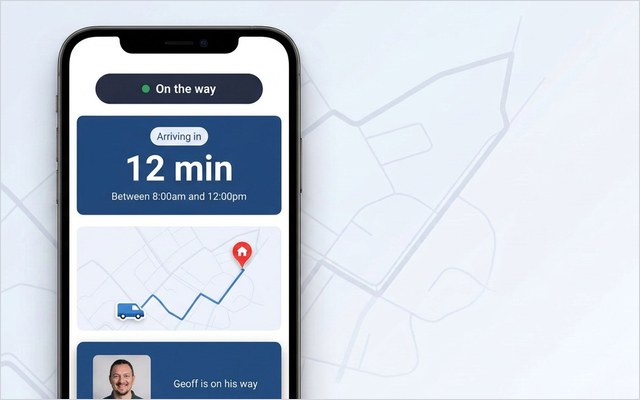
Once scheduling works, the biggest controllable cost is customers ringing about appointments. Across On My Way’s enterprise deployments, a large share of inbound contact-centre traffic is appointment logistics rather than fault reports: when the engineer will arrive, where they are now, how to move Thursday’s slot. Each call carries a handling cost, and each missed connection raises the odds of a wasted visit.
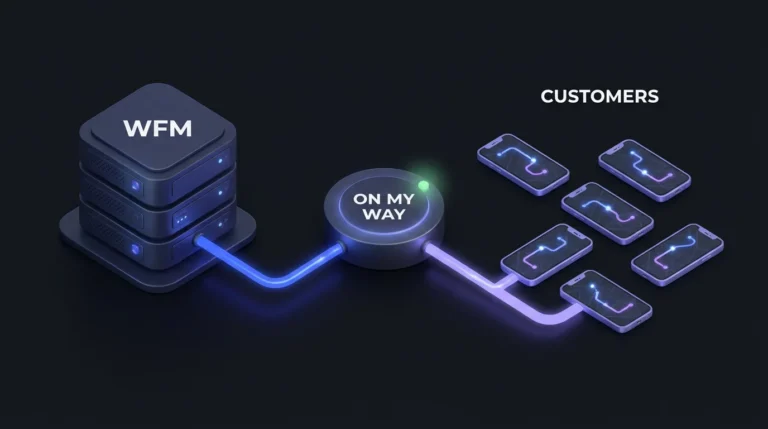
This is the section most roundups skip, because the problem barely exists below a certain size. The layer that fixes it provides live technician tracking with an ETA, confirmations and reminders by SMS and email, self-service rebooking and cancellation, real-time NPS and CSAT capture, and a contact-centre view so agents see exactly what the customer sees. Done properly it is white-label and browser-based: the homeowner sees the heating firm’s brand and taps a link. Nobody installs an app.
The at-scale proof: Bosch UK runs around 350 engineers covering roughly 1,100 appointments a day. After adding On My Way as the communication layer over its existing workforce management system, it recorded 53% fewer technician-location and ETA-related calls and 79% higher customer engagement with appointment communications. The same pattern holds across HVAC service operations, where seasonal peaks multiply appointment churn exactly when capacity is tightest.
Leadent backs deployments with a guarantee rather than a promise: a 35% reduction in appointment-related calls within 90 days of go-live, or the team keeps working at no charge until the number is hit. Typical results land in the 40–55% range.
Test it against your own numbers. Bring appointment volume and call rates to a 30-minute working session, no slide deck, and the Leadent team will map where the calls come from and what the layer would remove. Request a demo, or read how it works first.
When a trades firm outgrows trade tools
The signal is rarely a missing feature. It is a change in what the hard problem is, and four tells show up repeatedly:
- Dispatch already lives in a workforce management platform, and the trade tool duplicates half of it.
- IT asks about single sign-on and data residency before anyone asks about job sheets.
- Contact-centre headcount rises in step with appointment volume, and appointment queries dominate the call log.
- Compliance wants audit trails across regions and subcontractors, not a folder of PDFs.
The wrong response is ripping out systems that work. Scheduling engines are hard-won, and the gap is almost always the customer-facing layer on top of them. That layer can go live in four to six weeks against an existing platform, and a six-week pilot proves or disproves the call-reduction numbers on your own operation before any longer commitment.
Related reading: electrician software, plumbing software, HVAC software and job management software: the UK guide.
Frequently asked questions
Is there a single best job management software for tradesmen in the UK?
No. The honest shortlist starts with size: a phone-first job management app for sole traders, a scheduling and compliance platform for multi-crew firms, and for enterprise operations a workforce management system plus a customer communication layer. Products claiming to span all three usually serve one band well and the others politely.
What is the difference between a job management app and field service management software?
A job management app is an all-in-one tool for small trade businesses, running quote to invoice. Field service management software is the enterprise category: scheduling, dispatch, routing and mobile workflows for large workforces. At that scale the customer-facing side usually comes from a separate layer plugged into the platform.
Do gas engineers need software to stay compliant?
No. The legal requirements are Gas Safe registration and proper records, and HSE guidance says landlord gas safety records must be kept for at least two years; paper meets the law. Software earns its place by making CP12 anniversaries, retrieval and reissue automatic, which is exactly where paper systems quietly fail.
How much does job management software cost in the UK?
Trade platforms usually charge per user per month, tiered by feature set. Enterprise communication layers are typically priced on technician count or appointment volume and quoted case by case. The expensive mistake at either end is paying for scale you lack, or forcing a small-firm tool into an enterprise job.
Do customers need to download an app for tracking and rebooking?
Not with a browser-based layer. The customer taps a link in a text or email and sees live tracking, the ETA and rebooking options in the browser, branded as the service firm rather than the software vendor. Removing the install step is a large part of why engagement holds up.
Can a communication layer work with the WFM system we already run?
Yes, that is the design brief. On My Way sits on top of Oracle Field Service, Salesforce Field Service, SAP, IFS, ServiceMax and Microsoft Dynamics 365, reading appointment data rather than replacing the scheduler. Standard go-live is four to six weeks.
The bottom line
Match the tool to the size of the problem. Sole traders should buy speed, growing firms should buy scheduling discipline and findable records, and every band should treat UK compliance as the floor. Enterprise operations are buying something else again: the customer’s experience of the appointment, at a volume where calls become the cost centre. Bosch UK’s 53% call reduction shows what sits on the other side of that decision.
Running field service at hundreds of appointments a day? Request a quote and a demo, and bring your own appointment data; the working session is thirty minutes and there is no slide deck in it.
References
- Health and Safety Executive — Landlords: gas safety responsibilities (2025)
- Gas Safe Register — The official list of registered gas businesses (2025)
- GOV.UK — Electrical safety standards in the private rented sector: guidance (2020)
- Institution of Engineering and Technology — BS 7671, Requirements for Electrical Installations (2022)
- Gas Engineer Software — Gas certificate app guide (2024)
- Aquant — Field Service Benchmark Report (2024)
- MarketsandMarkets — Field Service Management Market forecast (2025)
- On My Way / Leadent Digital — enterprise deployment data (appointment-change volume; client outcomes).

Keep your WFM. Upgrade what your customers experience.
On My Way is the customer-experience layer for field service: live arrival tracking, self-service rebooking, notes and photos, and feedback, added on top of the scheduling system you already run. No rip-and-replace, live in four to six weeks.