Reactive Maintenance: When Prevention Isn’t Possible

At 4:47 on a Friday afternoon, a walk-in freezer at a supermarket in Leeds stops holding temperature. The store manager rings the facilities line at 4:58. By 5:10 your planner is looking at a full evening board, the nearest qualified engineer is 40 minutes away on another job, and five figures’ worth of frozen stock has started a slow countdown. None of it was on this morning’s schedule. That is reactive maintenance, and no strategy, however well planned, removes it entirely.
Quick answer: Reactive maintenance means repairing equipment after it fails rather than servicing it to a schedule. It is the right strategy for non-critical, cheap-to-replace assets, and an unavoidable share of everything else. The real cost sits in the response: failed first visits stretch jobs to 2.7 visits on average (Aquant), so triage, parts and customer communication decide the final bill.
Key takeaways
- Run-to-failure is a legitimate reactive maintenance strategy for non-critical, inexpensive assets; it only becomes a problem when it happens by neglect rather than by decision.
- The part is rarely the biggest cost on an unplanned job. Premium labour, expedited freight, disrupted schedules and repeat visits usually outweigh it.
- Aquant’s 2024 benchmark puts average first-time fix at 76%; when a first visit fails, the job stretches to 2.7 visits and takes 13 days longer.
- Customers will accept the earliest slot you can offer, but not silence, so live tracking and honest arrival windows matter most on emergency work.
- First-time fix on reactive jobs improves when the right information travels ahead of the engineer instead of arriving with the second visit.
What reactive maintenance is, and what it is not
Reactive maintenance is work triggered by a failure that has already happened: an asset breaks, someone reports it, and the repair is organised after the fact. You will hear it called corrective maintenance, breakdown maintenance or run-to-failure; the terms overlap but differ. Corrective maintenance is the broad category of restoring an asset to working order, some of it planned (a worn part found at inspection, scheduled for next month). Breakdown maintenance is the unplanned subset. Run-to-failure is the deliberate version: a documented decision to let a specific asset fail and replace it when it does.
The opposite half of the ledger is prevention, covered in our guide to planned preventive maintenance, which includes a direct PPM vs reactive maintenance comparison. This article owns the other half: responding well once the failure has happened. Both sit inside the wider discipline of field service management, a market forecast to grow from USD 5.10 billion in 2025 to USD 9.17 billion by 2030 (MarketsandMarkets).
Nor is reactive work a small remainder: the US Department of Energy’s maintenance guidance (2010) estimated that more than half of a typical facility’s maintenance resource still goes on reactive work. Response is a core competence, not an edge case.
When run-to-failure is the right strategy
Run-to-failure is the right reactive maintenance strategy when the full cost of a failure, consequences included, is lower than the cost of preventing it. Inspecting a £90 extract fan four times a year makes little sense when a like-for-like swap costs £120 fitted and nothing important stops in the meantime.
Four tests separate a sound run-to-failure decision from neglect:
- Failure does not halt operations, breach a compliance requirement or create a safety risk.
- Replacement is cheap and quick, ideally a standard part carried on the van.
- Nothing cascades. A £40 sensor that takes a £40,000 compressor with it is not a candidate.
- Redundancy exists, so service continues while you respond at normal rates.
Two habits keep the strategy honest. Write the decision down against the asset in the register, so run-to-failure is an auditable choice rather than a shrug. Review criticality on a cycle too, because it drifts: a pump from a redundant pair stops being non-critical the day its twin is decommissioned.
The true cost model of unplanned work
An unplanned repair costs more than the identical repair done as planned work, and the premium hides in four places. The same Department of Energy guidance put the saving from a functioning preventive programme at 12% to 18% against a purely reactive regime.
Labour comes first: out-of-hours call-out rates, overtime to finish the day’s displaced jobs, travel at times no optimiser would choose. Parts come second, bought at distress prices with expedited freight, occasionally bought twice when the first diagnosis was a guess over the phone. Third, and usually largest, is schedule disruption: every emergency that raids the planned board displaces booked customers, each displacement generates rebooking contact, and a preventive visit bumped for an emergency quietly converts future planned work into future breakdowns.
Fourth is the repeat visit. Aquant’s 2024 benchmark puts average first-time fix at 76%, with top performers at 87% and the bottom cohort near 55%. When a first visit fails, the job stretches to 2.7 visits in total and takes 13 more days to close. Reactive jobs sit at the wrong end of those numbers, because nobody chose the appointment, the diagnosis arrived by phone, and the van was stocked for a different day.
A triage playbook for enterprise reactive response
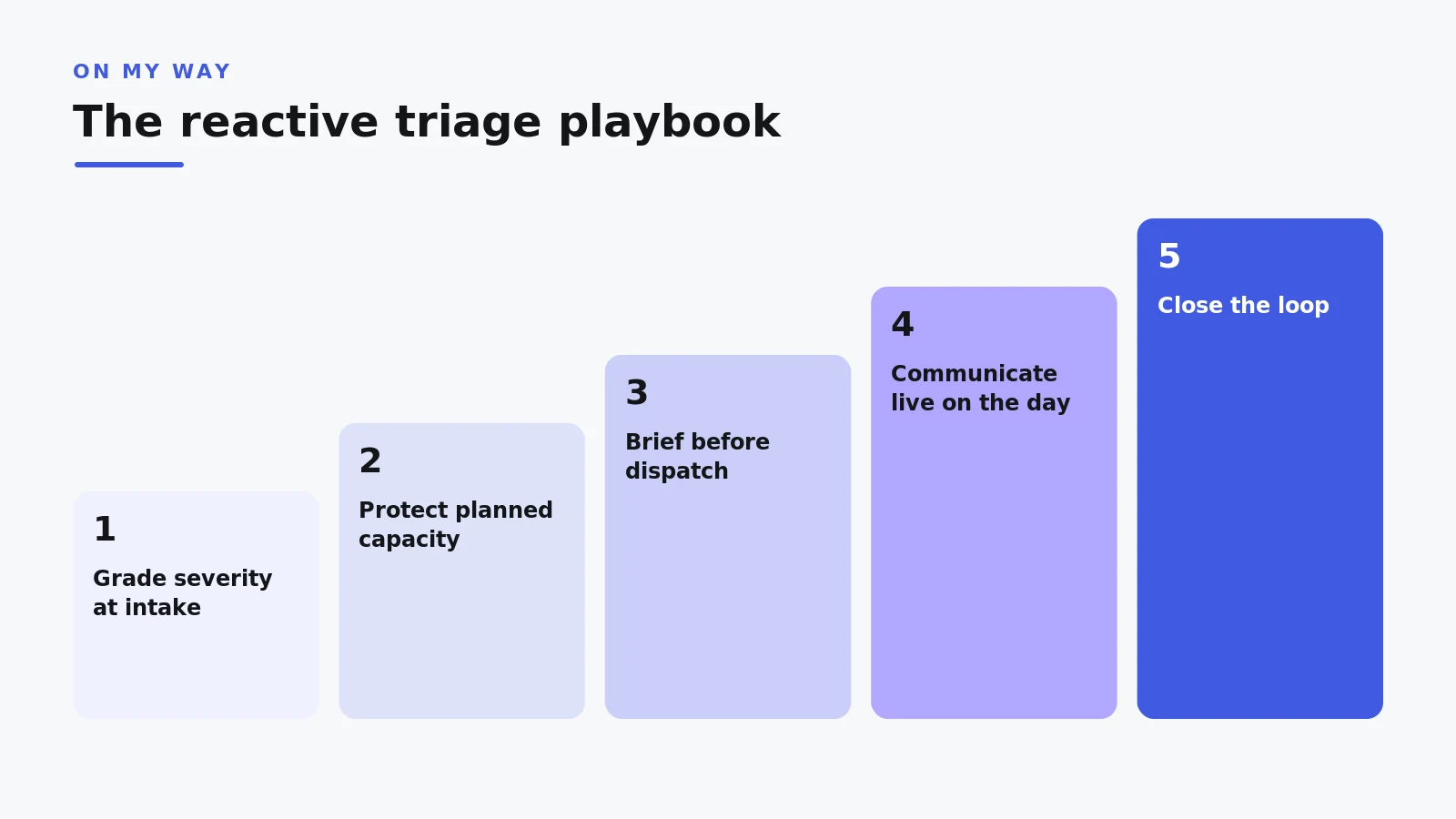
Enterprise reactive response comes down to four disciplines: grade the job, protect the schedule, brief the engineer, close the loop.
Grade severity at intake
A simple three-tier grading applied on every call beats a sophisticated one applied sometimes. P1 is safety, compliance or a critical asset down: same-day response, whatever the premium. P2 is degraded but operating: 24 to 48 hours. P3 is cosmetic or covered by redundancy: fold it into the next planned visit and pay no premium at all. Put the questions in the intake script and ask for photos while the caller is on the line.
Protect planned capacity
Ring-fence response capacity rather than raiding the diary. Protected slots by region, sized on trailing reactive volume, absorb most emergencies without touching booked customers. One unprotected P1 routinely becomes three rebooked appointments and three more calls into your contact centre.
Brief the engineer before dispatch
Send asset history, the last visit’s notes, error codes and the customer’s photos before the van moves, and check likely parts against the suspected failure mode. The disciplines in our first-time fix rate guide count double here, because a reactive job gets none of the preparation a planned one inherits by default.
Close the loop
Record cause, parts and time on site, then feed the record into criticality reviews. An asset failing twice in a quarter is a case for the planned programme; a run-to-failure asset costing more in call-outs than replacement is a case for retirement. Watch the reactive share monthly; the ratio, not any single job, tells you whether the strategy works.
See the response side working. Our how it works walkthrough shows a same-day job as the customer sees it, from first message to live tracking, or book a demo to run it against your own job types.

The customer experience of an emergency visit
Uncertainty is at its worst exactly when urgency is at its highest, and that is the defining feature of a reactive visit. Most maintenance guides stop at the asset. The customer, meanwhile, has no heating, a warming freezer or an alarm that will not set, and never chose this appointment: a failure chose it for them.
Reactive jobs are where the appointment problem bites hardest. Across On My Way enterprise deployments, three or four in every ten field appointments get changed by the customer after booking, another one in ten or so is cancelled outright, and each change that comes by phone ties up an agent for several minutes. Emergency work amplifies all of it: plans torn up at short notice, chasing calls that start early, contact landing out of hours when the centre is thinnest.
What works is unglamorous. Confirm by SMS and email the moment the job is graded, with a window you can keep; a kept two-hour promise beats a missed 45-minute one. On the day, give the customer live tracking and a moving ETA in the browser, nothing to install: nobody with a flooded kitchen should be asked to download an app to watch a van. If the visit cannot be same-day, let them move it themselves online rather than queueing on the phone. Brinks Home saw 34% fewer ETA calls once customers could see the engineer coming, and that effect concentrates on precisely these anxious, urgent jobs. The full toolset, two-way messaging to real-time feedback, sits on our features page.
The commercial commitment behind it is specific: 35% fewer appointment-related calls within 90 days of go-live, or Leadent keeps working at no charge until you get there. Typical deployments land between 40% and 55%.
Improving first-time fix when the job is unplanned
First-time fix on reactive work improves when information moves before the engineer does. The confirmation message is a channel, not just reassurance: a customer who replies with a photo of the rating plate, the error display or the leak has done your pre-visit inspection for you. Access notes, parking and gate codes travel the same way; each removes a reason for the visit to fail.
Arrival certainty matters as much as technical preparation. No-access visits are the quiet killer of first-time fix on emergency work: a customer who has waited three hours without an update leaves for the school run, and the engineer meets a locked door. Live ETAs keep people in place; self-service changes surface genuine conflicts before the van rolls. E.ON recorded 19% higher appointment-based first-time job completion with On My Way in place, and appointment-based is the operative phrase: jobs complete first time more often when the customer is in, informed and ready.
Frequently asked questions
What is the difference between reactive and preventive maintenance?
Preventive maintenance services assets on a schedule to stop failures before they happen; reactive maintenance repairs assets after they fail. Most enterprise operations run both, and the practical question is the ratio between them.
Is corrective maintenance the same as reactive maintenance?
Not quite. Corrective maintenance is any work that restores a failed or degraded asset, including repairs found at inspection and scheduled in advance. Reactive, or breakdown, maintenance is the unplanned subset, done after an unexpected failure.
When is a run-to-failure strategy acceptable?
When the asset is non-critical, cheap and quick to replace, cannot cascade damage into other equipment, and carries no safety or compliance exposure. Document the decision against the asset and review it periodically, because criticality drifts.
How do you cut the cost of reactive maintenance without adding engineers?
Grade jobs at intake so only real emergencies get emergency response, protect planned capacity, brief engineers with photos and history before dispatch, and automate customer communication so agents stop fielding ETA and rebooking calls.
How quickly can communication on reactive jobs be improved?
Faster than the maintenance strategy itself. On My Way sits on top of your existing workforce management system rather than replacing it, typically goes live in 4 to 6 weeks; a 6-week pilot can prove the effect on call volumes first.
The bottom line
Reactive maintenance is not a failure of planning; it is a permanent share of field service work that deserves the same rigour as the planned programme. Choose run-to-failure deliberately, on assets that qualify. Cost unplanned work honestly, premiums and repeat visits included. And treat the customer’s uncertainty as part of the breakdown, because on an emergency job the communication is half the repair.
Keep your WFM. Fix the response. See how On My Way works on a live reactive job, or book a demo: a 30-minute working session, no slide deck.
References
- Aquant — Field Service Benchmark Report (2024)
- US Department of Energy / PNNL — Operations and Maintenance Best Practices Guide, Release 3.0 (2010)
- MarketsandMarkets — Field Service Management Market Forecast (2025)
- On My Way / Leadent Digital — enterprise deployment data (appointment-change volume; client outcomes).