Customer Satisfaction Survey: Templates, Examples and Best Practices

Quick answer: A customer satisfaction survey is a short set of questions that measures how a customer felt about a service, product or specific interaction. For field service, the survey that works is sent the moment the visit ends, tied to that exact appointment and engineer, and kept to about eight questions covering satisfaction (CSAT), the engineer, the appointment window, likelihood to recommend (NPS) and one open comment.
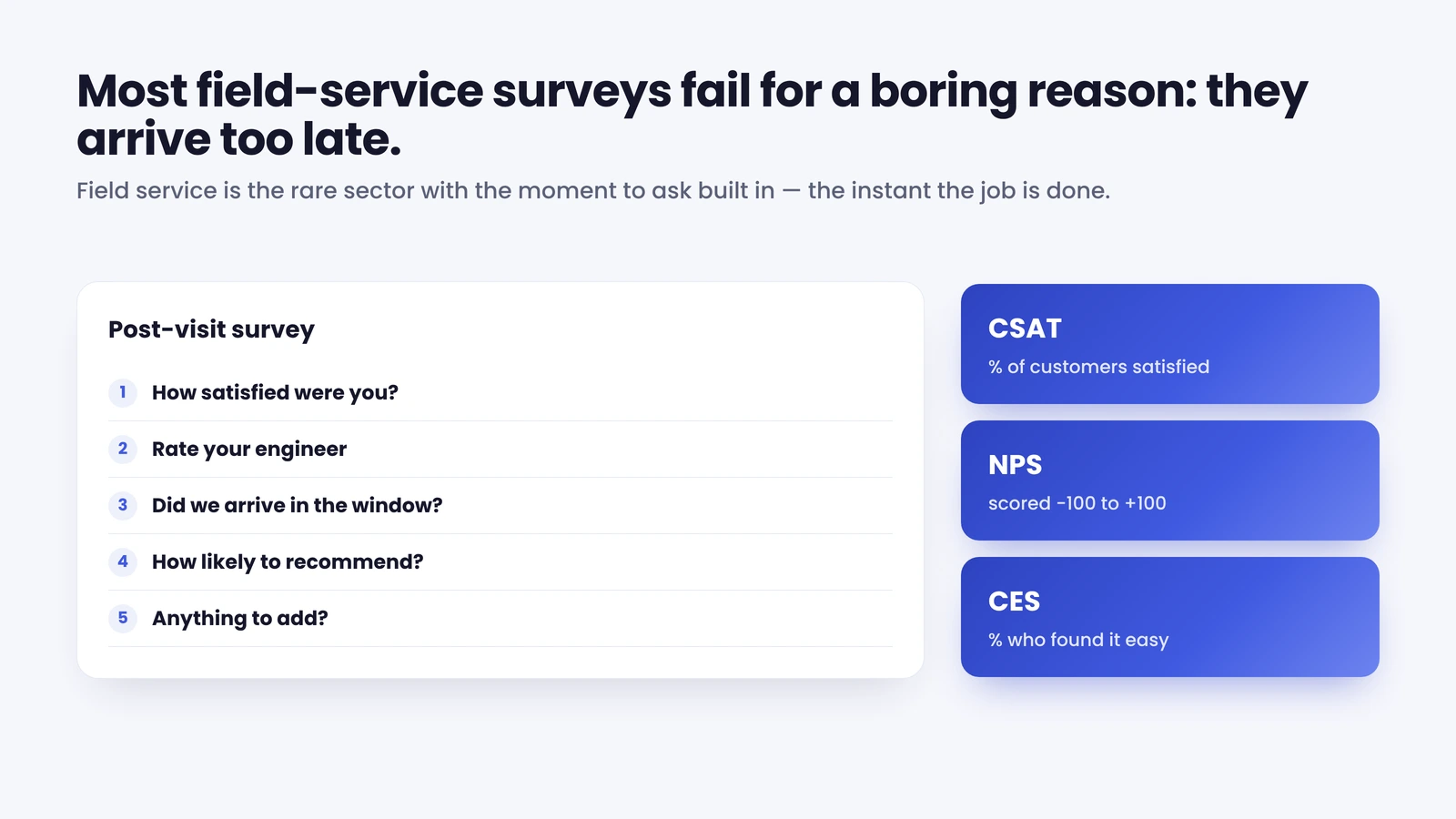
Most customer satisfaction surveys in field service fail for a boring reason: they arrive too late. A questionnaire that lands in an inbox a week after the engineer left is asking a customer to rate something they have half-forgotten, and the response rate shows it. The fix is not a cleverer survey. It is a better moment to ask, and a tighter set of questions built for the one interaction that defines satisfaction in this business: the visit itself.
This guide covers what a customer satisfaction survey is, when to send it in field service, the question types worth knowing, a ready-to-use template you can lift straight into your own programme, the best practices that lift response rates, and how to automate it so it runs the instant a job is marked complete.
What is a customer satisfaction survey?
A customer satisfaction survey is a structured way of asking customers how satisfied they are, turning a feeling into a comparable number you can track, benchmark and act on. It exists because “I think customers are reasonably happy” is not something you can manage or defend in a board review. A score is.
Most surveys are built around one or more standard metrics. The three you will meet constantly are CSAT (Customer Satisfaction Score), NPS (Net Promoter Score) and CES (Customer Effort Score). They measure different things, and a survey usually combines a couple of them with a short open-text question so a customer can say what a rating alone cannot. We unpack how each is calculated and what each is for in the companion guide to customer satisfaction metrics; this article is about the survey itself, which questions to ask and when.
For a field-service operation, the survey is not a generic CX exercise bolted on at the end of a quarter. It is an extension of the service. The appointment is a discrete, time-stamped event with a clear end, so there is a precise, repeatable moment to ask, “How did that go?” Most industries have to manufacture such a moment; field service has one built in, and a good survey programme uses it.
When to survey in field service: the post-visit moment
Send the survey the instant the job is marked complete, while the visit is still fresh in the customer’s mind. This is the single most important decision in the whole exercise, and it is where field service has an advantage almost no other sector enjoys.
Timing decides accuracy. Memory of a service interaction decays fast, and so does the response rate. A post-service survey triggered minutes after the engineer leaves catches the customer while the detail is vivid: whether the engineer was tidy, whether the problem is actually fixed, whether the arrival time matched the promise. Wait a week and you get a vaguer, lower-volume read, by which point any problem the survey surfaces is already cold and unrecoverable.
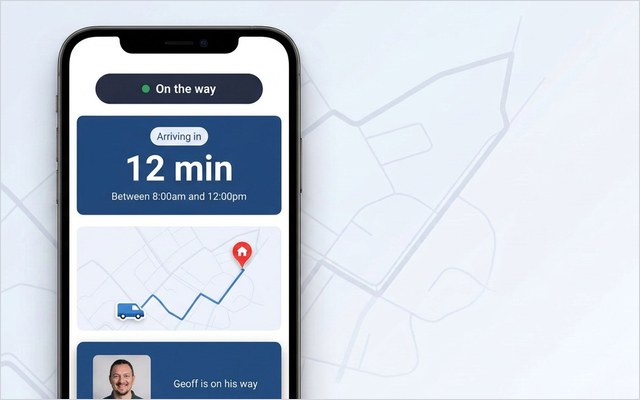
There is a deeper reason the post-visit moment matters here. What you are measuring is not abstract brand sentiment; it is one specific appointment, carried out by one engineer, against one time window. Capturing the score at that moment lets you tie it to the actual job, so you learn which engineer, job type and outcome produced the rating, instead of averaging a fortnight of fuzzy recollections into a meaningless number. The customer mindset rewards it too: the same impatience that makes people resent waiting on hold to chase an engineer makes them happy to give two taps the moment a job is done, on the device already in their hand. It is the self-service instinct that drives the wider field service customer journey — customers engage when it is quick, relevant and on their terms.

Question types: CSAT, CES and NPS
The strongest field-service surveys blend three question types, because each captures a different part of the experience.
A CSAT question measures satisfaction with the visit itself (“How satisfied were you with today’s appointment?”, usually 1 to 5 or a row of stars). It is the most direct read of “did that go well?” and the easiest score to explain, because it is simply the percentage of customers who were satisfied. A CES question measures effort — how much work the customer had to do (“How easy was it to book, track and manage your appointment?”). The research behind the Customer Effort Score found that reducing effort builds loyalty more reliably than trying to delight people, and in field service effort is concrete: how many calls it took to arrange the visit, whether they could reschedule online, whether they knew when the engineer would arrive. An NPS question measures loyalty (“How likely are you to recommend us?”, 0 to 10). It looks past the single visit to the health of the whole relationship, which makes it the best of the three for long-term trend.
You do not need a separate survey for each. A well-built post-visit survey carries all three together, plus an open comment, and still takes under a minute. That is what the template below sets out.
A field-service survey template you can use
Here is a post-service survey you can use as-is, designed for the moment a field-service appointment ends. It runs to eight questions, covers CSAT, the engineer, the appointment window, NPS and an open comment, and is deliberately short enough to finish on a phone in under a minute.

- Overall, how satisfied were you with today’s appointment? (1 to 5, or a row of stars) — your core CSAT question.
- Was your problem resolved during this visit? (Yes / Partly / No) — a plain first-time-fix check from the customer’s point of view.
- How would you rate the engineer who attended? (1 to 5) — covers professionalism, tidiness and conduct in one tap.
- Did the engineer arrive within the appointment window you were given? (Yes / No / They were late but let me know) — punctuality is one of the biggest drivers of a field-service rating.
- How easy was it to book, track and manage your appointment? (1 to 5) — your CES question, aimed squarely at self-service friction.
- How likely are you to recommend us to a friend or colleague? (0 to 10) — the standard NPS question for relationship trend.
- Is there anything that would have made today better? (open text, optional) — the one box where customers tell you what a number cannot.
- May we contact you about your feedback? (Yes / No, with contact preference) — closes the loop and flags recoverable detractors for follow-up.
Two notes on using it. Keep question 1 first so even a customer who abandons after one tap has given you the headline CSAT score, and resist adding a ninth or tenth item, since every extra question costs you completions. If you only have room for three, keep 1, 5 and 6 (CSAT, CES, NPS). Treat the template as a starting point: adapt the wording to your sector and brand, but keep the shape — short, post-visit, tied to the specific appointment.
Best practices for field-service satisfaction surveys
A few habits separate surveys that produce usable data from surveys that quietly waste customer goodwill.
Ask at the moment of completion. Everything above hinges on this: the survey fires when the job is marked done, not on a nightly batch the day after.
Keep it to about eight questions, one screen, no login. Length is the enemy of response rate. A customer is far more likely to finish a survey that opens in their browser with no app to download and no password to remember; the same friction-removing principle underpins good customer self-service.
Lead with the most important question so a partial response still gives you the CSAT number that matters most, and mix closed and open — scales give you trackable numbers, one open-text box gives you the context that explains a low score.
Tie every response to the job. A score attached to a specific engineer, job type and time window is an operational signal you can act on; a score floating free of the appointment is nearly useless.
Close the loop. A survey that surfaces an unhappy customer and then does nothing is worse than no survey at all, so route low scores to someone who can call back the same day. And before adding any question, decide who owns the number and what a bad answer triggers — a metric nobody acts on is just a tax on your customers’ patience.
79% — engagement with appointment comms reached by Bosch UK, a UK HVAC field operation, after it gave customers self-service, live tracking and feedback capture built into the appointment, rather than a survey sent days later.
Automating feedback in real time
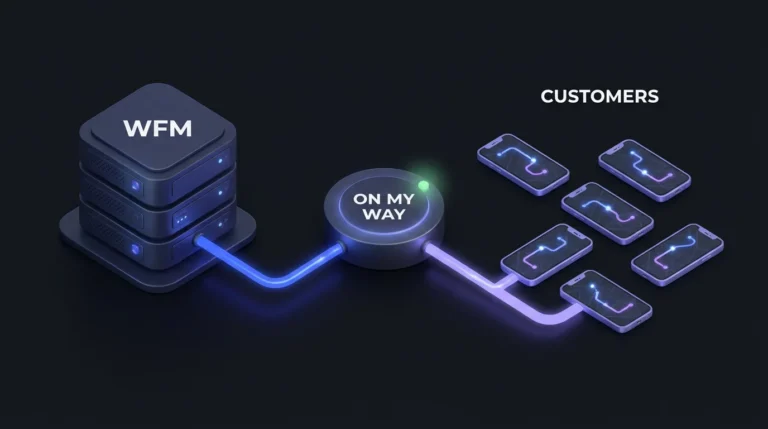
The reliable way to survey at the moment of completion, every time, is to automate it: trigger the survey when the WFM marks the job done, deliver it by SMS and email, and capture the response in a browser with no app install. Done by hand, the “ask at completion” rule breaks in the first busy week. Automated, it just happens, on every appointment, without anyone remembering to press send.
The moment an engineer closes a job, an automated SMS and email go out with a link to the short survey. The customer taps a rating in their browser, with no download and no account, and the response lands tied to that specific job and engineer. Because the prompt is timely and effortless, completion rates run well above what a delayed email blast produces, and the post-visit moment gets captured on every job rather than the handful someone got round to. Crucially, the score does not sit in a survey silo: it lands next to the operational data you already hold, so you can read satisfaction against first-time fix, no-show rate and call deflection on one view, and answer questions like whether customers who used live tracking rated the visit higher than the ones who phoned three times to chase.
It also addresses what we call the appointment problem. On My Way’s internal research finds that 30–40% of appointments are changed by the customer and another 10–15% cancelled, each change costing roughly a five-to-seven-minute call that usually lands after hours. Automating feedback at completion does not just measure satisfaction; it runs the self-service that removes those resented calls, which is what lifts the scores. That is the core of how OMW handles customer feedback: real-time NPS and CSAT capture, tied to the appointment, with no app for the customer to install.
What to do with the results
A survey is only worth running if the results change what you do. Read them on two levels.
At the individual level, a low score is a recovery opportunity with a short shelf life. Route it the same day to someone who can call the customer back while the problem is still warm, because a detractor reached quickly is often a detractor saved. The “may we contact you” question in the template exists to make that follow-up easy.
At the trend level, watch the scores move over time and against your operational KPIs. If CSAT dips, look at first-time fix and punctuality in the same period, because in field service the survey score is usually downstream of operational reality. First-time fix is the one to watch: the average across the industry is 76%, the top quintile of operations reach 87% and the bottom fifth sit at 55% (Aquant Field Service Benchmark, 2024), and every avoidable second visit is a satisfaction hit you can see coming. If CES improves after you launch online rescheduling, you have evidence the self-service is working. Reading the experience and operational scores together, on one dashboard, is what turns a pile of ratings into a decision — the companion guide to field service customer experience goes deeper on connecting the two, and how it works shows the data flowing from appointment to dashboard. The goal is not a higher number for its own sake but a faster loop: measure the visit, spot the problem, fix it, and watch the next visit’s score reflect the change.
CSAT for field service visits is not a generic survey
A field service CSAT survey has a specific moment to land in – within an hour of the engineer leaving – and a specific unit to attach to: the work order. That is what makes it reportable by engineer, team, visit type and region, and what lets a low score trigger a same-day call rather than a monthly review. Surveys sent days later, or detached from the job record, measure sentiment about the company rather than the visit. On My Way sends the request from the same tracking page the customer used on the day, which is why response rates are high enough to act on.
Related reading: customer experience software for service teams, Net Promoter Score software for field service and a customer experience strategy for field service.
Frequently asked questions
What questions should a customer satisfaction survey include?
For field service, include a CSAT question (“How satisfied were you with today’s appointment?”), a question on the engineer, a question on whether the appointment window was met, a CES question on how easy booking and tracking were, an NPS question (“How likely are you to recommend us?”), and one open-text box. Keep it to about eight questions so it finishes on a phone in under a minute, and put the CSAT question first.
When should you send a satisfaction survey?
The moment the job is marked complete, while the visit is fresh. In field service the appointment is a discrete, time-stamped event with a clear end, so the post-visit moment is the precise, repeatable time to ask. A survey sent days later gets a lower response rate and vaguer answers, and any problem it surfaces is already too cold to recover.
What is a good CSAT score?
It depends heavily on your sector and how you ask, so an absolute number means little without context. The more useful comparison is your own trend over time and your direct competitors, not a universal benchmark. Read CSAT alongside operational measures such as first-time fix and punctuality, and judge progress by whether the number is climbing, not by hitting a figure borrowed from a different industry.
How long should a field-service survey be?
Short. About eight questions is the practical ceiling, and three core scores make a perfectly good minimum. Every extra question costs you completions, and a one-screen, no-login survey in the customer’s browser will always out-perform a long questionnaire that asks them to download an app or log in.
What should a CSAT survey for field service technicians ask?
Keep it to three questions, sent within an hour of the visit: a rating of the visit (1–5 or 0–10), one question about the engineer (on time, explained the work, left the site tidy) and a free-text comment. Tie each response to the work order and the engineer so scores can be reported by team and visit type, and route low scores to a follow-up call the same day.
The bottom line
A customer satisfaction survey works in field service when it is short, sent the moment the visit ends, and tied to the specific appointment and engineer rather than fired off generically a week later. Build it from the template above, automate it so it triggers on every completed job, and read the scores next to your operational KPIs so the feedback actually changes what you do. To see real-time, post-visit feedback capture running on your own appointments, book a demo and we will walk you through it as a 30-minute working session, no slide deck.
References
- Aquant. 2024 Field Service Benchmark Report (first-time fix rate benchmarks: average 76%, top 87%, bottom 55%)
- Gartner / CEB. Dixon, Freeman & Toman, Stop Trying to Delight Your Customers (Harvard Business Review, 2010) — origin of the Customer Effort Score
- Bain & Company / Fred Reichheld. The One Number You Need to Grow (Harvard Business Review, 2003) — the Net Promoter Score
- On My Way / Leadent Digital — enterprise deployment data and “the appointment problem” research (appointment-change volume; client engagement outcomes).

Keep your WFM. Upgrade what your customers experience.
On My Way is the customer-experience layer for field service: live arrival tracking, self-service rebooking, notes and photos, and feedback, added on top of the scheduling system you already run. No rip-and-replace, live in four to six weeks.