Customer Experience Strategy for Field Service: A Six-Step Framework

The slide says “Improve customer experience”. It is the third slide in the quarterly operations review, and everyone around the table nods. Then the field director asks the only question that matters: what changes on Monday morning? Silence. Not for lack of conviction — the room believes in the ambition — but because nobody has yet turned it into decisions with owners, numbers and dates.
Quick answer: Build a customer experience strategy for field service as a sequenced programme, not a big-bang transformation: baseline two weeks of inbound contact, map the appointment journey, choose a few paired metrics, then deploy proactive communication, self-service rebooking and real-time feedback, in that order. The first stage alone typically removes 40–55% of appointment-related calls.
Key takeaways
- Build in a deliberate order: proactive communication first, self-service rebooking second, real-time feedback third. Each stage pays for the next.
- Baseline before you design. Two weeks of reason-tagged inbound contact shows where the pain sits, and it is almost always ETA chasing and rescheduling.
- Keep the scorecard small: pair every experience metric with an operational one, and give each pair a named owner and a review cadence.
- Win the executive case by attaching each metric to a cost line — inbound calls, no-shows and repeat visits.
- The first stage carries a contractual floor: 35% fewer appointment-related calls within 90 days, or Leadent keeps working at no charge until you get there.
This is the article for the morning after that meeting. Our pillar guide to customer experience in field service makes the case for why the appointment now decides renewals, complaints and cost; this one assumes you are already sold and covers the part strategy decks usually skip: how to build the programme, in what order, and how to keep it alive past the first quarter.
Why “improve customer experience” stalls in field service
Most field-service CX ambitions stall because they are written as outcomes rather than sequences. “Lift NPS by ten points” is a wish. A strategy names the first project, the metric it moves, the person accountable and the date it reports. If your leadership team cannot answer the Monday-morning question, you do not yet have a customer experience strategy; you have a slide.
The stakes are not in dispute. Salesforce’s customer-service research finds that 80% of customers say the experience a company provides matters as much as its products or services, and field service is where that judgement gets made in person, at the door. What generic CX playbooks miss is the operational complication: appointments move. Across On My Way enterprise deployments the pattern repeats in every sector — a substantial share of bookings shift in some way between the initial booking and the engineer arriving, and every change the customer cannot see or act on comes back as an inbound call. A strategy that does not deal with appointment volatility first is decorating the wrong room.
A customer experience strategy framework for field service: six steps
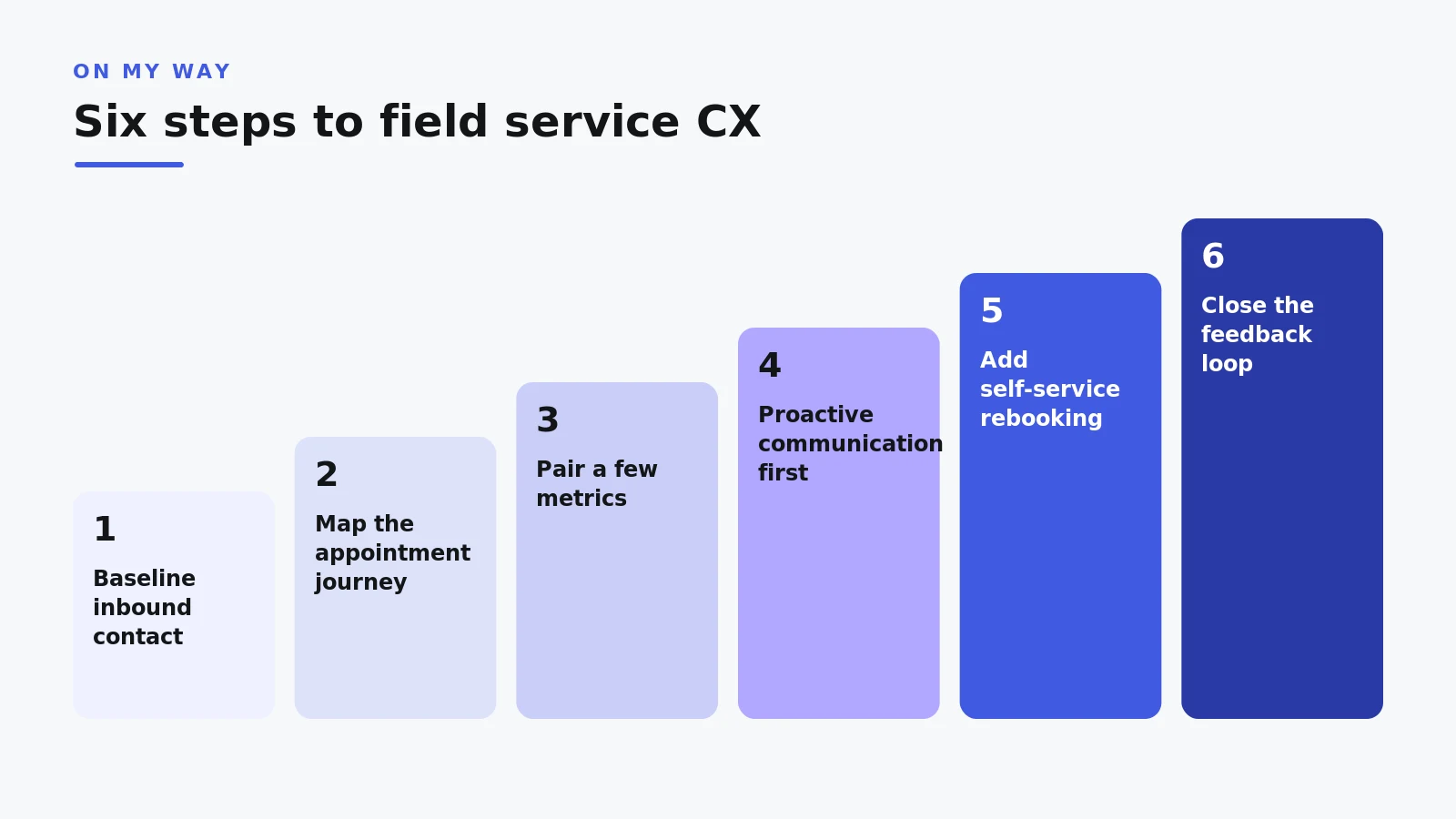
What follows is the CX strategy framework we use with enterprise operations running anywhere from 200 to over 1,000 technicians on Oracle Field Service, Salesforce Field Service, SAP, IFS, ServiceMax or Microsoft Dynamics 365. Six steps, in a deliberate order. Each one produces something the next depends on, which is why the order matters more than the ambition.
Step 1: Baseline honestly, with two weeks of tagged contact
Before designing anything, spend ten working days tagging every inbound contact by reason at the point of answer: where is my engineer, reschedule or cancel, confirm booking details, chase a part or a quote, complain. Do not rely on historic IVR categories, which flatter the operation because customers press whatever gets them to a human fastest. If your telephony cannot tag live, have team leaders hand-code a sample of 300 calls. Express the result as contacts per 100 appointments, split by reason. In most field operations the two biggest buckets turn out to be ETA chasing and rescheduling, and that finding sets your build order.
Step 2: Map the appointment journey end to end
Next, put the contact data on a timeline. Customer journey mapping in field service starts and ends with the appointment: confirmation, the wait, the day-before reminder, the morning of the visit, the visit itself, completion, follow-up. Mark every point where your organisation goes silent and every point where the customer’s only option is to phone. Then book a test appointment with your own company and live it. Our guide to the field service customer journey walks through the mapping workshop stage by stage; treat that as the deep-dive and hold this step to a fortnight.
Step 3: Choose few metrics, and pair each with an operational one
A scorecard with twenty numbers is a scorecard nobody owns. Pick three pairs at most, each coupling an experience measure to an operational one: relationship NPS with inbound calls per 100 appointments; day-of-visit CSAT with no-show rate; customer effort on rescheduling with repeat-visit rate. Pairing keeps CX metrics honest — a satisfaction score that rises while call volume also rises is telling you the sampling is off. For definitions, survey timing and realistic targets, use our customer satisfaction metrics guide; the strategic decision here is simply which few numbers you will stand behind.
Step 4: Fix proactive communication first
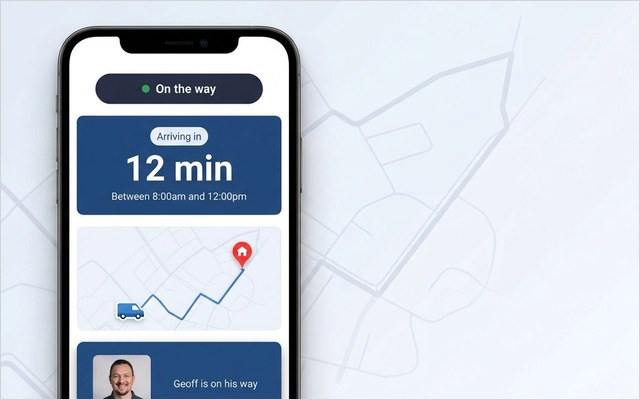
This is the fastest payback in the programme, which is why it goes first. Automate the moments your baseline flagged: booking confirmation, a reminder the day before, an on-the-day message with a live tracking link and a moving ETA. On My Way sends these over SMS and email, and the customer side runs in the browser, so there is no app to install and no adoption campaign to fund. Agents get the same live picture through Contact Centre View (a Premium option that needs no WFM licence), so the calls that do still come in are shorter. The commercial logic is blunt: Leadent underwrites 35% fewer appointment-related calls within 90 days of go-live, and keeps working at no charge until the number is met.
Step 5: Add self-service rebooking
Communication empties the “where is my engineer” bucket; self-service attacks rescheduling, usually the second biggest. Put a rebooking link in every message, so a customer whose week has changed can move or cancel the visit in seconds, with the change writing straight back into the WFM schedule. The loyalty case is well documented: Gartner’s effortless-experience research found 96% of customers who go through high-effort service interactions become more disloyal, against 9% after low-effort ones. A reschedule that takes three taps instead of a call queue is that finding put to work, and it converts silent no-shows into slots your planners can refill.
Step 6: Close the loop with real-time feedback and governance
Switch on real-time NPS or CSAT capture at job completion, while the visit is still fresh, and route detractor responses to a named desk the same day. Then wire governance around the numbers: each metric pair from step 3 has one owner; the paired scorecard is reviewed weekly in the operations meeting and monthly at executive level; any detractor gets a call back within 24 hours. Who owns the number matters more than which dashboard displays it. Skip this step and the first five decay quietly within two quarters.
Want to see the whole sequence running on a live schedule? How On My Way works shows each stage — first confirmation through to completed-job feedback — sitting on top of your existing WFM, with nothing replaced.

Winning the executive case for a customer experience programme
Attach every metric to a cost line and the case largely writes itself. Take the step 1 baseline of contacts per 100 appointments and multiply by the cost per contact your finance team already holds. Do the same for no-shows using your internal cost of an aborted visit, and for repeat visits using the cost of a second truck roll. Present the programme as three cost lines with a before-and-after range, put the 90-day guarantee underneath as the risk floor, and resist the urge to lead with sentiment. Boards fund arithmetic. Context helps too: MarketsandMarkets expects the field service management market to grow from around USD 5.1 billion in 2025 to USD 9.17 billion by 2030, a fair proxy for how quickly your competitors are automating exactly these moments.
Sequence the CX roadmap: communication, then self-service, then feedback
Sequencing is the difference between a programme that funds itself and transformation fatigue. The big-bang version, a platform overhaul with benefits arriving in month eighteen, tends to outlive its sponsor rather than its business case. A sequenced CX roadmap lands value in weeks: the communication stage produces call-deflection savings and cleaner contact data, which fund and inform the self-service stage, which creates the volume of digital touchpoints that makes real-time feedback worth reading.
Brinks Home shows what that looks like when it lands: proactive communication and self-service layered onto the existing operation delivered 34% fewer ETA calls and 25% higher appointment-based first-time job completion. The point is not only the size of the numbers; it is that they arrived in stages a leadership team could inspect, bank and build on.
There is a second payoff: sequence tells you where you stand. CX maturity in field service is less a badge than a queue position — it tells you which step you are actually ready to run. If you want to place your organisation on that curve before committing budget, our digital customer experience maturity model maps the stages from reactive to predictive. Most field-service operations discover they are one stage earlier than they assumed, which is a useful thing to learn before the funding conversation rather than after it.
What the first 90 days should look like
A realistic first quarter runs like this. Weeks one and two: the tagged-contact baseline and the journey map. Weeks three to six: configure the communication layer on top of the existing WFM, agree message templates and trigger points, connect the metric pairs. On My Way goes live in four to six weeks as standard, and a six-week pilot on a single region or trade is available where the organisation prefers to prove the pattern before scaling it. Day 90: review against the 35% guarantee and greenlight the self-service stage. The IT footprint stays deliberately light — the customer side is browser-based and white-label, sign-on runs through Microsoft Entra ID with role-based access control, and encryption, data residency and GDPR controls are part of the standard deployment rather than a project of their own.
Frequently asked questions
How is a customer experience strategy different from customer journey mapping?
Journey mapping is one input: step 2 of the six. A strategy adds the baseline evidence, the paired metrics, the build sequence, the owners and the cost case. A journey map that never becomes a sequenced programme is wall art within a quarter.
Who should own the CX programme in a field-service organisation?
Split it deliberately. Operations owns the operational half of each metric pair, the CX or service director owns the experience half, and one executive chairs the monthly review. Shared numbers keep both functions honest; a single owner for everything usually means one function stops looking.
How many CX metrics should the scorecard carry?
Three pairs, six numbers, is a practical ceiling. Fewer and you cannot see cause and effect; more and the weekly review turns into a reporting exercise instead of a decision meeting.
Do we need to replace our WFM system first?
No. The framework assumes you keep your scheduling engine. On My Way runs as a layer on top of Oracle Field Service, Salesforce Field Service, SAP, IFS, ServiceMax and Microsoft Dynamics 365, reading and writing appointment data through integration rather than replacement.
How quickly should a customer experience programme show results?
Within the first quarter, or the sequencing is wrong. The communication stage is contracted to deliver 35% fewer appointment-related calls inside 90 days, and mature deployments typically settle in the 40–55% range. Loyalty metrics move more slowly; allow two to three quarters of trend data before drawing conclusions there.
The bottom line
A customer experience strategy for field service is built, not declared: baseline the contact, map the journey, choose paired metrics, then deliver communication, self-service and feedback in that order, each stage funding the next. Start the two-week baseline this month. Everything else in the framework follows from what it tells you.
When you are ready to test the sequence against your own operation, see how On My Way works on top of your existing WFM, or book a demo: a 30-minute working session, no slide deck, built around your appointment volumes and your contact reasons.
References
- Salesforce — Customer Service Statistics (2024)
- Gartner — The Effortless Experience, Customer Service & Support Insights (2024)
- MarketsandMarkets — Field Service Management Market Forecast to 2030 (2025)
- On My Way / Leadent Digital — enterprise deployment data (appointment-change volume; client outcomes).

Keep your WFM. Upgrade what your customers experience.
On My Way is the customer-experience layer for field service: live arrival tracking, self-service rebooking, notes and photos, and feedback — added on top of the scheduling system you already run. No rip-and-replace, live in 4–6 weeks.