Customer Journey Management in Field Service

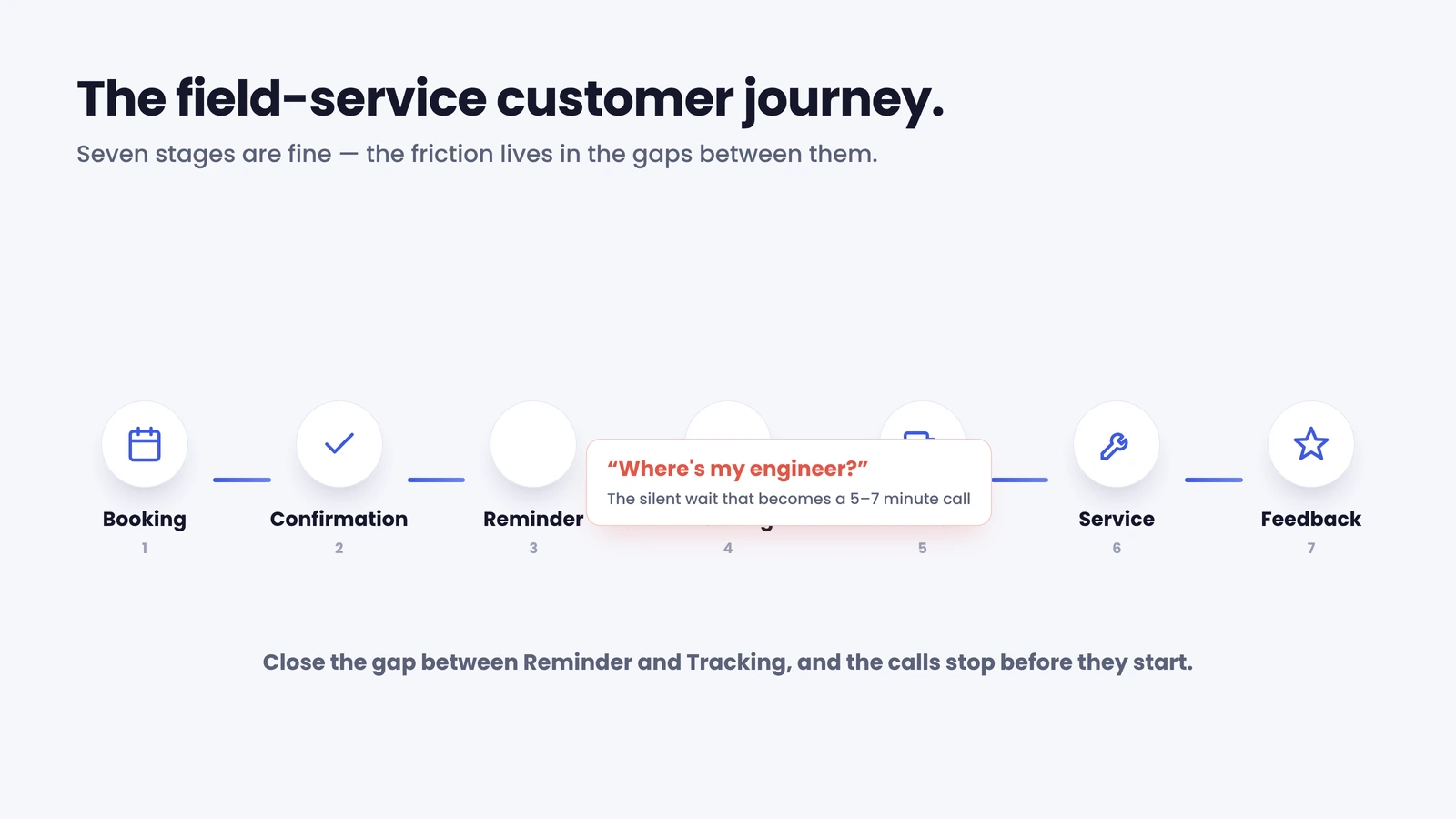
Quick answer: The field service customer journey is the full sequence a customer moves through around a service appointment: booking, confirmation, reminder, live tracking, arrival, the visit itself, and feedback. Customer journey management in field service is the practice of mapping those stages, finding where each one breaks down, and managing the touchpoints so the customer stays informed and in control throughout. Unlike a retail or online journey, almost every stage converges on one event: an engineer arriving at someone’s home or premises. Manage the journey well and you cut the calls, the no-shows and the repeat visits; manage it poorly and a flawless schedule still produces an anxious, dissatisfied customer.
Key takeaways
- The field service customer journey has seven recurring stages, and most of the friction sits in the gaps between them, especially the wait before arrival.
- Customer journey management means mapping each stage, defining its touchpoint, and measuring whether the customer felt in control.
- The costliest break point is the “where’s my engineer?” gap, where uncertainty turns into inbound calls and missed appointments.
- A large share of contact-centre volume is the same avoidable question: customers chasing an appointment they can’t see, each call running five to seven minutes.
- You can manage and measure the whole journey by adding a customer-facing layer on top of your existing WFM, no rip-and-replace.
A field service operation can run a perfect schedule and still lose the customer. The schedule is invisible to the person waiting at home; what they experience is the journey around it: whether the booking was easy, whether anyone confirmed it, whether they knew when the engineer would actually turn up. That journey, not the dispatch board, is what the customer remembers and rates.
This is the deeper companion to our pillar on field service customer experience, which maps the journey at a high level. Here we go stage by stage: what each step is, where it breaks down, the touchpoint that holds it together, and how to measure whether it’s working. The discipline that ties it together is customer journey management, and in field service it has a character all of its own.
What is customer journey management?
Customer journey management is the practice of mapping every stage a customer passes through, identifying the touchpoints at each stage, and actively managing those interactions so the overall experience is coherent rather than accidental. It grew out of customer journey mapping (the exercise of drawing the customer’s path as they actually experience it, not as the org chart imagines it) and adds the operational follow-through: measuring each stage, fixing the weak ones, and orchestrating the communication that carries the customer from one step to the next.
The generic version of this discipline lives in marketing teams, and the average consumer now uses more than three channels to reach a business, which is part of why journey management has climbed the priority list (Gartner). Field service narrows the problem and sharpens it. The journey is shorter and more linear than a sprawling retail funnel, but its defining moment, a named person arriving at a specific address in a specific window, carries far more weight and far more risk. Managing it is less about multichannel attribution and more about removing uncertainty from a sequence that ends with a stranger at the door.
The seven stages of the field service customer journey
Map the journey across enterprise field service (utilities, telecoms, home services, appliance support) and the same seven stages appear regardless of sector: booking, confirmation, reminder, tracking, arrival, service and feedback. Most well-built journey maps land on five to seven stages; fewer than four is too abstract to guide a fix, and more than eight usually means steps have been mistaken for stages (Smaply). Seven is the natural resolution for a service appointment.
What makes the field-service version worth managing is that each stage is simultaneously a customer-experience touchpoint and an operational lever, so improving one improves the other. The touchpoint-to-metric table below is the working tool: it pairs every stage with the action that holds it together and the number that tells you whether it’s working. First, though, it helps to see where each stage tends to break.

Where the journey breaks, stage by stage
A journey map earns its keep when it shows you the break points. Here is where each stage tends to fail, and the touchpoint that fixes it.
Booking and confirmation: control starts here
The journey breaks at the very first step when the only way to book is to phone during office hours and accept whatever window is offered. Customers want to choose a slot that fits their life, not the operation’s. Self-service booking, with an immediate confirmation that carries the details and a link to change them, sets the tone for everything after: the customer starts the journey in control rather than on hold.
The numbers back the preference: around 61% of customers would rather use self-service to resolve a simple issue than speak to an agent (Salesforce, State of the Connected Customer, 2024), and moving an appointment is exactly that kind of task. A confirmation that lets the customer reschedule themselves (covered in our enterprise self-service playbook) removes a future call before it’s ever made.
Reminder: the cheapest defence against a wasted visit
Skip the reminder and the journey leaks at stage three. The customer forgets, double-books, or simply isn’t home — and a failed visit is among the most expensive events in field service, because it consumes a slot, a journey and an engineer’s time for zero resolution. A timely reminder, sent the day before with a one-tap way to confirm or move the slot, is the lowest-cost intervention in the entire journey. More than two-thirds of customers say they want organisations to reach out with proactive notifications rather than wait to be chased (Salesforce, 2024).
Tracking and arrival: the “where’s my engineer?” gap
This is the stage that breaks most often and costs the most. Between the reminder and the engineer’s arrival sits a window of pure uncertainty, and uncertainty generates calls. In a typical enterprise operation, a third or more of booked appointments are moved by the customer and roughly a tenth cancelled, with each amendment tending to produce a five-to-seven-minute call, frequently outside business hours (On My Way deployment research). Add the customers who phone simply to ask when the engineer will arrive, and a large share of contact-centre volume turns out to be one question the customer could have answered themselves: where is my engineer?
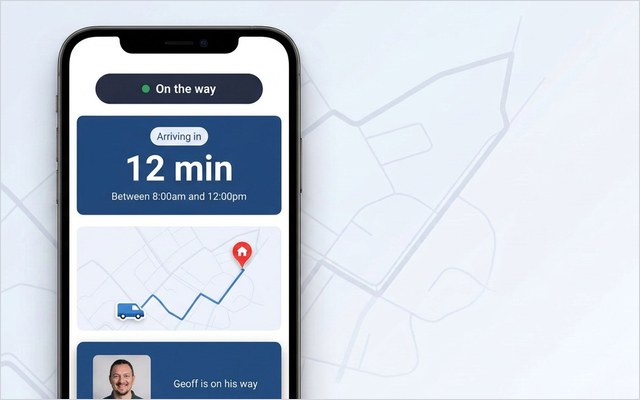
The fix is visibility. Live technician tracking, an ETA the customer can watch plus a “your engineer is 20 minutes away” notification, collapses the anxiety and the call together. Organisations that add proactive ETA notifications report 25–35% fewer “where’s my technician?” enquiries, alongside higher post-service satisfaction (Fieldwork, Field Service Management Trends, 2026). People who track a parcel to the door in real time no longer accept a four-hour window with no updates; the tracking stage is where that expectation is either met or missed.
Service and feedback: closing the loop while it still matters
The visit itself is the stage the operation obsesses over, and rightly, but the journey doesn’t end when the engineer leaves. It breaks at the end if no one asks how it went, because the only signal you get is a churn report months later or a one-star review you can’t answer. Capturing real-time feedback and NPS immediately after the visit surfaces a problem while it’s still recoverable, and closes the loop on a journey that the customer otherwise leaves with no way to be heard. Organisations that follow up within 24–48 hours of service see measurably higher retention (Fieldproxy, 2024).
How to manage and measure each touchpoint
Mapping the journey tells you where the gaps are; managing it means assigning each stage a touchpoint and a metric, then watching whether they move together. This is the heart of customer journey management in field service, the single view that turns seven loose stages into a measurable system:
| Stage | Touchpoint that holds it together | Metric that proves it works |
|---|---|---|
| Booking | Self-service slot selection | Share of bookings made without an agent |
| Confirmation | Instant confirmation with self-edit | Confirmation rate |
| Reminder | Pre-day reminder + one-tap reschedule | No-show / failed-visit rate |
| Tracking | Live ETA notification | ETA-call deflection rate |
| Arrival | On-time window adherence | Appointments met within window |
| Service | Right information to the engineer | First-time fix rate |
| Feedback | Post-visit NPS / CSAT | Response rate and score |
Read the table as a single instrument, not seven separate dials. The reason it works is the correlation between the second and third columns: when a customer uses live tracking and the visit lands first time, the post-appointment NPS is measurably higher, same engineer, same outcome, better score, purely because the journey gave them visibility and control. Manage the touchpoints and both the experience metrics and the operational metrics climb together. This connects directly to the broader field service customer experience programme, where these numbers sit alongside CSAT and call-deflection targets, and to the enterprise self-service playbook that drives the booking, confirmation and reminder rows.
How On My Way maps to the journey
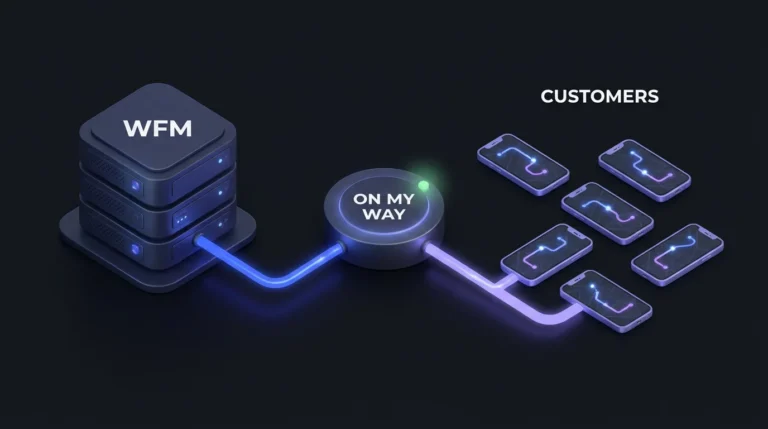
The reason field service operations under-manage the journey is rarely indifference. It’s that the workforce-management system was built to schedule and dispatch, not to talk to the customer. Closing the gap doesn’t require replacing it. On My Way adds a customer-facing layer on top of whatever WFM you already run (Oracle, IFS, SAP, ServiceMax or Salesforce), and each of its features maps onto a journey stage: self-service booking and rebooking for stages one to three, live tracking for stage four, and real-time feedback for stage seven. You can see how On My Way works end to end, mapped to exactly these touchpoints.
See it on your journey. On My Way turns each appointment stage — booking, reminder, tracking, feedback — into a managed touchpoint on top of your existing WFM, no rip-and-replace. Book a 30-minute working session (no slide deck) or see how it works.
What managing the journey delivers
Managed well, the journey pays back in numbers, not sentiment. Enterprise operations that turn each stage into a managed touchpoint typically see appointment-related calls fall into the 40–55% range within the first months, which is why On My Way underwrites a 35% reduction in appointment-related calls within 90 days, or we keep working at no cost until it’s hit. (The fuller set of sector results sits in the field service customer experience pillar.)
The point worth holding onto is that the journey is not a soft CX concept. It is a sequence of measurable touchpoints, each with a number attached, and the same moves that lift the experience scores are the moves that take cost out of the contact centre.
The bottom line
Customer journey management in field service comes down to a discipline that is unglamorous but reliable: map the seven stages, find the break points, assign every touchpoint a metric, and manage the communication that carries the customer from booking to feedback. The biggest single win is closing the tracking gap, the “where’s my engineer?” uncertainty that drives most avoidable calls. None of it means replacing the systems you already run; it means adding the layer that makes the journey visible, manageable and measurable from the customer’s side of the door.
Map your appointment journey. On My Way makes every stage a managed, measurable touchpoint on top of your existing WFM. Book a demo to see it mapped to your operation, or read the field service customer experience pillar for the wider programme.
Related reading: digital customer experience in field service, customer satisfaction surveys for field service visits and Net Promoter Score software for field service.
Frequently asked questions
What is the customer journey in field service?
It’s the sequence a customer moves through around a service appointment: booking, confirmation, reminder, live tracking, arrival, the visit itself, and post-visit feedback. Unlike an online journey, almost every stage converges on one event — an engineer arriving at the customer’s home or premises — which makes communication, punctuality and first-time fix the dominant factors.
What is customer journey management in field service?
It’s the practice of mapping those stages, identifying the touchpoint at each one, and actively managing the interactions so the customer stays informed and in control. In field service that means proactive confirmations and reminders, a live ETA the customer can track, and real-time feedback — managed against a metric at every stage rather than left to chance.
Where does the field service customer journey break down most?
In the gap between the reminder and arrival — the “where’s my engineer?” window. Uncertainty there drives most avoidable inbound calls, since a large share of contact-centre volume is simply customers asking when the engineer will turn up. A live ETA notification closes that gap, deflecting the call and removing the anxiety at once.
How do you measure the customer journey in field service?
Assign each stage a metric: booking self-service rate, confirmation rate, no-show rate, ETA-call deflection, on-time arrival, first-time fix, and post-visit NPS or CSAT. The most useful insight comes from correlating the experience metrics with the operational ones — for example, showing that customers who used live tracking report higher NPS.
Do you need to replace your WFM to manage the customer journey?
No. A customer-facing layer sits on top of your existing workforce-management system (Oracle, IFS, SAP, ServiceMax, Salesforce and others), adding self-service booking, reminders, live tracking and feedback without disrupting scheduling or dispatch. It maps the journey from the customer’s side without touching the engine underneath.
References
- Gartner — The Customer Service Journey.
- Salesforce — Teams Tap AI and Data to Drive Revenue as Service Expectations Rise (State of the Connected Customer, 2024).
- Smaply — Customer Journey Stages: How to Define Them.
- Fieldwork — Field Service Management Trends in 2026.
- Fieldproxy — Field Service Customer Journey Mapping Guide.
- On My Way / Leadent Digital — enterprise deployment data (appointment-change volume; client outcomes).

Keep your WFM. Upgrade what your customers experience.
On My Way is the customer-experience layer for field service: live arrival tracking, self-service rebooking, notes and photos, and feedback, added on top of the scheduling system you already run. No rip-and-replace, live in four to six weeks.