Mobile Workforce Management: The 2026 Guide
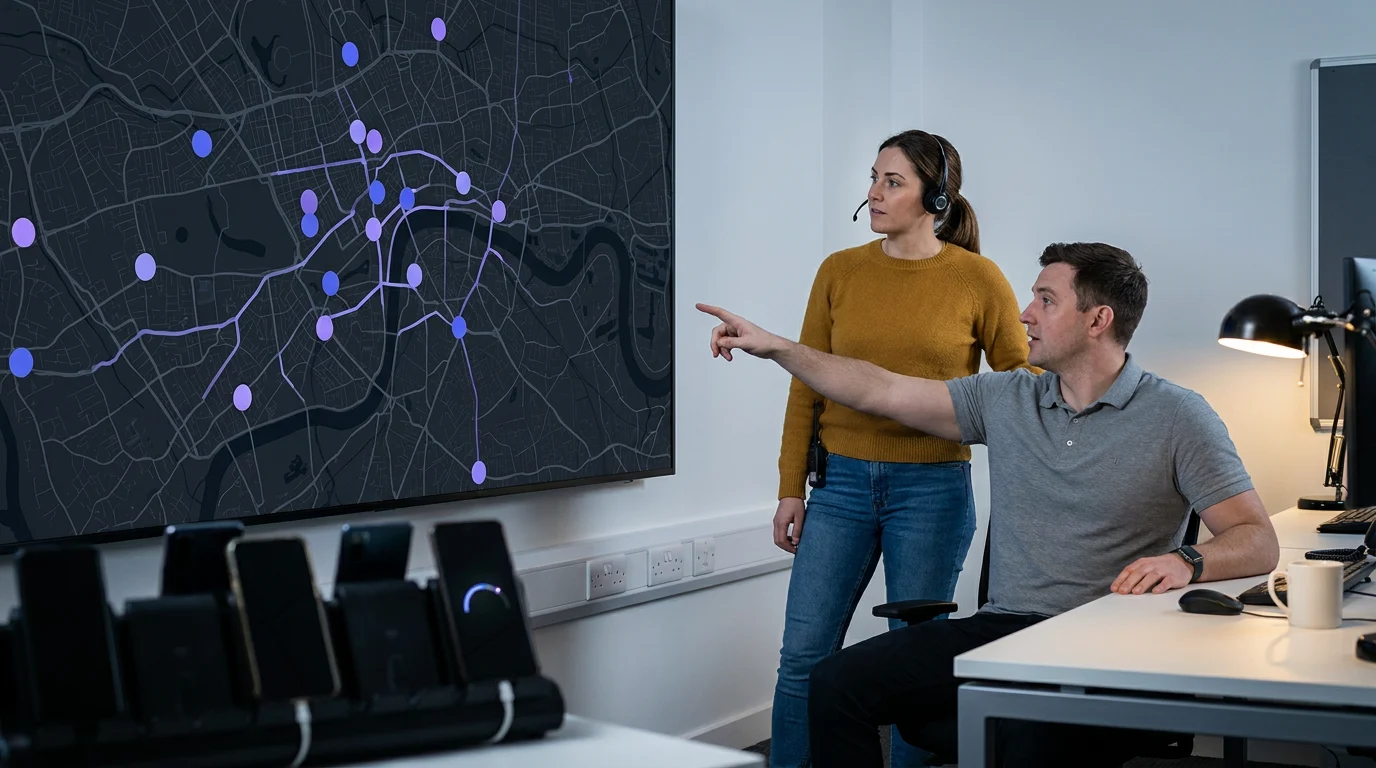
By eight on a Tuesday the depot has emptied and the day is already in motion. Most of the engineers started from home and will finish there; the office running their day will not lay eyes on one of them. For the next ten hours the operation is map pins, status events and the occasional phone call. Managing that well is a discipline of its own.
Quick answer: Mobile workforce management is the discipline of running field teams the office never sees: keeping work moving through dead spots, replacing phone-chasing with status that reports itself, meeting lone-worker duty of care and handling location data in a way technicians accept. It is how a field service market heading for USD 9.17 billion by 2030 gets run.
Key takeaways
- Mobile workforce management is a discipline, not a software category: connectivity, communication, safety, trust and measurement for a team you cannot see.
- Design for disconnection: dead spots are part of the working day, and silence on the map is not the same as a problem.
- Duty of care is a legal obligation: HSE lone working guidance expects risk assessment, reliable contact and escalation for mobile workers.
- Location tracking keeps workforce trust only while it is proportionate, transparent and visibly useful to the technicians themselves.
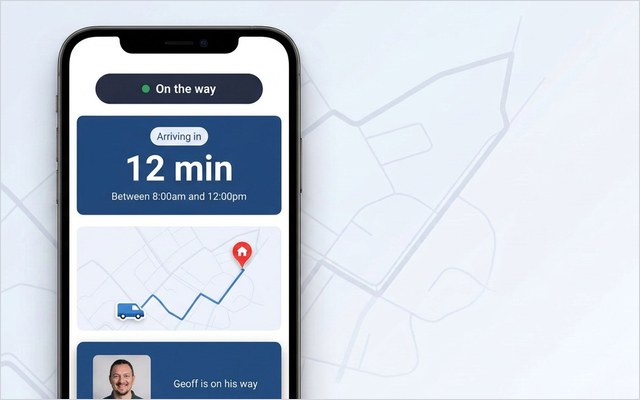
- The live location that guides the dispatcher can serve the customer as an ETA, turning tracking from oversight into service.
What mobile workforce management involves
Mobile workforce management is everything involved in running technicians who work away from any office: keeping them connected, informed, safe, trusted and productive, with the customer in the loop while they work. The phrase is used loosely, so separate the discipline from the tooling. The engine that plans and dispatches the day is a workforce management system; the software an engineer works from is the technician app, covered in our field service app guide; and both sit inside the wider practice of field service management. This guide covers the layer in between: managing people you never see.
Search for mobile workforce management software and the results mostly resolve to the same WFM platforms; at 200 to 1,000 or more technicians the question is usually settled by whichever of Oracle Field Service, IFS, SAP, Salesforce Field Service, Dynamics 365 or ServiceMax you already run. The spend is settled too: MarketsandMarkets (2025) projects the field service management market growing from USD 5.10 billion in 2025 to USD 9.17 billion by 2030, a 12.5% annual rate. What no platform settles is doctrine: the five problems of day-to-day field team management this guide takes in turn, plus the participant most operations forget.
Connectivity: manage for the offline reality
Assume disconnection. A UK field day includes basement plant rooms, steel-framed units and rural rounds where one bar of signal is good news, so a mobile workforce spends part of every day invisible. Offline-first technician tooling is the procurement answer; the management questions are behavioural.
Three rules follow. First, silence is not status: an engineer who has gone quiet is usually in a signal hole, occasionally in trouble, and the operation needs a defined line between the two. Second, queued updates arrive late and out of order, so anyone reading the board must know “nothing has happened” from “nothing has synced”. Third, never build a process that needs live connectivity mid-job; the authorisation requiring a call from a basement fails on the jobs that matter. Map the dead zones and set expected quiet windows per route, and coverage turns from daily surprise into planning input.
Communication at distance: status that reports itself
Communication that works at distance is asynchronous: status flows from systems as events, and voice is reserved for judgement. When an engineer goes en route, arrives or completes, the technician app says so; nobody should ring anybody to establish facts a system already knows. Phone-chasing charges the operation twice, once for the agent making the call and once for the engineer interrupted mid-diagnosis to answer it. The admin load is heavy already: mobile workers estimate 18% of their working hours, more than seven a week, go on tasks like form-filling and hunting for information (Salesforce, 2024).
Where the pattern is missing, the vacuum fills with WhatsApp groups: job details, addresses and photos drift into personal messaging, invisible to the operation and awkward under UK GDPR. Managing remote field teams at scale means giving status a proper home, then defending it: dashboards read events, exceptions raise flags, and a ringing phone means something genuinely needs a human. Engineers notice: the operations they rate are rarely the chattiest, just the ones where the phone only rings when it must.
Duty of care: a mobile workforce is mostly a lone workforce
Most field technicians meet the Health and Safety Executive’s definition of a lone worker, someone who works by themselves without close or direct supervision, and HSE lone working guidance names mobile workers away from a fixed base explicitly. The duties do not shrink with distance: employers must assess and control lone-working risk under the Health and Safety at Work etc. Act 1974 and the Management of Health and Safety at Work Regulations 1999, which in practice means risk assessments that consider the lone condition, training for situations nobody can escalate in person, reliable contact and a defined response when it fails.
The regime is unglamorous and testable. Check-in cadence proportionate to risk: a gas engineer in occupied homes is not a rigger on a remote mast. Escalation that actually fires when a check-in is missed, owned by named people rather than a shared inbox. Man-down and panic functions where the assessment demands them. And honest reconciliation with the connectivity rules above: if a route includes ninety silent minutes in a basement, the protocol must expect that, or every real alarm drowns in false ones. Duty of care is also where location data earns its first honest use, which brings us to the awkward subject.
Location visibility, privacy and trust
Location tracking is legitimate, useful and entirely capable of souring the relationship with your workforce; the outcome depends on how it is run. The case for: dispatchers re-flow the day around real positions, lone-worker escalation depends on a last known location, and when a customer insists nobody turned up, the data settles it, usually in the engineer’s favour. The case against is equally real. Tracking that follows people rather than work, runs outside working hours or feeds disciplinary fishing trips will be read as surveillance, because it is.
UK GDPR draws a workable line: lawful basis, stated purpose, proportionality, transparency. In practice, track during working hours only, collect the minimum the purpose needs, write down who sees what and for how long, and tell the workforce all of it before switch-on. Consult early; where unions or works councils are involved, bring them into the design. The pattern across deployments is consistent: technicians accept visibility that demonstrably protects and defends them, and resent the same data arriving unexplained. The difference is entirely managerial.
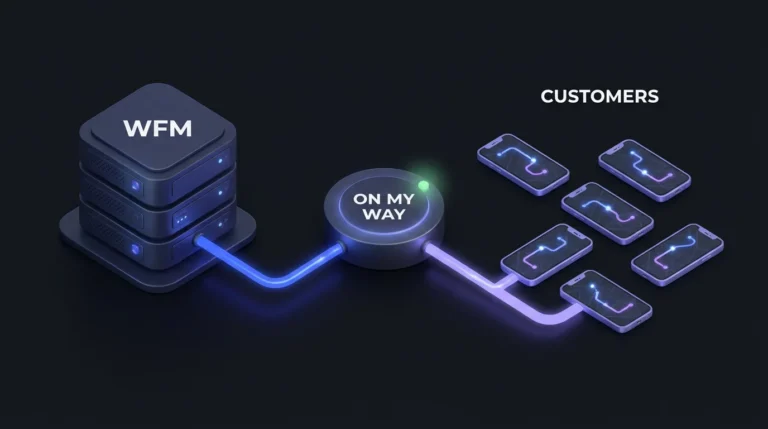
Want the visible version rather than the theory? How On My Way works walks the customer-facing side end to end, from confirmation message to live day-of-visit ETA, on whichever WFM you already own.
Productivity without surveillance theatre
Measure outcomes, not motion. Surveillance theatre — idle-time colour codes, geofence alerts, league tables of stationary minutes — measures inputs because inputs are easy, and pays for them with the trust the previous section described. Outcomes are what the operation exists for: first-time fix, completed jobs, travel ratio, rework, customer feedback. Aquant’s 2024 Field Service Benchmark shows the room those measures hold: the industry averages 76% on first-time fix against 87% for the top quintile, and a job not fixed first time takes 2.7 visits on average to resolve. No recovered idle minute compares, and none of those gaps closes by watching dots more sternly.
The labour market sharpens the point. TSIA’s State of Field Services (2025) keeps workforce pressure near the top of the industry agenda, with experienced technicians retiring faster than replacements arrive; an operation that burns goodwill on theatre volunteers for the wrong side of that shortage. Capacity comes from removing friction, the interruptions, admin and repeat visits already covered, and from tuning the scheduling estate itself, the territory of our guide to workforce optimisation. Trust, it turns out, is an efficiency measure.

The flip: the customer is part of the mobile equation
The most under-used location feed in field service is the one the customer never sees. Every appointment has a second participant, and they are the blindest person in the operation: a four-hour window and a phone number. Appointments will not sit still either: On My Way deployment research finds well over a third are changed by the customer after booking, and without a self-service route those changes arrive by phone. Preference is not in doubt: 61% of customers would rather handle a simple task themselves than ring an agent (Salesforce, 2024).
So make the location data work twice. Serve the position feed the dispatcher already trusts to the customer as a live ETA: white-label and browser-based, nothing to install, a link in the appointment SMS or email that opens with the booking loaded, plus rebooking, cancellation and a feedback prompt, with a Contact Centre View so agents see what the customer sees. Bosch UK, whose ~350 engineers handle some 1,100 appointments a day, saw 53% fewer technician-location/ETA-related calls and 79% higher customer engagement with appointment comms after making that flip on its existing WFM. Hold the commercial numbers apart: 35% within 90 days is the guarantee, 40 to 55% is the typical range across deployments, and Bosch UK’s 53% is a named actual. The full customer-facing set, from live tracking to real-time NPS and CSAT, is on our features page.
Notice what this does to the trust problem. Tracking that exists so a manager can watch is surveillance; tracking that spares engineers the where-are-you calls and settles doorstep disputes serves everyone, technicians included. Same feed, different social contract.
Related reading: workforce scheduling for field service teams, job management software: the UK guide and route optimisation for field service teams.
Frequently asked questions
Is mobile workforce management the same as workforce management software?
No. The software side, the WFM platform, forecasts, schedules and dispatches. Mobile workforce management is the surrounding discipline: connectivity doctrine, communication patterns, lone-worker duty of care, location policy and outcome measurement for a team the office never sees.
What is the best mobile workforce app?
For technicians, the mobile client of your own WFM platform is nearly always right, judged on offline behaviour, speed and integration depth. For customers, the strongest mobile workforce app is no app at all: a white-label browser link for tracking and rebooking. On My Way deliberately provides the second, not the first.
Is it legal to track field technicians in the UK?
Yes, within UK GDPR limits: a lawful basis, a stated purpose, proportionality and full transparency with the people tracked. Confine tracking to working hours, collect the minimum, document who sees what, and consult before switch-on. Covert or out-of-hours tracking is where employers come unstuck.
What does HSE lone working guidance expect for field teams?
Risk assessments that consider lone working specifically, training and supervision proportionate to risk, a reliable means of keeping in touch and defined escalation when contact fails. HSE counts mobile workers away from a fixed base, which describes most field technicians, as lone workers.
How quickly can the customer-facing layer go live?
Four to six weeks is typical, because the WFM underneath stays untouched; a six-week, single-region pilot suits operations that want evidence first. For IT: Entra ID single sign-on, role-based access control, encryption, regional data residency and GDPR alignment, with pricing quoted against technician count and appointment volume.
The bottom line
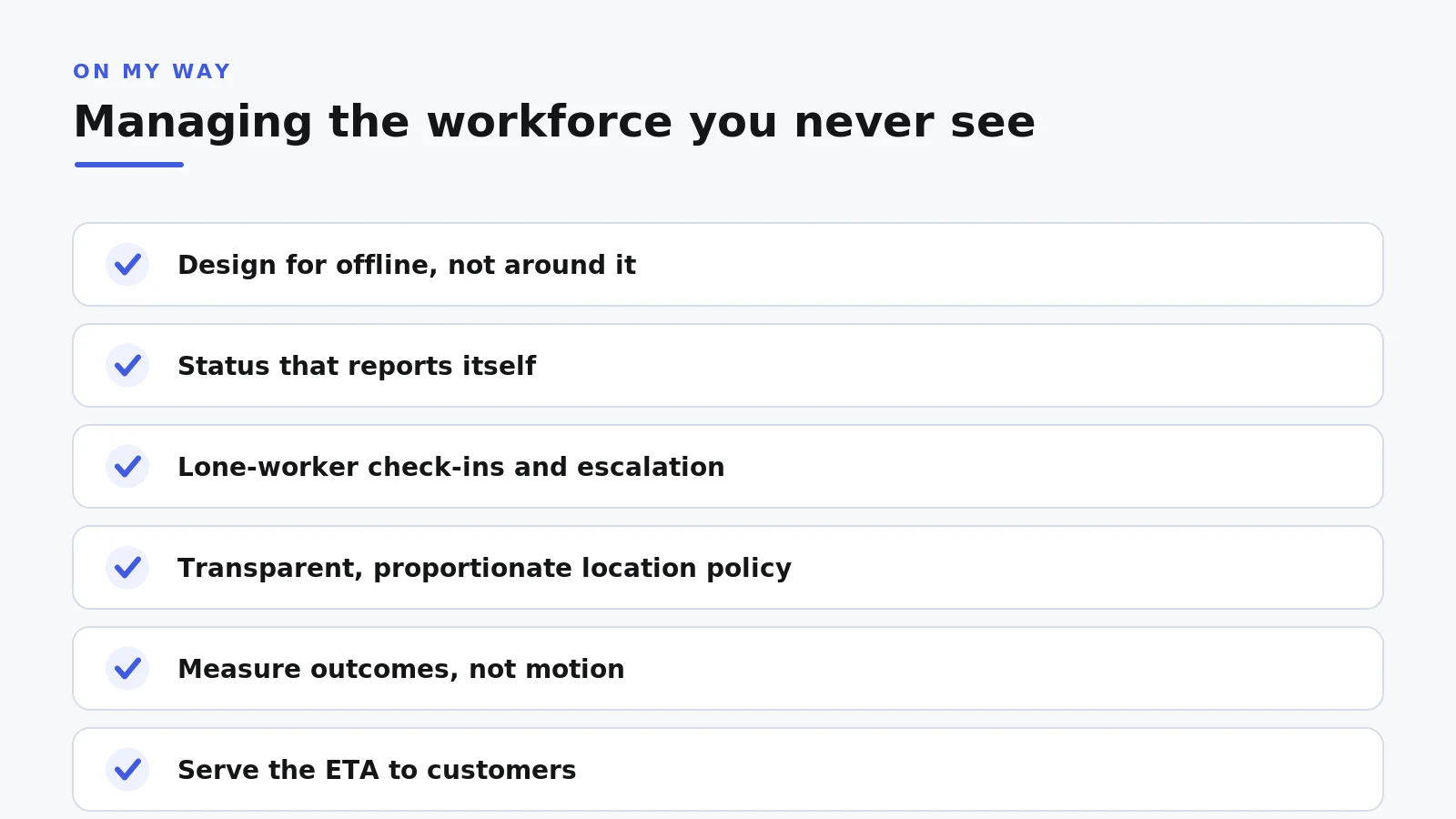
Mobile workforce management comes down to running well what you cannot watch: assume disconnection, let status report itself, meet the HSE lone-working duties properly, run location data transparently enough to keep trust, and measure outcomes rather than motion. Then make the flip the platforms miss: give the customer the dispatcher’s live picture, and tracking stops being oversight and starts paying for itself in calls that never happen.
See it against your own operation. Book a demo: a 30-minute working session, no slide deck, your appointment volumes and your WFM. Or read the mechanics first on how On My Way works.
References
- MarketsandMarkets — Field Service Management Market worth $9.17 billion by 2030 (2025)
- Health and Safety Executive — Lone working: protect those working alone (2020)
- Aquant — Field Service Benchmark Report (2024)
- TSIA — The State of Field Services (2025)
- Salesforce — State of Service: Customer Service Statistics (2024)
- On My Way / Leadent Digital — enterprise deployment data (appointment-change volume; client outcomes).

Keep your WFM. Upgrade what your customers experience.
On My Way is the customer-experience layer for field service: live arrival tracking, self-service rebooking, notes and photos, and feedback, added on top of the scheduling system you already run. No rip-and-replace, live in four to six weeks.