Enterprise Service Management: What It Is and Why It Matters

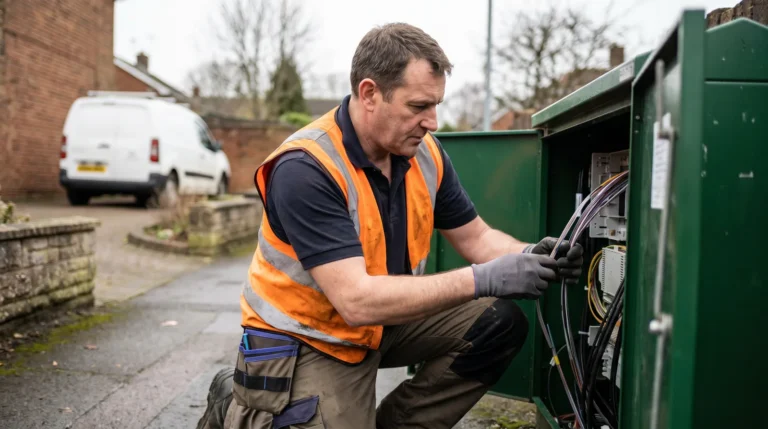
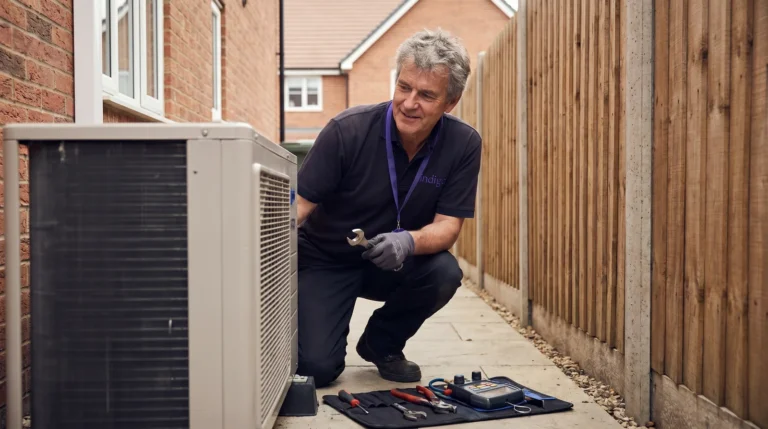
A power company restores a fault, an HVAC firm services a boiler, an IT desk resets a password. Three very different jobs, one shared question: how do you run service consistently across an organisation when the work, the teams and the tools are all different? Enterprise service management is the answer most large organisations reach for — and, for anyone with engineers in the field, the place where it tends to fall short.
Quick answer: Enterprise service management (ESM) is the practice of applying structured service-management principles — request intake, workflows, SLAs and a service catalogue — across every department that delivers a service, not just IT. It extends the discipline of IT service management to HR, facilities, finance and field operations, so the whole organisation handles requests in a consistent, trackable way.
Key takeaways
- ESM takes the structure that IT service management (ITSM) brought to the help desk and applies it organisation-wide: HR, facilities, finance and field service. ITSM is a subset of ESM, not its rival.
- Most ESM platforms trace their lineage to ITSM tooling, which is why they are strong on internal tickets and weak on the external customer who is waiting for a visit.
- For organisations with field operations, ESM is incomplete without a customer-communication layer — the part that keeps the person at the end of the appointment informed.
- You can close that gap on top of the systems you already run, rather than replacing them.
What is enterprise service management?
Enterprise service management is the extension of service-management principles (the disciplined way IT teams handle requests, incidents and changes) to every part of an organisation that provides a service. Instead of those practices living only in the IT department, ESM puts the same structure behind a new-starter request to HR, a maintenance request to facilities, an expense query to finance, or a repair booking handled by field operations.
The idea grew from a simple observation. The methods IT had refined over decades (logging requests in one place, routing them by workflow, holding them to service-level agreements, reporting on performance) were not about IT at all. They were about managing service. And almost every department in a large organisation delivers a service to someone. ESM is the recognition that the discipline travels.
In practice, an ESM approach gives an organisation a few shared building blocks: one way for people to raise requests (a portal or service catalogue), workflows that route and escalate work automatically, agreed service levels measured against performance, and a knowledge base so common questions get answered without a human. The pay-off is consistency — a request is logged, owned, tracked and resolved the same way whether it lands with the service desk or the maintenance team, and leaders get visibility across the lot.
ESM vs ITSM: what’s the difference?
The difference between ESM and ITSM is scope. ITSM (IT service management) is the set of practices for designing, delivering and supporting IT services: the help desk, incident and problem management, change control, the configuration database. ESM is those same practices applied beyond IT, across the whole enterprise. ITSM is a subset of ESM, not its opposite.
53% — the reduction in ETA-related calls Bosch UK, a UK HVAC field operation running ~350 field engineers, achieved after adding a customer-communication and self-service layer on top of its existing systems — alongside 79% higher engagement with appointment comms.
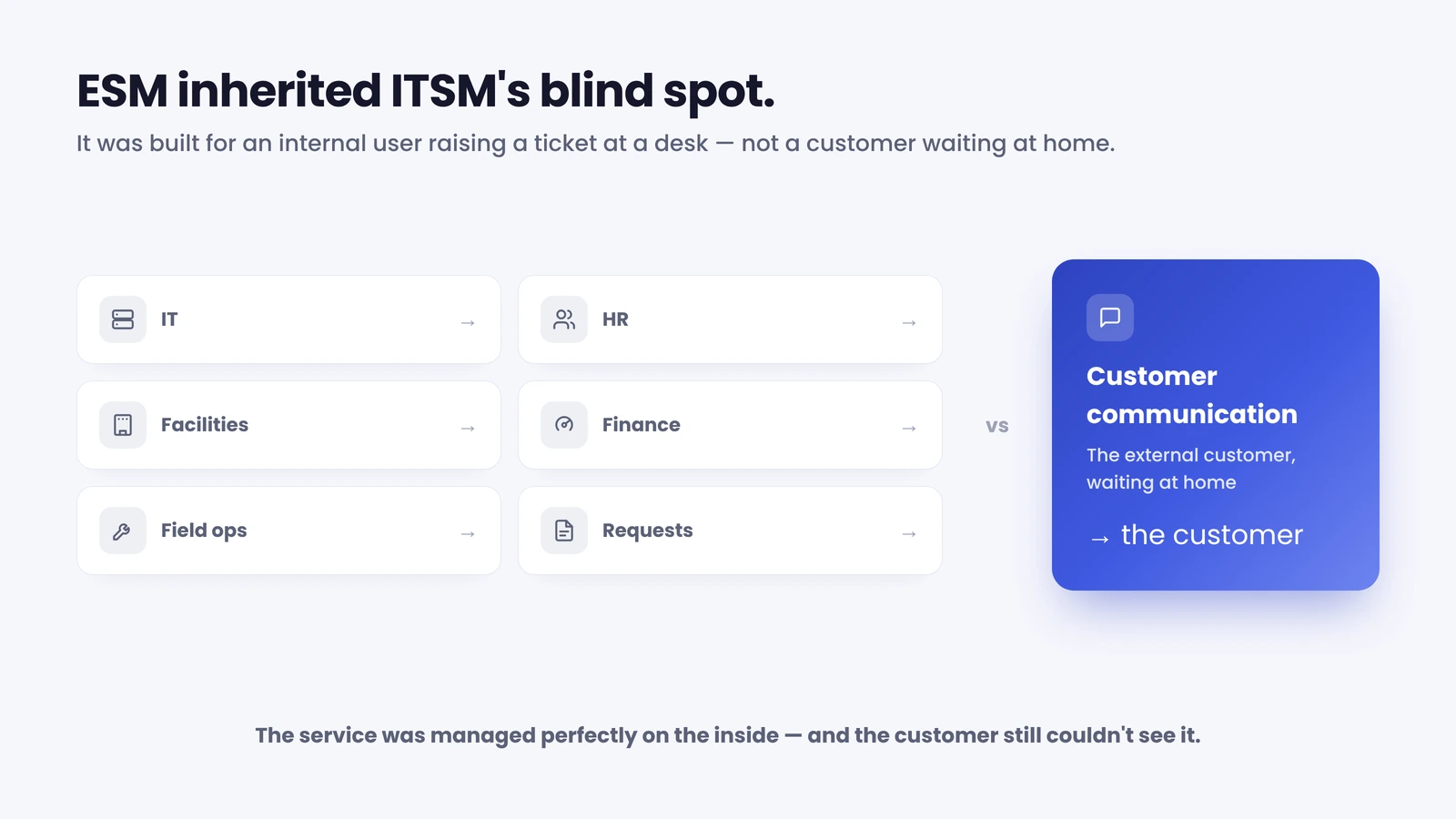
The lineage is worth being precise about, because it explains a lot of what follows. Frameworks such as ITIL codified ITSM, and the big service-management platforms that grew up around them were built first for the IT help desk, then opened up so other departments could run their own service desks on the same engine. That is ESM in most organisations: an ITSM platform, generalised. The strength of that heritage is mature structure and workflow. The limitation is just as real: the model was designed around an internal user raising a ticket at their desk, not an external customer waiting at home for an engineer. That distinction matters enormously the moment field work enters the picture.

ESM for field service
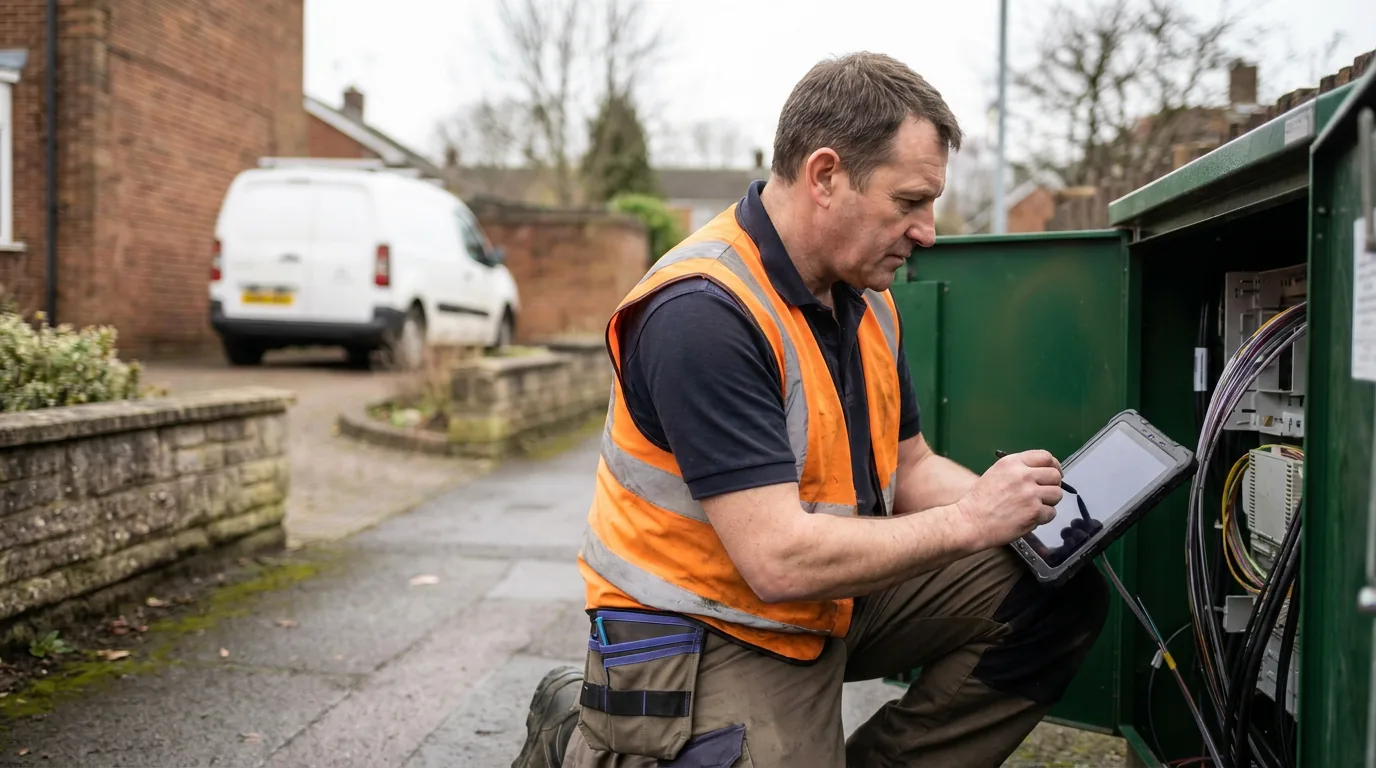
For organisations with field operations, ESM has obvious appeal: one consistent way to manage service across IT, facilities, HR and the field, with shared reporting and accountability. Standardising intake and workflow across departments that previously ran on email and spreadsheets is a genuine improvement, and field teams benefit from the same structure — logged jobs, clear ownership, measured SLAs.
But field service is not an internal help desk, and the difference is not cosmetic. When IT resolves a ticket, the person waiting is a colleague who can see the ticket status. When a field operation books a visit, the person waiting is a paying customer at home, with a half-day booked off work, who cannot see anything at all. The structure that works for the internal ticket assumes a captive, visible user. The field customer is neither.
This is the heart of the field service customer experience problem, and it is where ESM platforms built on ITSM foundations tend to stop. They can route the work order, hold it to an SLA and close it out. What they were never designed to do is talk to the customer on the other end of that work order: the confirmations, the live ETA, the easy reschedule. For a deeper treatment of running the field side well, see our guide to field service management.
Core capabilities of enterprise service management
A mature ESM capability is usually built from the same core parts, whichever platform delivers them:
- A unified service catalogue and portal: one front door where people request whatever they need, from any department, in a consistent way.
- Workflow automation: requests routed, assigned and escalated by rules rather than by someone forwarding an email.
- Service-level management: agreed response and resolution targets, measured, with breaches flagged before they happen.
- A knowledge base and self-service: answers to common questions surfaced so routine requests resolve without an agent.
- Case and request management: every request logged, owned and tracked from intake to closure, with a full audit trail.
- Reporting and analytics: cross-department visibility into volumes, performance and bottlenecks.
For a field operation, the work-order side deserves its own attention, because the job record is where service management meets the real world; our guide to work order management covers it in detail. Notice what every capability on this list has in common, though: each one points inward, at the organisation and its internal users. None of it, on its own, manages the experience of the customer waiting for the work to arrive.
The customer-communication layer most ESM platforms miss
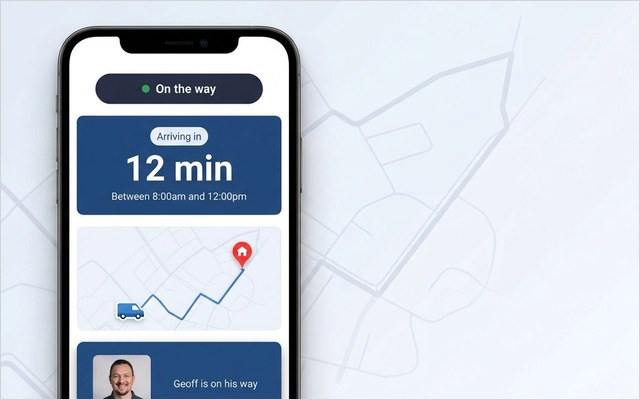
For field operations, the one capability ESM platforms consistently leave out is the customer-communication layer: the proactive updates, live tracking and self-service that keep the person at the end of the appointment informed. It is missing for a reason: the ITSM heritage assumed an internal user who could see the ticket. The external field customer has no such window, so when they want to know what is happening, they do the only thing available. They phone.
And they phone a lot. In a typical enterprise field operation, 30–40% of appointments are changed by the customer and 10–15% are cancelled — and each change tends to generate a five-to-seven-minute call, usually after hours (On My Way internal research). Add everyone ringing simply to ask “where’s my engineer?”, and a large share of contact-centre volume turns out to be questions the customer could have answered themselves, given visibility. That is the appointment problem in miniature: the service was managed perfectly on the inside, and the customer still couldn’t see it.
This is the layer that completes ESM for anyone with field operations, and it is exactly what customer communication management software provides. It is a narrow job done well: keep the customer informed and in control around the appointment. That means automated SMS and email confirmations and reminders, a live technician ETA the customer can watch (a browser-based portal, no app to install), self-service rescheduling and cancellation, and feedback captured the moment the visit ends. The same update that reassures the customer also removes the call, which is why Bosch EU, a European field-service operation that added this layer, cut ETA-related calls by around 35%.
Find out where your calls are really coming from. Most field operations are surprised how much contact-centre volume is just “where’s my engineer?”. On My Way adds live tracking, self-service rescheduling and the contact centre view on top of the systems you already run. Book a 30-minute working session.
This is not a second platform that replaces the first. On My Way is the customer-communication layer for field service, not a full ESM or ITSM suite, and it sits on top of whatever workforce-management system already runs scheduling and dispatch, from Oracle and SAP to IFS, ServiceMax, Salesforce Field Service and Dynamics 365. Keep your systems; upgrade the customer experience. And because it inherits the same governance discipline ESM exists to enforce, it clears enterprise review rather than stalling in it: single sign-on via Microsoft Entra ID, role-based access control, encryption and regional data residency, with GDPR and Works Council compliance built in. The automated notifications and tracking are the part the customer sees; that governance is what lets an enterprise put them in front of customers at all.
Getting started with enterprise service management
The sensible way into ESM is incremental, not a single organisation-wide programme. A practical order of operations:
Standardise where the structure is missing first. Pick the departments still running service on email and spreadsheets — often facilities or HR — and bring them onto a shared catalogue, workflow and SLA model. The early wins come from consistency, not technology.
Measure before you optimise. For the field side, baseline the numbers that drive everything: first-time fix, no-show rate, and a fortnight of tagged inbound contact split into ETA enquiries, rescheduling, post-appointment and other. The tagging almost always reveals how much volume is avoidable.
Close the customer-communication gap as its own move. For any operation with field visits this is the cheapest, fastest step of the lot, and it does not wait on the wider ESM rollout. Add proactive communication and self-service on top of your existing workforce-management system; see how it works. In field service, the same move that improves the customer experience also takes cost out of the contact centre, so one project pays back on both counts.
The bottom line
Enterprise service management is a genuine advance: it takes the structure IT spent decades refining and gives the rest of the organisation the same consistency, visibility and accountability. The catch, for anyone with engineers in the field, is that the ITSM lineage behind most ESM tooling stops at the organisation’s edge — it manages the work, not the customer waiting for it. Close that last gap with a customer-communication layer on top of the systems you already run, and ESM finally reaches the person it was always meant to serve.
Frequently asked questions
What is enterprise service management?
Enterprise service management (ESM) is the practice of applying service-management principles — structured request intake, workflows, service-level agreements, a service catalogue and self-service — across every department that delivers a service, not just IT. It extends the discipline of IT service management to HR, facilities, finance and field operations, so the whole organisation handles requests consistently and trackably.
What is the difference between ESM and ITSM?
The difference is scope. ITSM (IT service management) is service management applied to IT: the help desk, incident and change management, the configuration database. ESM is those same practices applied across the whole enterprise. ITSM is a subset of ESM. Because most ESM platforms grew out of ITSM tooling, they are strong on internal tickets but often weak on communicating with external customers, such as those waiting for a field-service visit.
Is ESM the same as field service management?
No. ESM is the broad practice of running service consistently across all departments. Field service management is the specific discipline of running off-site work — scheduling, dispatch, work orders and on-site completion. An ESM approach can cover the field team’s internal workflow, but it rarely includes the customer-facing communication a field operation needs, which is why the two are usually complemented rather than equated.
Does enterprise service management software handle customer communication?
Usually not well for field service. Most enterprise service management software descends from internal IT help-desk tooling, which assumes a user who can see their own ticket. Field customers cannot see anything, so they phone — and inbound “where’s my engineer?” calls pile up. A dedicated customer-communication layer (proactive updates, live ETA tracking, self-service rescheduling) fills that gap and sits on top of the systems already in place.
Do you need to replace your systems to add a customer-communication layer?
No. A customer-communication and self-service layer sits on top of your existing workforce-management system — Oracle, SAP, IFS, ServiceMax, Salesforce Field Service or Dynamics 365 — adding tracking, self-service and feedback without disrupting scheduling or dispatch. It is faster and lower-risk than replacing a platform, with a typical go-live of four to six weeks, and it targets the customer-experience gap most ESM and ITSM tools leave open.
References
- On My Way / Leadent Digital — enterprise deployment and appointment-change research (“the appointment problem”).
- MarketsandMarkets — Field Service Management Market (market sizing and CAGR), 2024
- Aquant — Field Service Benchmark Report (first-time fix rate benchmarks), 2024

Keep your WFM. Upgrade what your customers experience.
On My Way is the customer-experience layer for field service: live arrival tracking, self-service rebooking, notes and photos, and feedback — added on top of the scheduling system you already run. No rip-and-replace, live in 4–6 weeks.