Call Centre Software: How Field Service Teams Are Cutting Inbound Calls

Quick answer: Most call centre software helps you handle inbound calls faster, with better routing, smarter IVR and more agents. The bigger win in field service is removing the reason customers call at all. The highest-volume driver is the appointment: “where’s my technician?” and “can I move my slot?”. Give customers live tracking, proactive alerts and self-service rebooking, and those calls never reach the queue, cutting appointment-related volume by 40-55%.
Key takeaways
- The single largest, most avoidable category of inbound contact in field service is the appointment — “where’s my technician?” and “can I rebook?”.
- In a typical enterprise operation, 30-40% of appointments are changed by the customer and 10-15% cancelled, with each change tending to mean a five-to-seven-minute call, often after hours.
- Call deflection done well isn’t a better IVR; it’s removing the need to ring, through live tracking, proactive notifications and self-service rebooking, on top of the WFM you already run.
- Enterprise deployments typically cut appointment-related calls by 40-55%; Bosch UK cut ETA calls by 53%.
Every inbound call has a price. By the time a routine appointment query has waited in the queue, reached an agent, been verified against a job reference and resolved, you’ve spent five to seven minutes of paid contact-centre time on something the customer could have done in ten seconds from their phone. Multiply that by the share of a field-service appointment book that moves in any given week, and a large slice of an enterprise contact centre turns out to be answering questions the customer never wanted to ask. Most teams then reach for the wrong tool to fix it.
The instinct is to buy more capacity or smarter call centre software: better routing, a sharper IVR, more agents on the overflow, all of which makes a call you didn’t want to receive marginally cheaper to handle. The teams pulling ahead attack the reason customers call, the appointment itself, so the call is never placed. This article covers the hidden cost of those inbound calls, why customers pick up the phone, the difference between deflecting a call and eliminating it, and how self-service plus tracking removes the highest-volume contact category in the operation.
The hidden cost of inbound calls in field service
The biggest cost of inbound calls in field service isn’t the per-call handling cost; it’s the sheer, predictable volume of calls that should never have been made. Most contact centres are sized to absorb that volume rather than question it, so the cost hides in plain sight: it looks like a normal Tuesday.
Strip the volume into categories and the pattern is stark. A large share of field-service inbound isn’t complaints or complex queries; it’s people asking where their technician is, or trying to move an appointment. These are short, repetitive, low-stakes calls, and that’s exactly why they’re so deflectable: the customer is asking a question the system can already answer (the ETA), or requesting a change it could let them make themselves (the reschedule), often into an after-hours overflow line. The bill also scales with the business: the field service management market is forecast to grow from USD 5.10 billion in 2025 to USD 9.17 billion by 2030, a 12.5% CAGR (MarketsandMarkets, 2025), with contact volume rising alongside it. The honest way to size this is to measure it, the foundation of useful contact centre analytics: tag two weeks of inbound, bucket it (ETA enquiries, reschedules, cancellations, post-appointment, complex queries), and watch how much sits in the first three.
Why customers actually call: the “where’s my technician?” problem
Customers call because they have no other way to answer the one question that matters on the day: when is someone coming? Hand them a four-hour arrival window and a morning off work, and uncertainty does the rest. “Where is my technician?” is not an awkward customer; it’s a reasonable person reaching for the only tool you’ve given them.
The numbers behind this are bigger than most operations assume. Across enterprise field-service deployments, a large minority of booked appointments are changed by the customer and a further tranche cancelled, with each change tending to generate a five-to-seven-minute agent call, frequently outside business hours (On My Way internal research). Add the customers who phone purely to ask for an ETA, and the appointment (booking it, moving it, tracking it) turns out to be the largest single source of inbound contact in the operation, growing in lockstep with the book whatever your agents do.
It stays unsolved because it doesn’t look like a problem you fix with software; it looks like the cost of doing business. But the behaviour is predictable, and predictable behaviour can be designed out. People don’t want to phone; the queue is a fallback they reach for because nothing better is on offer. Treating the appointment as the root cause is the whole basis of a modern field service customer experience, and the starting point for reducing the calls it generates.

Call deflection vs call elimination
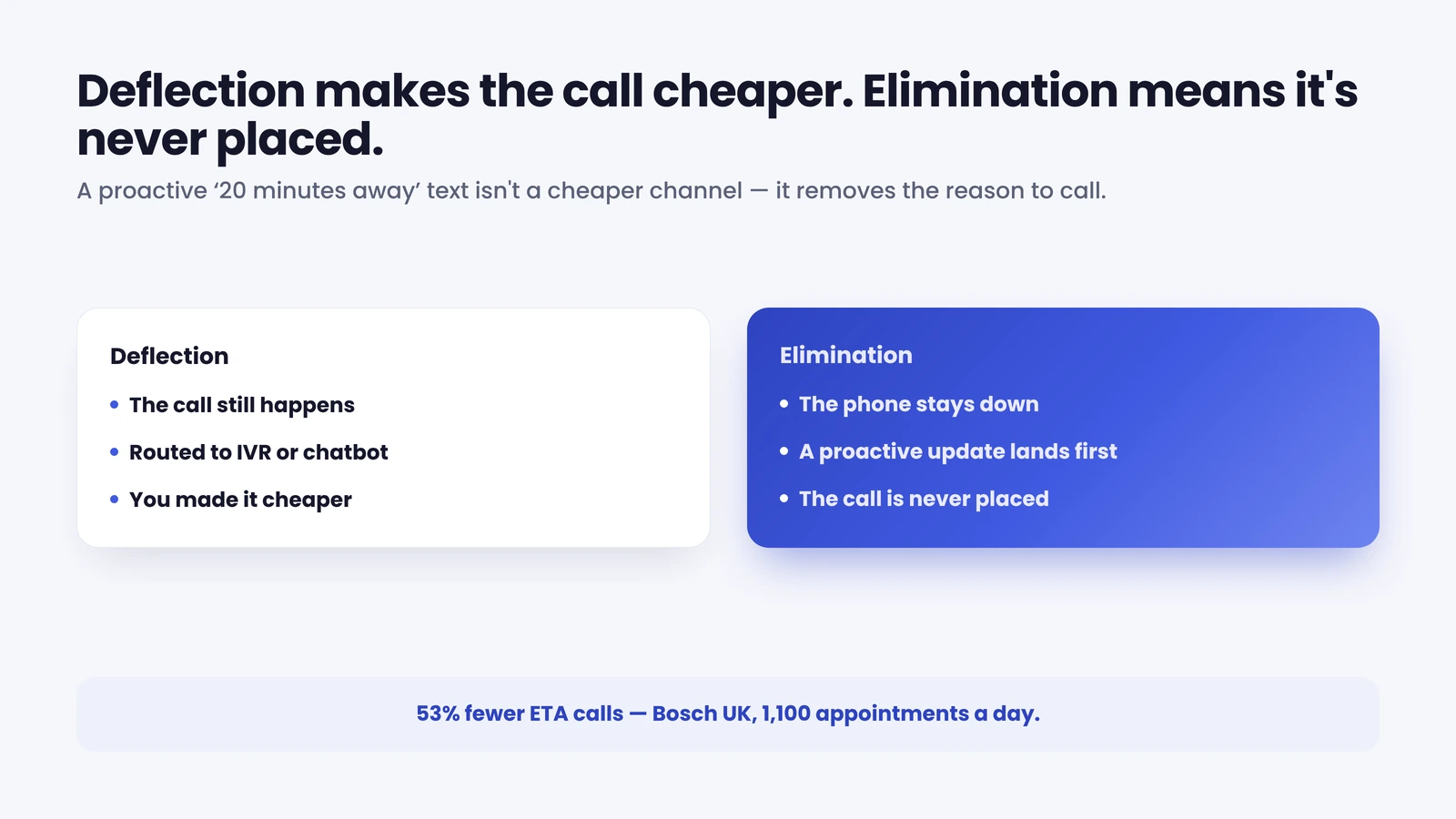
Call deflection and call elimination sound alike, but they describe two different strategies, and conflating them is why a lot of “deflection” projects disappoint. Deflection, as usually meant, steers a call that’s already happening somewhere cheaper: an IVR menu, a “press 1 for status” prompt, a chatbot, a callback. The customer still set out to contact you; you’ve just made the contact cost less. Useful, but it treats the symptom.
Elimination removes the reason to make contact at all. The customer never picks up the phone, because the thing they would have called about — the ETA, the reschedule, the confirmation — has already been handled before the thought of ringing occurs to them. A proactive “your technician is 20 minutes away” text doesn’t deflect the ETA call to a cheaper channel; it means the call is never placed.
53% — the reduction in ETA-related (“where’s my technician?”) calls at Bosch UK, a UK enterprise HVAC operation running ~350 field engineers and handling around 1,100 appointments a day, after rolling out self-service and live technician tracking.
The practical upshot: stop measuring success by how cheaply you handle the call and start measuring it by how many calls don’t arrive. A better IVR absorbs demand you’d rather not have; eliminating the demand, through the appointment rather than the phone line, is what moves the volume itself.
Self-service as call reduction
The most direct way to reduce inbound calls is to let customers do the thing they would have called about. Given how many appointments get changed anyway, the question isn’t whether those changes happen — it’s whether each runs through an agent or the customer’s own phone. Customer self-service rebooking moves the highest-volume call category out of the contact centre entirely: the customer taps a link, picks a new slot from real available capacity, and the change writes back to the schedule without anyone dialling. Every routine change handled this way is a call that never enters the queue, and the saving compounds across an appointment book measured in tens of thousands per month. Customer effort falls too, because moving an appointment in ten seconds beats holding to recite a job reference.
Crucially, none of this requires the customer to download an app. A forced install adds exactly the friction self-service exists to remove; a browser-based portal reached from a link in the appointment reminder will always out-convert a download. The same proactive customer communication that carries the reminder also carries the self-service link, so the tool to avoid the call arrives in the customer’s hand before they’ve thought to make it.
Real-time tracking and proactive notifications
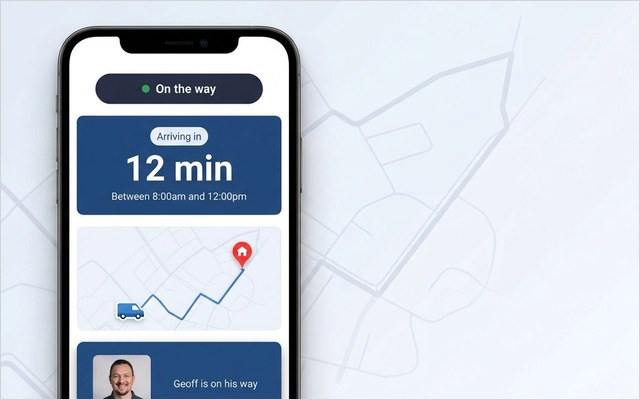
If self-service removes the reschedule call, live tracking and proactive notifications remove the other big one: “where is my technician?”. A real-time ETA the customer can watch — the way they’d track a parcel or a taxi — turns the dreaded arrival window into a shrinking, visible countdown. Technician tracking doesn’t deflect the ETA call to a cheaper channel; it answers the question before it’s asked.

Proactive notifications do the same job a step earlier. A booking confirmation, a reminder ahead of the day, an “on my way” alert when the technician sets off: each closes an information gap that would otherwise have become a call. SMS is the natural channel because it reaches customers fast and appointment reminders are among the messages people most want to receive. A customer who’s been kept informed has no reason to seek information, which is what good notifications buy you: not nicer messaging, but a quieter phone line. They also lift satisfaction, since an appointment bookended by anxiety scores poorly even when the repair goes perfectly, changing how the visit feels across the field-service customer journey, not just how many calls it generates.
And when a customer does still ring, a contact centre view lets the agent see exactly what the customer sees, the same live ETA and status, so they answer in one sentence instead of putting the customer on hold to check the schedule.
What the numbers look like
The reason to treat the appointment as the lever, rather than the phone line, is that the returns are large and repeat across sectors. The figures vary by operation; the mechanism is identical.
- Bosch UK, running ~350 field engineers and handling around 1,100 appointments a day, cut ETA-related calls by 53% after deploying self-service and live tracking.
- Bosch EU, a European field-service operation, cut ETA-related calls by around 35%.
- Brinks Home, a North American home-services provider, cut ETA-related calls by 34%.
Be precise about which number is which, because they get blurred. The typical range for appointment-related call reduction across enterprise deployments is 40-55% in the first months of going live; the Bosch UK result above, 53% on ETA calls specifically, sits at the top of that band. The commercial commitment is different again: On My Way underwrites a minimum 35% reduction in appointment-related calls within 90 days, or it keeps working at no additional cost until that figure is hit. The guarantee is the floor, not the expected result: a deliberately conservative number a vendor will stand behind, which is a different proposition from a feature list.
Getting started
Reducing inbound calls is a contained project, not a transformation programme, and it pays to do it in order. Baseline the volume first: tag two weeks of inbound and size the buckets, because the ETA-and-reschedule share is usually your business case in a single chart. Then fix proactive communication (confirmations, reminders and a live ETA move call volume within weeks), add self-service rebooking to empty the next, larger tranche, and close the loop with real-time feedback so problems surface while they’re still recoverable.
None of this means replacing the system that runs your schedule. A communication-and-self-service layer sits on top of your existing WFM (Oracle Field Service, SAP, IFS, ServiceMax or Salesforce Field Service), reading its appointment data via API and writing customer changes back, dispatch logic untouched. Keep your WFM and upgrade the customer experience on top of it, which is why it goes live in weeks, not the quarters a core-system replacement demands.
The fastest way to see whether the numbers stack up for your operation is to look at the live product against your own appointment data. Book a demo for a 30-minute working session (no slide deck), and ask about the 35%-in-90-days guarantee while you’re there.
Frequently asked questions
How can field service teams reduce inbound calls?
By removing the reasons customers call rather than handling those calls more cheaply. The largest, most avoidable category is appointment-related: “where’s my technician?” and “can I rebook?”. Give customers live technician tracking, proactive SMS and email updates, and self-service rebooking, and appointment-related calls typically fall by 40-55%, because so much of the appointment book gets changed by customers and each change otherwise means an agent call.
What is call deflection?
Call deflection usually means steering a call that’s already happening to a cheaper channel (an IVR menu, a chatbot, a status page or a callback) so it costs less to resolve. Useful, but it treats the symptom: the customer still set out to make contact. The bigger prize in field service is call elimination: removing the reason to call at all, for example by proactively texting a live ETA so the “where’s my technician?” call is never placed.
Is call centre software the same as reducing inbound calls?
No. Most call centre software (or contact centre software) helps you receive and route inbound calls efficiently, through queuing, IVR, agent desktops and analytics, which makes calls cheaper to handle but doesn’t reduce how many arrive. Reducing the calls comes from a different layer: self-service, tracking and proactive notifications that pre-empt the appointment questions driving the volume. The two are complementary: one absorbs demand, the other removes it.
Does this mean replacing our existing call centre or WFM system?
No. This isn’t a telephony platform and it doesn’t replace your workforce-management system. It’s a customer communication and self-service layer on top of your existing WFM (Oracle, SAP, IFS, ServiceMax or Salesforce), connecting via API. It reads appointment and status data to power tracking, alerts and self-service, while scheduling, routing and dispatch stay exactly as they are.
The bottom line
In field service, the cheapest inbound call is the one that’s never made. The highest-volume driver of contact, “where’s my technician?” and “can I rebook?”, is best treated as a question of appointment visibility, removed at source through self-service, live tracking and proactive notifications on top of the WFM you already run, rather than as call-handling to optimise after the fact. Handle the call better and you save pennies; eliminate the reason for it and you cut appointment-related volume by 40-55%.
References
- On My Way / Leadent Digital — internal deployment research (“the appointment problem”: 30-40% of appointments changed by the customer, 10-15% cancelled, each change ≈ a 5-7-minute contact-centre call).
- MarketsandMarkets — Field Service Management Market (USD 5.10B in 2025 to USD 9.17B by 2030, 12.5% CAGR), 2025
- Aquant — Field Service Benchmark Report (average first-time fix rate 76%; top performers 87%, bottom 55%), 2024

Keep your WFM. Upgrade what your customers experience.
On My Way is the customer-experience layer for field service: live arrival tracking, self-service rebooking, notes and photos, and feedback — added on top of the scheduling system you already run. No rip-and-replace, live in 4–6 weeks.