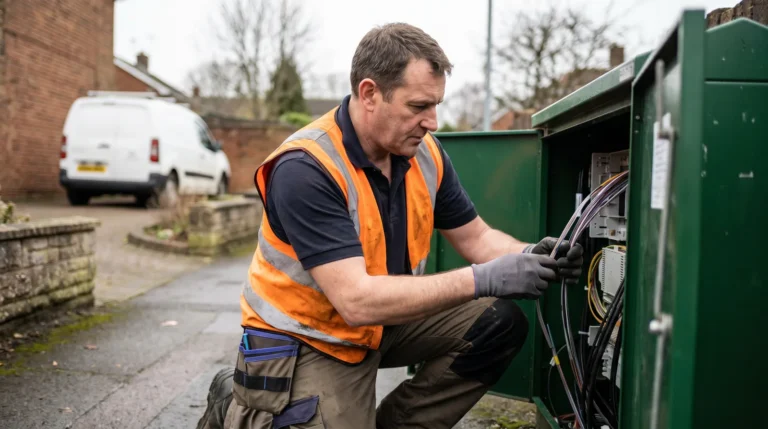
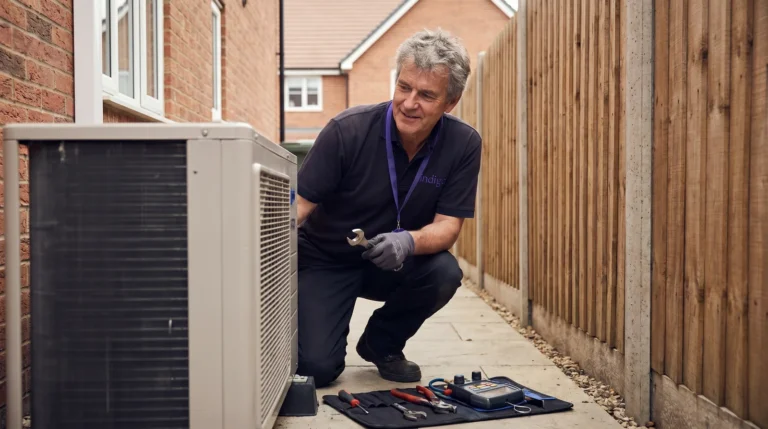
Gas Engineer Software: The Complete UK Guide

Quick answer: Gas engineer software is a job-management platform built for heating and gas businesses. It handles scheduling and dispatch, gives engineers a mobile app for job sheets and digital gas certificates (including the CP12 Landlord Gas Safety Record), and manages parts, invoicing and compliance records in one place. For a sole trader it replaces the paper diary. For an enterprise gas or heating operation running hundreds of engineers, it is the system that keeps Gas Safe compliance auditable at scale and, paired with a customer-communication layer, turns every annual safety visit into a tracked, self-serve appointment instead of a missed slot and an inbound call.
Key takeaways
- Gas engineer software covers four jobs: scheduling, mobile job management, digital certification (CP12 and the wider gas-record set), and back-office invoicing, all tied to a compliance audit trail.
- Compliance is the non-negotiable layer: only a Gas Safe registered engineer can issue a CP12, certificates are valid for 12 months, and the software’s job is to make that record-keeping instant and auditable.
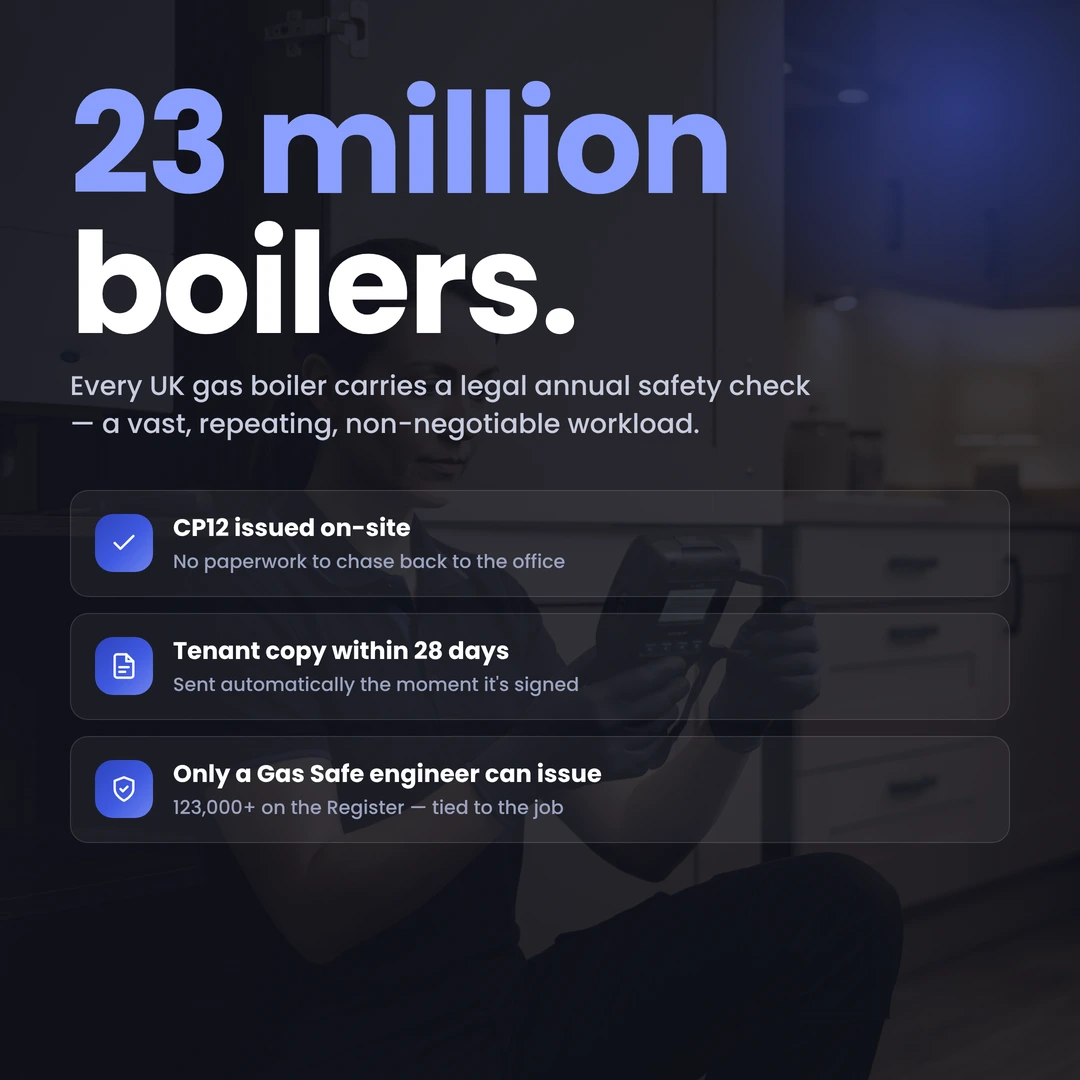
- Around 23 million gas boilers sit in UK homes and roughly 1.5 million are installed each year; every one carries an annual safety or service obligation, which is a vast, repeating appointment workload.
- The feature most enterprises under-buy is the customer side: appointment tracking, self-service rebooking and reminders. That layer is where no-shows, repeat visits and inbound “where’s my engineer?” calls actually get cut.
- You don’t need to replace your scheduling system to add it. The customer-experience layer sits on top of whatever workforce-management platform you already run.
Picture a regional heating operation in mid-October. Three thousand annual boiler services are booked across the next eight weeks, spread over 120 engineers. The schedule is tight, the parts van is loaded, and the engineering side is running well. Then the calls start: when’s my engineer coming, can you move my Thursday, I’ve not had my certificate. Within a fortnight a third of the contact centre’s volume is appointment admin, no-show rates climb as the cold snap disrupts diaries, and the safety certificates are landing late. None of that is an engineering failure. It’s a software gap, and it’s exactly the gap gas engineer software is meant to close.
This guide covers what that software is, the features that matter, how the compliance side works under UK gas regulation, and the one layer most enterprise heating operations buy last when they should buy it first: the customer-communication and self-service layer that connects the annual safety visit to the customer waiting at home.
What is gas engineer software?
Gas engineer software is a field-service platform tailored to the gas and heating trade. You’ll see the same product sold as heating engineer software or, more broadly, gas engineer job management software, depending on which part of the workflow the vendor leads with. At its core it does what any field service management system does — schedule work, dispatch engineers, capture what happened on site, raise the invoice — but it adds the trade-specific pieces a heating business can’t operate without: industry-standard gas certificates, Gas Safe compliance records, and appliance-level service history.
The market splits into two broad tiers. At the small end, tools aimed at sole traders and small firms promise to save the average engineer several hours a week on paperwork by digitising the diary, the certificate pad and the invoice book. At the enterprise end (utilities, social-housing repairs teams, national service contractors and the service arms of boiler manufacturers) the software is part of a larger operational stack, integrating with a workforce-management (WFM) system, an ERP, and a contact centre. The trade specifics are the same. The scale, the integration demands and the compliance-audit stakes are not.
This guide is written mainly for that second tier. If you run 50 to 1,000-plus engineers, the question isn’t whether to digitise; it’s which capabilities actually move your operational and customer numbers.
The core features of gas engineer software
A capable platform covers four functional areas, plus the compliance layer that ties them together. Treat the list below as a checklist when you evaluate.
- Scheduling and dispatch. Calendar-based job allocation, ideally skills-aware so you only send a qualified, Gas Safe registered engineer to a gas job. Route optimisation matters most at scale: for a utility, a small percentage off travel time across hundreds of vans is a large number, and getting the right job and appliance detail to the engineer before arrival is what lifts first-time completion (E.ON improved appointment-based first-time job completion by 19% this way).
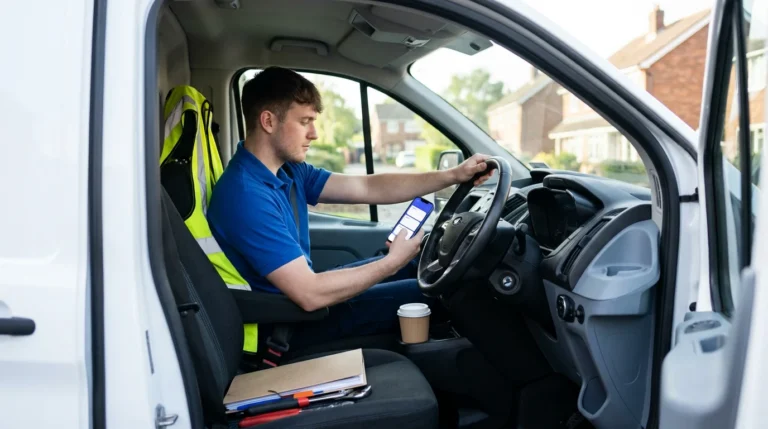
- Mobile job management. An app the engineer uses on site: job details, customer and appliance history, photos, parts used, signatures, and the all-important certificate capture. The best mobile apps work offline (plant rooms and rural properties rarely have good signal) and sync when they reconnect.
- Digital job sheets and gas certificates. Pre-filled, industry-standard records completed on the phone and sent instantly: the CP12 Landlord Gas Safety Record, warning notices (CP14), service and maintenance checklists (CP6), and commissioning sheets. Covered in detail below, because this is the piece unique to gas.
- Parts, stock and invoicing. Van-stock tracking, parts-to-job linking, and quote-to-invoice flow so a completed job converts to a bill without re-keying. At enterprise scale this usually feeds an existing finance system rather than replacing it.
- Reporting and compliance audit trail. A searchable record of who did what, when, against which appliance and certificate: the backbone of both commercial reporting and regulatory defensibility.
Most gas engineer software does the first four reasonably well. The differences that matter at enterprise scale show up in two places: how rigorously the platform handles compliance, and whether it does anything for the customer. We’ll take those in turn.
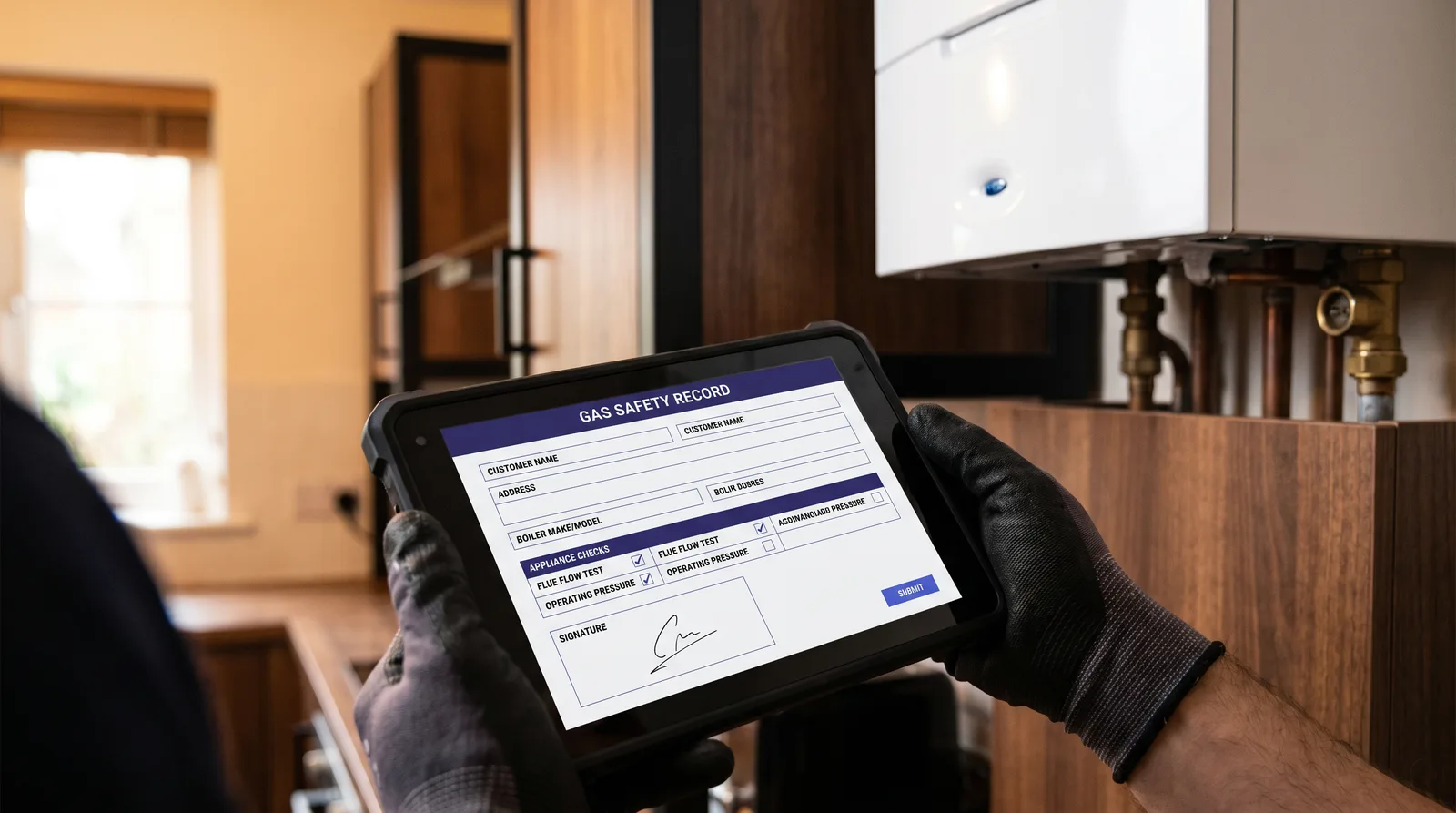
Mobile apps for gas engineers
The mobile app is where the value is won or lost, because it’s where the engineer actually works. A gas engineer app should let an engineer arrive at a property, pull up the appliance history, run the safety checks, capture readings and photos, generate the certificate, take a signature, and move to the next job, without paper and without a second data-entry step back at the office.
Two capabilities separate a usable app from a frustrating one. The first is offline working: a domestic plant room or a rural farmhouse will not have reliable mobile data, so the app must capture everything locally and sync later. The second is pre-filled records: the engineer should not be re-typing the customer, property and appliance details that the system already holds. Good software carries that data into the certificate automatically, which both saves time and removes a common source of error on a legal document.
For an enterprise operation there’s a third requirement that sole-trader tools ignore: the app has to fit the engineer’s existing workflow rather than replace the WFM that dispatches them. A boiler manufacturer’s service arm running on Oracle, IFS or SAP doesn’t want a second scheduling system; it wants the job data and certificates to flow back into the system of record. This is why integration, not feature count, is the enterprise buying criterion.
Digital gas certificates and the CP12
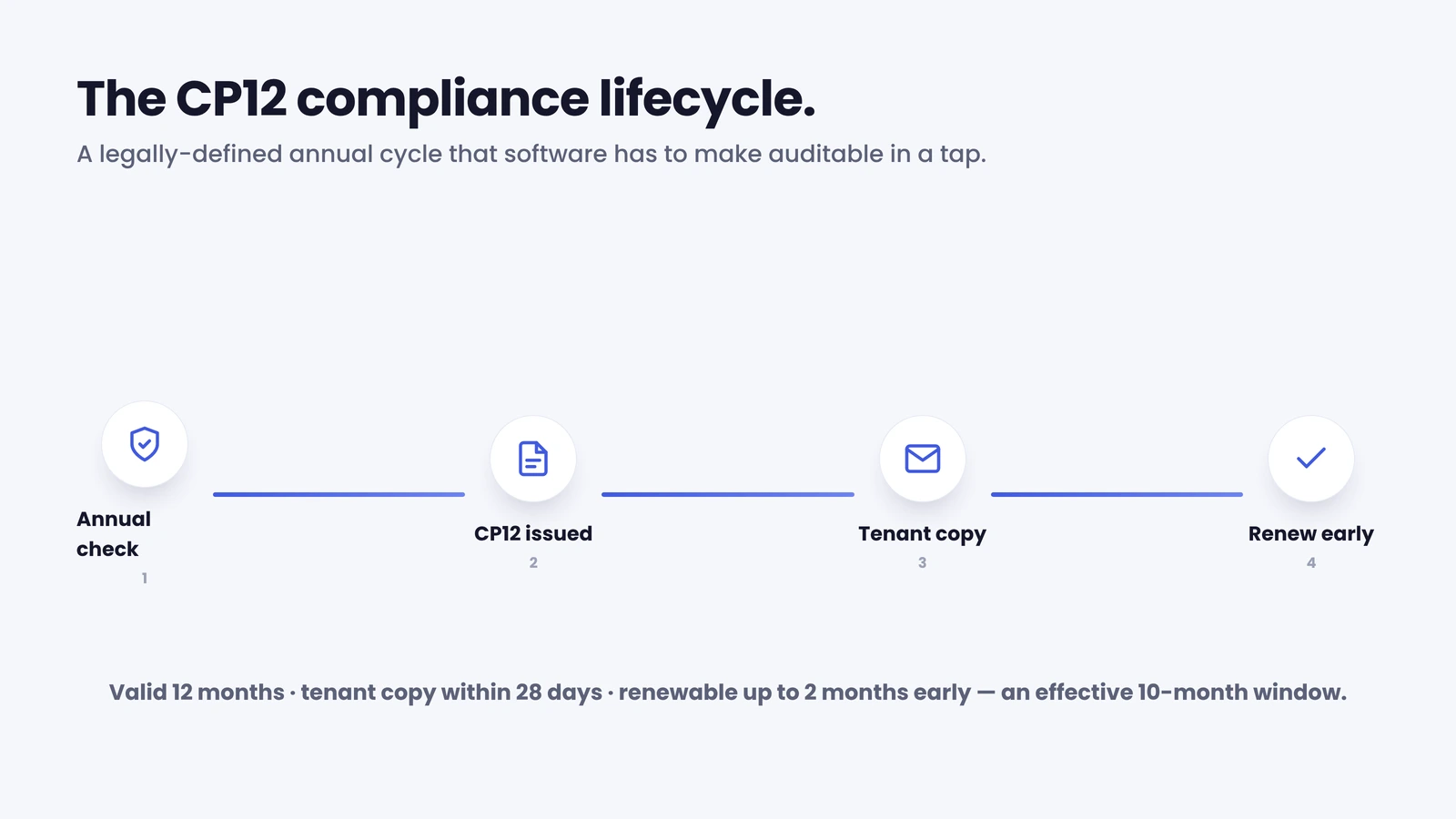
Here is the trade-specific core. A CP12 is the common name for the Landlord Gas Safety Record (also called the LGSR) — the document produced after the annual gas safety inspection of appliances, fittings and flues in a let property. Under the Gas Safety (Installation and Use) Regulations 1998, a landlord must have this check carried out every 12 months by a Gas Safe registered engineer, and must give the tenant a copy within 28 days (or before a new tenant moves in). A certificate is valid for 12 months, and since 2018 the check can be done up to two months before the anniversary date without resetting the cycle — a practical 10-month renewal window. Non-compliance is a criminal offence, with fines reaching into the thousands and, in serious cases, the threat of imprisonment.
Gas engineer certificate software turns that legal obligation into a few taps. The engineer completes the CP12 on the mobile app, pre-filled with the property and appliance data, and the record is generated, stored and sent to the customer the same day. (Some vendors brand this capability “gas safe software,” but the term has no official link to Gas Safe Register — it simply means certificate and compliance tooling for the trade.) The wider gas-record set works the same way — CP12 for the landlord safety record, CP14 for warning notices when an appliance is unsafe, CP6 for service and maintenance checklists, plus commissioning and breakdown records.
For an enterprise operation the value isn’t only speed — it’s the audit trail. When you’re issuing tens of thousands of certificates a year across a distributed workforce, you need to prove, on demand, that every appliance was checked by a qualified engineer, that the record reached the customer inside the statutory window, and that any defect was actioned. A digital system makes that a search query. A paper or part-paper process makes it a risk. That defensibility is the real reason gas certificate software graduates from “nice to have” to “core system” once you cross a few thousand certificates a year.
Compliance: Gas Safe, certification and the audit trail
Software does not make anyone competent to work on gas — the law does that, and the line is bright. Only a Gas Safe registered engineer may legally carry out gas work in the UK, the Isle of Man, Jersey and Guernsey. Gas Safe Register is the official body that replaced CORGI in 2009; more than 123,000 engineers are currently on the Register, each issued a seven-digit licence and ID card, with the body carrying out inspections of registered engineers’ work to police safety standards.
What software can do is enforce the operational discipline around that legal requirement:
- Skills and qualification checks in scheduling, so a gas job can only be dispatched to an engineer whose Gas Safe registration and ACS competencies are current.
- A complete, timestamped record of every certificate, reading and photo, tied to the appliance and the engineer.
- Renewal and re-service prompts that automatically flag properties due for their annual safety check or boiler service, which keeps the operation on the right side of the 12-month rule and recovers repeat revenue.
That last point connects compliance directly to the customer side, and it’s where most enterprise operations are leaving value on the table. The annual gas-safety check and the annual boiler service are recurring, predictable appointments. Software that knows a check is due is one step away from software that proactively books it, reminds the customer, and lets them confirm or move it — which is exactly the bridge into the customer-experience layer.
The customer-communication layer: where enterprise gas operations win
This is the part that doesn’t show up on a sole-trader feature list, and the part that matters most at scale. Once your scheduling, mobile and certification are solid, what’s left to fix is communication, not engineering. And in a heating operation, communication failures are expensive.
Consider the appointment workload. With roughly 23 million gas boilers in UK homes and around 1.5 million installed each year, every property carries an annual safety or service obligation. That’s a colossal, repeating volume of appointments, and appointments are where the friction lives. On My Way’s deployment data shows that across a typical enterprise field operation, somewhere between a third and a half of booked slots get moved or cancelled by the customer, and each of those changes pulls a contact-centre agent into a call that runs the better part of ten minutes, often outside business hours. Add the customers who simply ring to ask when the engineer will arrive, and a large slice of contact-centre volume turns out to be questions the customer could have answered themselves, given visibility.
A customer-communication layer closes that gap with four capabilities that sit on top of your existing scheduling:
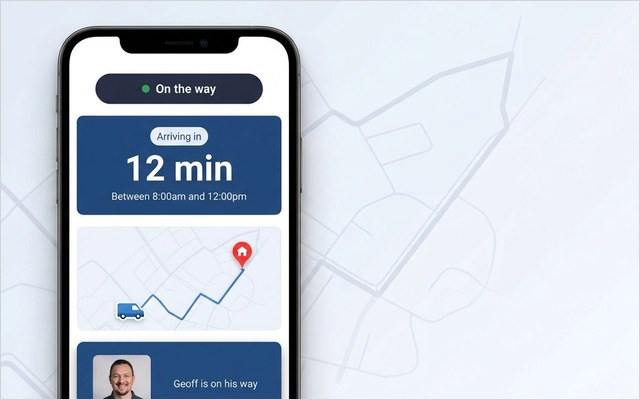
- Appointment tracking. A live ETA so the customer can see the engineer approaching, instead of phoning to ask.
- Self-service rebooking. The customer moves their own annual service in seconds, removing a whole category of contact-centre work.
- Proactive reminders. Confirmations and day-before nudges that cut no-shows, which matters acutely for an annual visit a customer booked months ago.
- Real-time feedback. An NPS or CSAT prompt straight after the visit, so a problem surfaces while it’s still fixable.
The results from enterprise deployments are consistent. Bosch UK, running around 350 field engineers, cut ETA-related calls to its contact centre by 53% and lifted engagement with its appointment communications to 79% after adding self-service tracking and rebooking on top of its existing WFM. Hand the customer a live ETA and a self-service button and most of the reasons they used to phone fall away, while the people who do get in touch are calling about something that matters. This is the angle field-service customer experience takes as a discipline, and it’s the wedge that separates an enterprise gas operation that merely schedules well from one that customers actually rate.
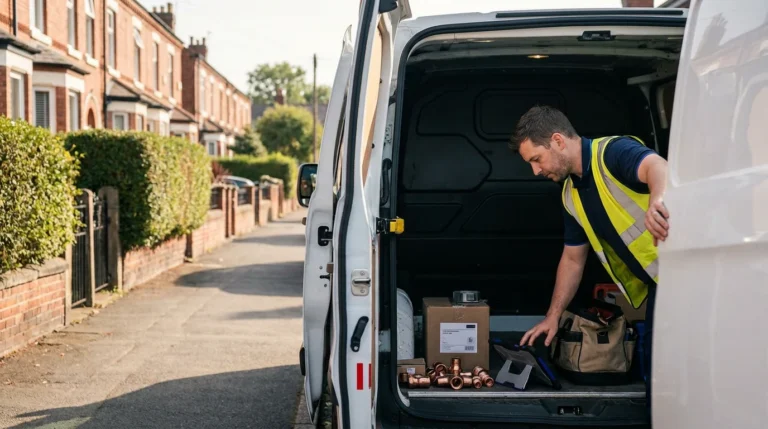
There’s a first-visit dividend too. When the right appliance history and parts information reach the engineer before arrival, more jobs are fixed on the first visit — and few things damage a heating customer’s experience (or your cost line) like a second or third trip for the same fault. Improving first-time fix rate is both a CX win and an operational one: the fix that pleases the customer is the same fix that takes a return trip off the cost line.
See it on your operation. On My Way adds live appointment tracking, self-service rebooking and instant feedback on top of your existing scheduling and WFM — no rip-and-replace, live in 4–6 weeks. Book a demo and we’ll show it against your own appointment workload.
How to choose a gas engineer software platform
The right choice depends almost entirely on your scale. Run through these questions in order.
- Sole trader or enterprise operation? A solo engineer needs an all-in-one tool that replaces the diary, certificate pad and invoice book. An enterprise needs software that integrates with the systems it already runs rather than replacing them. Buying the wrong tier is the most common and most expensive mistake.
- How does it handle compliance? Confirm it produces every certificate you issue (CP12, CP14, CP6 and commissioning records), enforces Gas Safe qualification checks in scheduling, and gives you a searchable audit trail. For a regulated, high-volume operation this is the floor, not a feature.
- Does the mobile app work offline? If engineers lose data on site and can’t capture a certificate, the whole system stalls. Test this on a real job, not in a demo with full signal.
- What does it do for the customer? Most platforms stop at the office and the engineer. Ask specifically about appointment tracking, self-service rebooking, reminders and feedback — the capabilities that cut no-shows and inbound calls. If the platform ignores the customer, you’ll need a field-service customer experience layer alongside it.
- Will it fit your existing stack? For enterprises, the question is whether it integrates cleanly with your WFM, ERP and contact centre — ideally without forcing you to abandon a scheduling engine that already works. The lower-risk path is to add the customer-facing layer on top of your current systems rather than replace core software mid-operation.
If your work is specifically heating and HVAC, the same logic applies with sector detail in our guides to field service for heating and HVAC and dedicated HVAC software — gas certification is one part of a broader heating-service operation, and the customer-experience principles carry straight across.
A note on where the market is heading. The global field service management market is forecast to grow from USD 5.10 billion in 2025 to USD 9.17 billion by 2030 (a 12.5% CAGR, per MarketsandMarkets), and most of that investment is flowing into scheduling, routing and engineer mobility. The customer-facing layer remains comparatively under-served — which, for an enterprise heating operation, is precisely where the easiest competitive gains still sit.
Frequently asked questions
What is gas engineer software? It’s a job-management platform for heating and gas businesses that handles scheduling and dispatch, gives engineers a mobile app for on-site job sheets and digital gas certificates (including the CP12), and manages parts, invoicing and compliance records. At enterprise scale it integrates with a workforce-management system and adds a customer-communication layer for appointment tracking and self-service.
Can gas engineer software create CP12 certificates? Yes. Most gas certificate software lets a Gas Safe registered engineer complete a CP12 (Landlord Gas Safety Record) on a mobile app, pre-filled with the property and appliance details, then generate, store and send it to the customer the same day. The wider record set — CP14 warning notices, CP6 service checklists and commissioning sheets — works the same way.
Is a CP12 a legal requirement? For landlords, yes. Under the Gas Safety (Installation and Use) Regulations 1998, every let property’s gas appliances, fittings and flues must be checked annually by a Gas Safe registered engineer, and the tenant must receive a copy of the record within 28 days. The certificate is valid for 12 months, and non-compliance is a criminal offence. Software doesn’t change the obligation — it makes the record-keeping instant and auditable.
Do gas engineers need to be Gas Safe registered to use the software? The software is open to any business, but only a Gas Safe registered engineer may legally carry out gas work or issue a gas safety certificate in the UK. Good software enforces this by checking an engineer’s registration and ACS competencies in scheduling, so a gas job is only dispatched to a qualified person. More than 123,000 engineers are currently on the Gas Safe Register.
What’s the difference between gas engineer software for sole traders and for enterprises? A sole-trader tool is an all-in-one replacement for the paper diary, certificate pad and invoice book. An enterprise platform — for utilities, social housing, national contractors or manufacturers’ service arms — has to integrate with existing WFM, ERP and contact-centre systems, handle compliance audit at high volume, and increasingly add a customer-communication layer. Buying the wrong tier for your scale is the most common mistake.
How does gas engineer software reduce no-shows and inbound calls? By adding a customer-communication layer on top of scheduling: live appointment tracking, self-service rebooking, automated reminders and post-visit feedback. These remove the reasons customers phone in (uncertainty about timing) and the reasons they miss appointments (no reminder, no easy way to move it). At Bosch UK this cut ETA-related calls to the contact centre by 53% and lifted engagement with appointment communications to 79%.
Can you add a customer-experience layer without replacing your scheduling system? Yes — and for an enterprise this is the lower-risk path. A customer-facing layer such as On My Way sits on top of whatever WFM you already run (Oracle, IFS, SAP, ServiceMax, Salesforce), adding tracking, self-service and feedback without disrupting dispatch. Go-live is typically 4 to 6 weeks, against the months and risk of replacing a core scheduling engine.
References
- Gas Safe Register — Official list of Gas Safe registered businesses (number of registered engineers; role and remit)
- HSE — Gas Safety (Installation and Use) Regulations 1998 / Gas Safe Register.
- Gas Engineer Software (GES) — CP12 Gas Safety Certificates: A Complete Guide (CP12 / LGSR, 28-day rule, 10-month window)
- WarmZilla — Do UK Landlords Need a CP12 Gas Safety Certificate? (annual requirement, penalties)
- AnglianPHE — UK Boiler Statistics 2025 (23m boilers, ~1.5m installed/yr, ~130k Gas Safe installers)
- MarketsandMarkets — Field Service Management Market worth $9.17 billion by 2030.
- Aquant — 2024 Field Service Benchmark Report (average first-time fix rate 76%; top 87%, bottom 55%)
- NetSuite — Field Service Customer Experience (74% of field workers say expectations are higher; 73% want a more personal touch)
- On My Way / Leadent Digital — enterprise deployment data (appointment-change volume; client outcomes).

Keep your WFM. Upgrade what your customers experience.
On My Way is the customer-experience layer for field service: live arrival tracking, self-service rebooking, notes and photos, and feedback — added on top of the scheduling system you already run. No rip-and-replace, live in 4–6 weeks.