Customer Experience Software for Service Teams: A Buyer’s Guide
You already run a workforce management system and the schedule is optimised, yet customers still ring all day to ask where the engineer is. So the question lands on your desk: would customer experience software fix this, and which kind is actually built for field service?
Quick answer: Customer experience software captures feedback, maps journeys and manages what customers feel about your service. For field service teams, the highest-value CX software is the layer that instruments the appointment itself. That is how Bosch UK achieved 53% fewer technician-location and ETA-related calls across a field force of roughly 350 engineers.
Key takeaways
- Customer experience software covers four jobs: voice of the customer capture, journey analytics, experience management and communications orchestration.
- Enterprise suites such as Qualtrics and Medallia are strong on digital-first journeys; they were not designed to instrument the in-person appointment, where field service experience is won or lost.
- Service organisations should score any shortlist against four criteria: appointment-native feedback, real-time capture, integration with the WFM flow and white-label delivery.
- The results are measurable: Bosch UK recorded 53% fewer technician-location and ETA-related calls and 79% higher customer engagement with appointment comms.
- On My Way underwrites the outcome: 35% fewer appointment-related calls within 90 days of go-live, or Leadent keeps working free of charge until the target is hit.
What does customer experience software actually cover?
Customer experience software is the tooling an organisation uses to measure, understand and improve how customers experience its service, and in practice the category spans four jobs. Feedback capture comes first: surveys, NPS and CSAT collection, usually grouped under voice of the customer. Journey analytics stitches interactions together to show where customers stall or drop out. Experience management routes what you learn to the people who can act on it and closes the loop with the customer. Communications orchestration coordinates the messages customers receive along the way.
Vendors label these capabilities loosely. You will see customer experience management software, customer experience platform and CX tools used almost interchangeably, which makes shortlisting harder than it should be. The label matters less than the coverage: which moments get measured, how quickly, and who can act on the result. The stakes are well documented; Salesforce finds 80% of customers say the experience a company provides is as important as its products and services.
Field service adds a complication most of the category ignores: much of your customer experience happens in person, at the customer’s home or site, with no screen involved. Our pillar guide to field service customer experience maps that full journey; this article is about choosing the software.
CX software or customer engagement software: which are you shopping for?
They are different categories, and separating them will save you a procurement cycle. Customer experience software measures and manages the experience: it tells you what customers felt, where the journey broke and whether your fixes worked. Customer engagement software is the communication layer: the confirmations, tracking links and two-way messages that shape the experience as it happens. We cover the second category in our guide to customer engagement software.
In field service the two converge, because the message that lets a customer move an appointment is also what prevents the no-show, and a feedback prompt only earns a response if it reaches the customer while the visit is fresh. Buy measurement and communication as one layer and the data flows end to end; buy them separately and you will spend the integration budget reconnecting them.
The enterprise suites: what Qualtrics and Medallia do well
Qualtrics built its reputation on survey design and experience analytics across customer and employee programmes. Medallia is strong at capturing experience signals at scale across web, app and contact-centre channels. For a bank, a retailer or a software business, both map well onto how customers actually interact with the brand.
Notice the design assumption, though: digital-first. A customer experience platform of this generation grew up instrumenting websites, apps and call recordings, with email surveys sweeping up sentiment after the event. That model works when the experience itself happens on a screen. A field service visit does not. The experience is a person arriving at a door, and a survey email three days later measures a memory, not a moment.
The gap matters more each year because field service is scaling fast: MarketsandMarkets values the field service management market at USD 5.10 billion in 2025, heading for USD 9.17 billion by 2030. The scheduling and dispatch layer is getting heavy investment. The experience layer around the appointment has lagged behind it.

The appointment moment: what digital-first CX tools miss
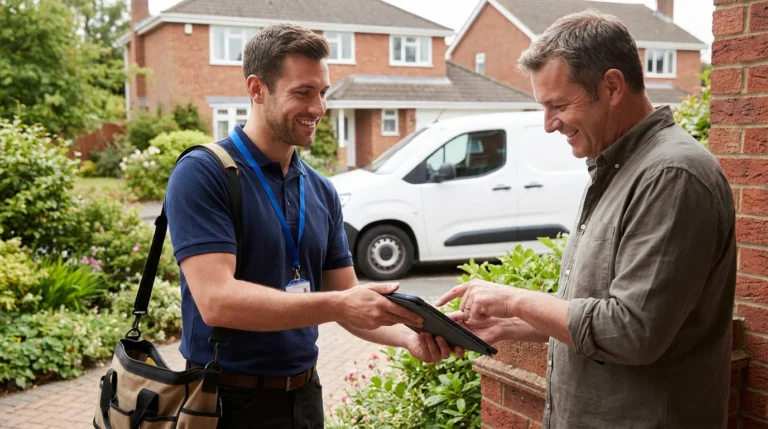
In field service the experience is decided in person, during the appointment, and that is precisely the window most digital-first platforms cannot see. Consider what the customer goes through: a wait window that can hold them at home for half a day, uncertainty about whether anyone is coming, an arrival, a fix or a follow-up visit. None of it produces a web session or an app event for a suite to capture.
The blind spot shows up in the contact centre first. Analysis of On My Way enterprise deployments shows that between 30% and 40% of appointments are changed by the customer before the engineer arrives, and where no self-service route exists, each of those changes reaches you as a phone call. A digital-first CX programme will not log any of that as an experience failure. Your agents will spend their day handling it anyway.
Repeat visits deepen the problem. Aquant’s 2024 benchmark puts the average first-time fix rate at 76%, with top performers at 87% and bottom-quartile organisations at 55%; when the first visit fails, resolution takes an average of 2.7 visits and adds roughly 13 days. Every extra visit re-runs the wait window and the uncertainty, and a quarterly survey programme cannot attribute the resulting detractor score to the third visit that caused it.
Measurement is its own discipline here. If you are still deciding what to track, our guide to customer satisfaction metrics covers NPS, CSAT and effort scores properly. The short version: the score matters less than the moment you capture it.
Want to see appointment-level experience data from your own operation? Book a 30-minute working session, no slide deck: bring your appointment volumes and we will map where the calls and detractors come from. Request a demo, or read how it works first.
Buying criteria: choosing customer experience tools for field service
Four criteria separate software that will move your numbers from software that will decorate a dashboard. Put them in the RFP and score every vendor against them.
1. Appointment-native feedback
Feedback should be captured against the job, not just the brand. That means NPS or CSAT collected as the visit closes, tied to the job reference and the technician who attended, so a poor score is actionable the same day rather than anonymous at month-end. This is the model behind our customer feedback capability: the prompt follows the appointment automatically and responses land in real time.
2. Real-time capture and routing
Batch surveys produce reports; real-time capture produces interventions. If a customer scores a visit badly at 11am, the right area manager should know before the end of the day, with the job context attached. Ask every vendor to demonstrate the elapsed time between a customer submitting feedback and a named owner seeing it.
3. Integration with the WFM flow
A field service CX layer is only useful if it reads from the system that runs the schedule. On My Way sits on top of Oracle Field Service, Salesforce Field Service, Microsoft Dynamics 365, IFS, SAP and ServiceMax, taking appointment data straight from the WFM so tracking, messages and feedback always reflect the live schedule. Contact centre agents see the same picture through Contact Centre View, a Premium option that needs no WFM licences. Keep your WFM; upgrade the layer your customers actually touch.
4. White-label, with nothing to install
Customers should see your brand, not your vendor’s, and they should never need an app. On My Way runs white-label in the customer’s browser, with messages delivered over SMS and email through Twilio, Boomerang or the Leadent SMS Gateway. Self-service is now the default expectation: Document360’s research roundup reports that 88% of customers expect an online self-service option. Rebooking and cancellation belong in that channel, not in a phone queue.
One further gate for IT before anything reaches the shortlist: single sign-on via Microsoft Entra ID, role-based access control, encryption, regional data residency and GDPR compliance should be standard answers, not roadmap items.

What results should you expect, and how fast?
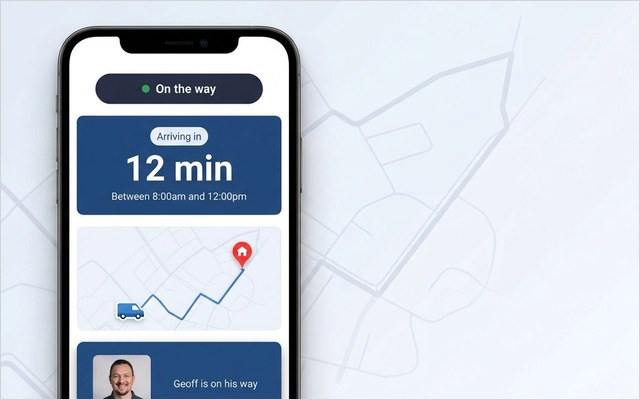
Expect measurable call deflection within a quarter, or question the purchase. On My Way’s deployment at Bosch UK instrumented the whole appointment journey: live technician tracking with an accurate ETA, self-service rebooking and cancellation, real-time NPS capture after each visit, and relevant offers presented while the customer is already engaged with the appointment. The outcome across roughly 350 engineers: 53% fewer technician-location and ETA-related calls and 79% higher customer engagement with appointment comms.
Hold three numbers apart when you build the business case — the contractual guarantee, the typical range and any one client’s measured result. The guarantee is a 35% reduction within 90 days of go-live, with Leadent working on at no charge if a deployment falls short. Typical deployments land between 40% and 55%. Bosch UK’s actual result was 53%. Set the internal case at the guarantee floor and treat anything above it as upside.
Timescales are short by enterprise standards: go-live typically takes 4–6 weeks because nothing in the WFM estate is replaced, and a 6-week pilot is available if you want evidence from your own customers before committing. Pricing is per technician, with an appointment-volume model for large estates; request a quote and you will get a figure built on your actual numbers rather than a rate card.
Frequently asked questions
Do we need Qualtrics or Medallia before adding an appointment layer?
No. They solve different problems and can run side by side. If you already own an enterprise suite, an appointment layer becomes a high-signal feedback source feeding it. If you do not, appointment-level capture is the faster route to usable experience data in a field service business.
What is voice of the customer software?
Voice of the customer software collects and analyses customer feedback across channels: surveys, reviews, call notes and messages. In field service the highest-signal moment for voice of the customer capture is immediately after the visit, while the experience is minutes old and the job reference is still attached to the response.
How is appointment-level feedback different from email surveys?
Timing, attribution and response quality. An email survey days after the visit measures a fading memory and rarely links cleanly to the job or the technician. Feedback requested as the appointment closes reaches the customer at peak recall and lands in your data tied to a specific visit, which is what makes it operational rather than decorative.
Will a CX layer disrupt our workforce management system?
It should not touch it. On My Way reads appointment data from the WFM and adds tracking, messaging, self-service and feedback on top; scheduling and dispatch logic stay exactly where they are. The customer side is browser-based with no app to install, which is also why adoption holds up.
How much does customer experience software cost?
Enterprise CX suites price by module, volume and contract, and published figures are rare, so budget through a formal quote. On My Way is priced per technician, with an appointment-volume option for large organisations; request a quote and you will get a number based on your field force size.
The bottom line
For a digital-first business, the established suites are a sound choice. For a field service operation, the experience is decided at the appointment, so the customer experience software that pays back first is the layer that instruments the appointment itself: live tracking, self-service and feedback captured while the van is still on the street. Measure that moment well and every other CX investment gets sharper.
Ready to put numbers against your own appointment journey? Request a quote and book a demo: we will run it on your appointment volumes and your existing WFM rather than a slide deck. If you want the mechanics first, how it works walks through the journey step by step.
References
- MarketsandMarkets — Field Service Management Market Press Release (2025)
- Aquant — Field Service Benchmark Report (2024)
- Salesforce — Customer Service Statistics, State of the Connected Customer (2024)
- Document360 — Self-Service Statistics (2024)
- On My Way / Leadent Digital — enterprise deployment data (appointment-change volume; client outcomes).

Keep your WFM. Upgrade what your customers experience.
On My Way is the customer-experience layer for field service: live arrival tracking, self-service rebooking, notes and photos, and feedback — added on top of the scheduling system you already run. No rip-and-replace, live in 4–6 weeks.