Digital Customer Experience in Field Service
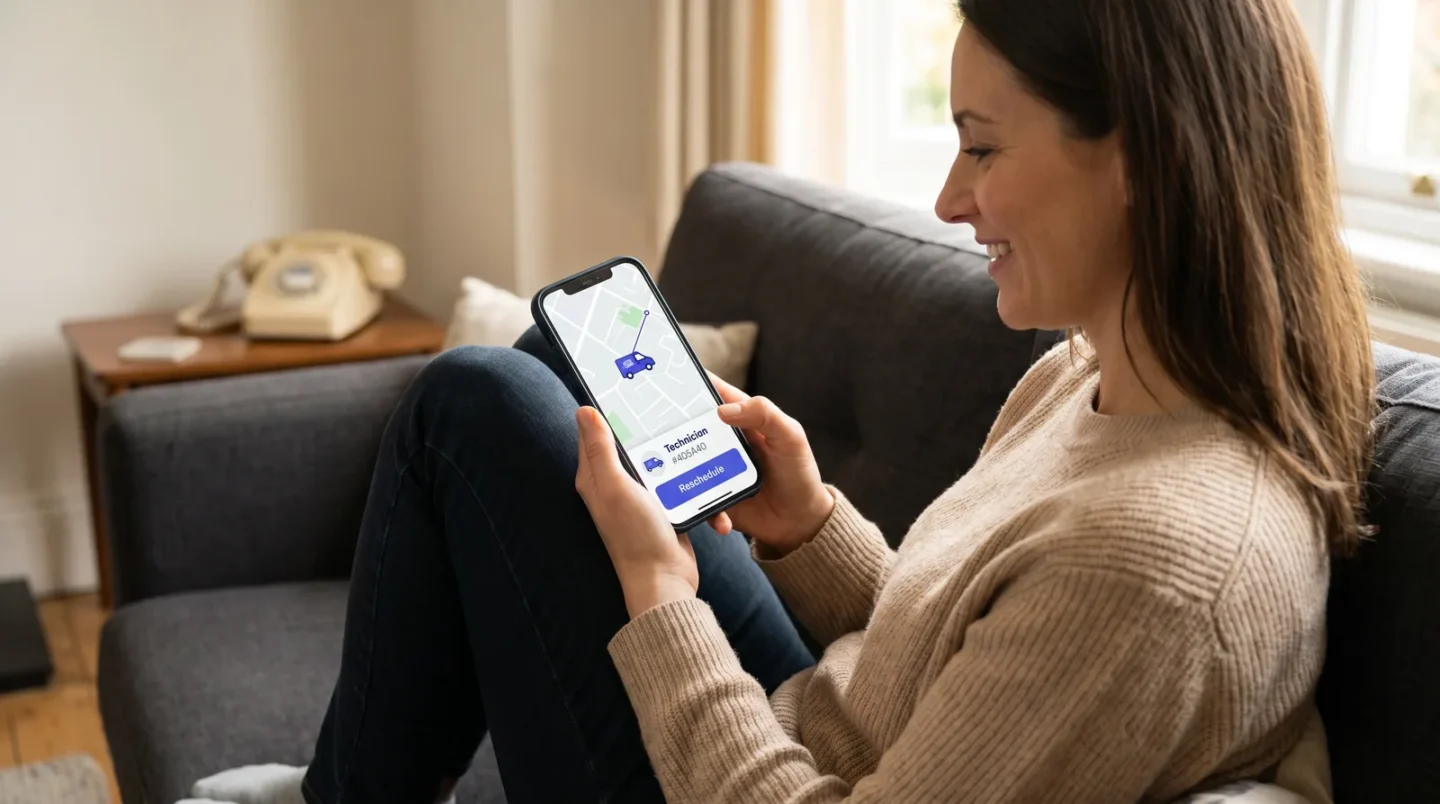
Your customer booked a four-hour window and took the morning off work. By half past nine they have no idea whether anyone is coming, so they do the only thing left to them and phone the contact centre. That call, multiplied across thousands of appointments a week, is the clearest sign of a field-service operation that has digitised its scheduling but not its customer experience.
Quick answer: Digital customer experience (digital CX) is the sum of every interaction a customer has with you through digital channels. In field service, those interactions cluster around one event — the appointment. It runs from basic SMS notifications, through real-time tracking, to full self-service and feedback, delivered without a phone call.
What is digital customer experience in field service?
Digital customer experience is the part of the customer relationship that happens through screens rather than people: the messages, the tracking, the self-service, the feedback prompts. Digital customer experience management is the discipline of designing and improving those touchpoints deliberately, so the sum builds trust instead of friction.
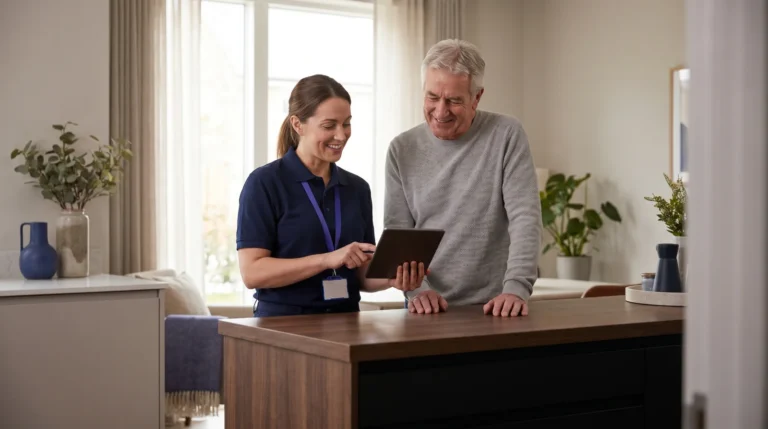
Most definitions of digital CX were written with retail and banking in mind, where the journey is almost entirely online. Field service breaks that assumption. The defining interaction is physical, a named person arriving at a customer’s home, at an agreed time, to fix something that matters, and everything digital exists to support that visit. So here it is not a website project but the work of wrapping the appointment in digital touchpoints, so the customer feels in control from booking to feedback.
The bar has been set elsewhere. A customer who can watch a £4 parcel cross a map in real time does not understand why the engineer attending a £400 repair is invisible. Your benchmark is not the operator down the road; it is the last good digital experience your customer had with anyone.
From phone calls to self-service: a maturity model
Digital CX in field service matures in three tiers, and most operations can place themselves on the curve within a minute. The progression runs from telling the customer things, to showing them, to letting them act.
53% — the reduction in ETA-related calls Bosch UK, a 350-engineer UK enterprise HVAC operation, achieved after adding real-time tracking and self-service to its appointments, alongside 79% customer engagement.
Tier 1 — Basic: proactive notifications
The first rung is communication that goes out without being asked for: a confirmation, a reminder the day before, a “your engineer is on the way” message. It sounds modest, and it is one of the highest-value moves in field-service CX. Where operations are still reactive — the customer has to chase — closing that gap with proactive automated SMS and email updates removes a large share of avoidable contact. Cheapest tier to reach, fastest to pay back.
Tier 2 — Intermediate: real-time tracking
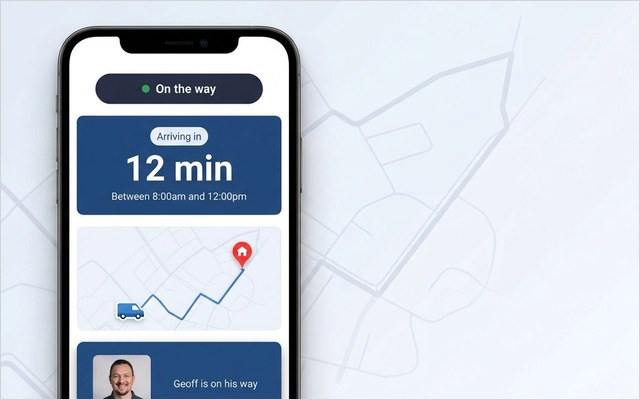
Next comes a live answer in place of “sometime this morning”. Real-time tracking lets the customer watch the engineer’s estimated arrival on a map and receive a “20 minutes away” alert — the same visibility they take for granted from a food-delivery app. This is where the “where’s my engineer?” call disappears, because the customer can answer the question themselves. Live technician tracking turns the most anxious window of the journey into something the customer can trust.
Tier 3 — Advanced: self-service, feedback and campaigns
The top rung hands the customer control. Self-service lets them rebook, cancel or confirm a visit in seconds without phoning anyone, and real-time feedback captures how it went while the visit is still fresh and still recoverable. Because the customer is already in a branded digital space around the appointment, that space can also carry a well-timed message — a service-plan reminder, a related offer. At this tier the appointment stops being a cost to manage and becomes a channel that informs, retains and occasionally earns. The point is not to reach the top overnight, but to climb deliberately — each tier removes a category of friction and a category of cost at once.
These four touchpoints, notifications, tracking, self-service and feedback, are the spine of the service visit, and a digital experience is only as good as its weakest one. Get three right and fumble the fourth, and the fumble is what the customer remembers. They all converge on a single moment.

Why the appointment is the moment of truth
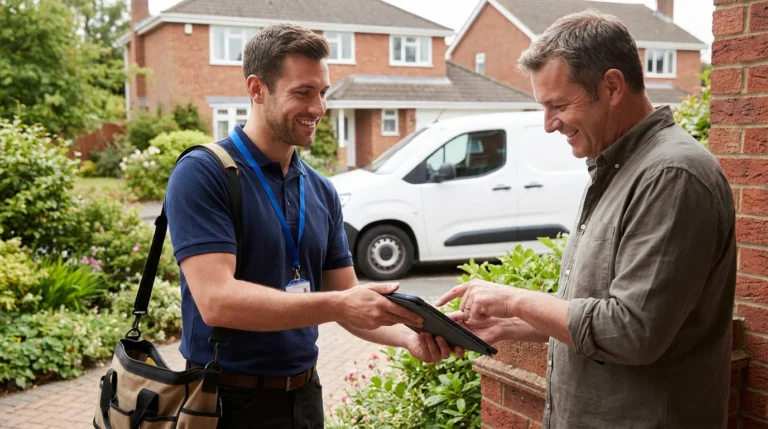
Your brand is decided at the door. A customer’s impression of an energy supplier, a manufacturer or a telecoms provider is rarely formed by an advert; it is formed by whether the engineer arrived when promised, kept them informed, and fixed the fault first time.
The appointment is also where the cost hides. By On My Way’s internal research into “the appointment problem”, 30 to 40 per cent of appointments are changed by the customer and 10 to 15 per cent are cancelled, with each change tending to generate a five-to-seven-minute call, frequently after hours. Add the customers who phone simply to ask when the engineer will arrive, and much of contact-centre volume turns out to be questions a good digital experience answers without a human.
Costs run past the phone, too. When a first visit fails, the average job needs 2.7 visits in total and takes an extra 13 days to resolve, according to the Aquant Field Service Benchmark (2024). A failed appointment is a CX failure and a cost failure in the same breath, which is why getting the digital touchpoints right pays back on both counts at once.
Measuring digital CX
You manage what you measure, and digital CX is measurable on two sides: how the customer felt, and how the operation performed. On the experience side, two metrics carry the load: NPS (Net Promoter Score), captured immediately after the visit, and CSAT (Customer Satisfaction) for that specific appointment. On the digital-performance side, engagement tracks the share of customers actually using the touchpoints (the 79 per cent in the HVAC deployment above is this metric, and it is the leading indicator, since nothing else improves if customers do not use the channel), while call-deflection rate captures the routine enquiries handled digitally rather than by an agent.
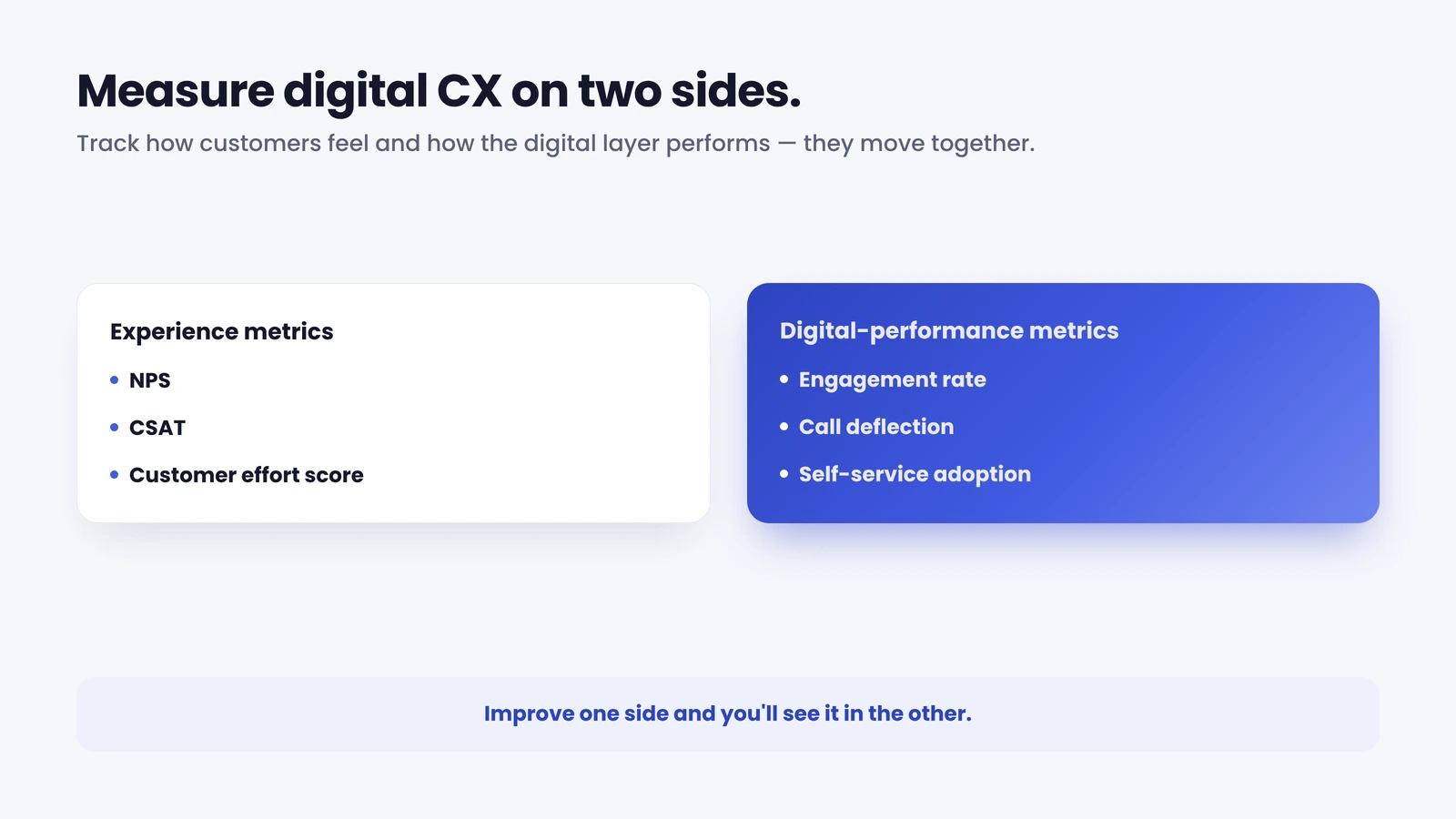
What makes the effort worthwhile is the correlation between the two. When a customer uses real-time tracking and the visit lands first time, the post-appointment NPS is measurably higher — same engineer, same outcome, better experience, purely because the customer had visibility and control. For more, see our guides to customer satisfaction metrics and field service customer experience.
The ROI of digital CX
Digital CX is unusually easy to defend on the numbers, because the same intervention improves the experience and cuts the cost. The field service management market is forecast to climb from $5.10 billion in 2025 to $9.17 billion by 2030, a 12.5 per cent compound annual growth rate, according to MarketsandMarkets (2025). Yet most of that spend goes into scheduling engines and technician apps; the customer-facing layer is where the unspent advantage sits.
Across enterprise deployments the pattern holds. Beyond the HVAC operation’s 53 per cent fall in ETA calls, Foxtel reduced no-shows by 38 per cent through reminders and easy rescheduling, and E.ON lifted appointment-based first-time job completion by 19 per cent by getting the right information to the engineer before the visit. The numbers vary by sector; the mechanism does not.
Typical call reduction lands in the 40 to 55 per cent range within the first months. That repeatability is why On My Way underwrites a 35 per cent reduction in appointment-related calls within 90 days, or it keeps working at no cost until the figure is hit. The 35 per cent is the guaranteed floor, not a forecast — the typical result runs higher, and the HVAC operation’s 53 per cent is what a mature deployment looks like.
Getting started
Improving digital CX is a sequence, and the maturity model gives you the order.
Baseline the experience. Tag two weeks of inbound contact and bucket it — ETA enquiries, rescheduling, post-appointment, other. Most operations are surprised how much sits in the first two buckets, which is exactly the volume digital self-service removes.
Climb the tiers in order. Fix proactive notifications first (fastest payback), add real-time tracking next (the biggest single deflection win), then self-service rebooking and real-time feedback, where the experience becomes customer-led.
Layer it on, don’t rip and replace. A browser-based customer layer — no app for the customer to install — sits on top of whatever WFM you already run and adds the digital experience without disrupting the operation underneath. That is the model On My Way is built on; see how On My Way works end to end.
See it on your operation. On My Way adds real-time tracking, self-service rebooking and instant feedback on top of your existing WFM — no rip-and-replace, live in four to six weeks. Book a 30-minute working session, no slide deck.
Frequently asked questions
What is digital customer experience?
Digital customer experience is the sum of every interaction a customer has with an organisation through digital channels — messages, tracking, self-service, feedback and the rest. In field service those interactions cluster around the appointment: confirming it, showing its progress, letting the customer change it, and capturing how it went.
How is digital CX different in field service?
Most digital CX is entirely online and remote. Field service digital CX exists to support a physical event — an engineer arriving at someone’s home or premises — so it is organised around the appointment rather than a website or an app. That makes notifications, real-time tracking and first-time fix the dominant factors, and gives the “where’s my engineer?” question no equivalent in a purely online journey.
How do you measure digital CX?
On two sides at once. Experience metrics — NPS and CSAT, captured immediately after the visit — tell you how it felt. Digital-performance metrics — engagement (how many customers use the channel) and call-deflection rate (how many routine enquiries are handled without an agent) — tell you whether it works operationally. The most useful insight correlates the two: customers who use live tracking tend to report higher NPS.
What is the fastest digital CX win in field service?
Proactive notifications, then real-time tracking. Reminders are the cheapest tier to reach and immediately cut avoidable contact, while live tracking is the single biggest deflection win — it answers the “where’s my engineer?” question before the customer has to ask. Enterprise deployments typically see appointment-related calls fall by 40 to 55 per cent.
Do you need to replace your WFM to improve digital CX?
No. A customer-facing experience layer sits on top of your existing workforce-management system — Oracle, IFS, SAP, ServiceMax, Salesforce, Dynamics 365 and others — adding notifications, tracking, self-service and feedback without disrupting scheduling or dispatch. It is far faster and lower-risk than a platform migration, and it is how an operation climbs the maturity model.

The bottom line
Digital customer experience in field service comes down to one discipline: treat the appointment as the moment that defines your brand, and wrap it in digital touchpoints that keep the customer in control. Climb the maturity model in order, notifications, tracking, then self-service and feedback, and the experience and the cost line improve together rather than trading off against each other. None of it requires replacing the systems you already run.
References
- MarketsandMarkets — Field Service Management Market. Field service management market valued at $5.10 billion (2025), forecast $9.17 billion by 2030, 12.5% CAGR. 2025
- Aquant — Field Service Benchmark Report. Average first-time fix rate 76%; a failed first visit averages 2.7 total visits and adds 13 days to resolution. 2024
- On My Way / Leadent Digital — internal research, “the appointment problem”: 30–40% of appointments changed by the customer, 10–15% cancelled, each change ≈ a 5–7-minute call, usually after hours. Enterprise deployment outcomes (appointment-change volume; client results).

Keep your WFM. Upgrade what your customers experience.
On My Way is the customer-experience layer for field service: live arrival tracking, self-service rebooking, notes and photos, and feedback — added on top of the scheduling system you already run. No rip-and-replace, live in 4–6 weeks.