IFS Cloud and Field Service: What You Need to Know

When IFS folded IFS Applications, IFS FSM and IFS PSO into one product, field service operators were left with a fair question: what actually changed? Is IFS Cloud a rebadge of tools that already existed, or a different platform with different implications for how you run service? This guide sets out the answer for teams who run IFS today or are weighing it against the alternatives.
Quick answer: IFS Cloud, launched in 2021, is IFS’s unified platform: ERP, enterprise asset management and service management in one product, with PSO scheduling built in. It runs the operational side of field service to a high standard. The customer-facing appointment experience, from live tracking to self-service rebooking, is a layer you add on top.
Key takeaways
- IFS Cloud unified IFS’s ERP, asset management and field service products into a single platform in 2021, updated through two feature releases a year plus monthly service updates.
- Scheduling is the standout strength: IFS PSO re-optimises the plan continuously, which is why asset-heavy industries and complex service organisations rate the platform.
- MarketsandMarkets values the field service management market at USD 5.10 billion in 2025, heading for USD 9.17 billion by 2030, and lists IFS among the major vendors.
- Like every enterprise WFM, IFS Cloud is built to run the operation; live tracking, self-service rebooking and real-time customer feedback sit in a layer above it.
- Bosch’s multi-country European operation cut ETA-related calls 35% by adding On My Way as that customer layer, with no change to the scheduling underneath.
What is IFS Cloud?
IFS Cloud is the single platform IFS launched in 2021 to replace its previously separate product lines: IFS Applications for ERP, IFS FSM for service management and IFS PSO for scheduling optimisation. Instead of three products with three data models, there is one product, one data model and one user experience, with capabilities switched on as an organisation needs them.
The company behind it matters here. IFS is a Swedish-founded enterprise software firm with a deliberate industry focus: energy and utilities, telecoms, aerospace and defence, construction, manufacturing and service industries. That focus shows in the product. Where horizontal platforms treat field service as one workload among many, IFS puts service management near the centre of the whole proposition.
The commercial context supports the positioning. MarketsandMarkets values the global field service management market at USD 5.10 billion in 2025, projected to reach USD 9.17 billion by 2030, and its 2025 analysis lists IFS among the market’s major vendors alongside Salesforce, Oracle, SAP and Microsoft. Anyone evaluating IFS field service capability is not looking at a niche player.
The field service heritage behind IFS Cloud
IFS did not arrive at field service recently; it bought and built its way in over more than a decade. The engine now sold as IFS PSO, short for Planning and Scheduling Optimisation, came with the acquisition of 360 Scheduling in 2010. Astea, a service management vendor with a large installed base, followed in 2019, and Clevest added mobile workforce technology for utilities in 2020. Alongside the acquisitions, IFS FSM matured into one of the more complete dedicated field service products on the market, covering work orders, contracts, warranty and reverse logistics.
Those threads now converge in IFS Cloud, which IFS positions as its flagship going forward. Organisations on standalone IFS FSM or older IFS Applications releases will face the move at some point, on a timetable worth negotiating deliberately. PSO keeps a distinct life of its own: it can run embedded in IFS Cloud or as a standalone optimisation engine alongside another system of record, which is exactly how some large European service operations deploy it.

What IFS Cloud does well for field service
Three strengths stand out: scheduling depth, asset-centred data and fit for complex service organisations.
Scheduling and optimisation. IFS scheduling capability centres on PSO, which re-optimises the plan continuously as the day unfolds rather than fixing routes each morning. It weighs skills, parts, SLAs, travel time and appointment windows at once, and it supports scenario modelling for planners. For an operation dispatching hundreds of technicians, that is the difference between a plan that survives contact with the day and one that collapses by mid-morning.
Asset-centred operations. Because asset management and service management share one data model, a technician’s work order, the asset’s maintenance history and the contract governing response times connect natively. Utilities, energy firms and manufacturers servicing an installed base tend to value this most.
Complex service organisations. Multi-country operations, contract- and warranty-heavy businesses, and firms mixing field work with depot repair sit squarely in IFS territory. The performance stakes justify the tooling: Aquant’s 2024 Field Service Benchmark Report found that a service organisation’s weakest technicians can cost markedly more per job than its strongest — the performance gap disciplined scheduling exists to close.
Already running IFS PSO or IFS FSM? On My Way reads your existing schedule and adds the customer-facing layer on top, typically live in 4–6 weeks. See how the IFS integration works or book a demo.
IFS Cloud modules and the evergreen release model
IFS Cloud modules are licensed from a single platform rather than installed as separate products. Capabilities span ERP (finance, supply chain, projects, human resources), enterprise asset management (maintenance planning, asset performance) and service management (work order management, contracts, warranty, PSO scheduling and mobile tools for technicians). An operator can start with service management and switch on adjacent modules later without re-implementing.
The release model changed as much as the packaging. IFS Cloud follows what IFS calls an evergreen cadence: two feature releases a year, supplemented by monthly service updates, replacing the multi-year upgrade projects that defined the on-premises era. Customers choose between IFS’s managed cloud and their own infrastructure, and the release rhythm applies either way.
For operators, upgrades stop being events and become routine. That is genuinely useful, and it assumes a discipline of regression testing and release management that some IT teams need to build first.
Realistic considerations before you commit
IFS Cloud is an enterprise platform and carries enterprise implications. None of what follows is a criticism of IFS; the same points apply to SAP, Oracle or any system of comparable depth.
Start with implementation scale. Consolidating ERP, asset and service data into one model is a programme, not a project, and it involves sustained work on data quality, process design and integration with whatever remains around the platform. Organisations that treat the move as a technical swap tend to struggle; those that treat it as an operating-model change fare better.
Then there is the upgrade path. Estates on IFS Applications 9 or 10, or on standalone IFS FSM, face a move closer to re-implementation than upgrade, largely because historic customisations need rebuilding as configuration and extensions rather than carrying across as core modifications. That is healthier in the long run and demanding in the short run. Pressure-test estimates against your own customisation inventory before you commit.
Release discipline completes the list. The evergreen model rewards organisations that can absorb change twice a year. If your last upgrade took eighteen months, the operating rhythm needs attention before the software does.
Where IFS Cloud stops: the customer-facing appointment experience
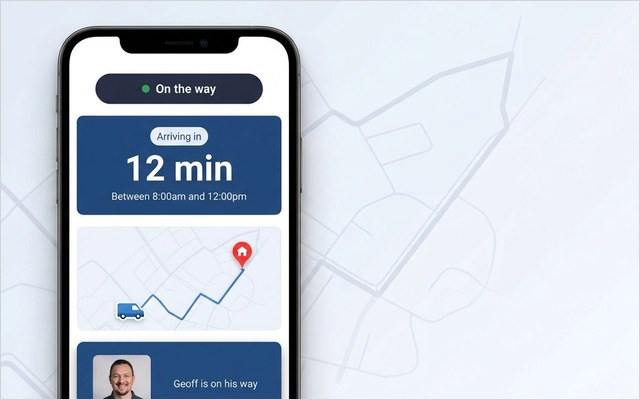
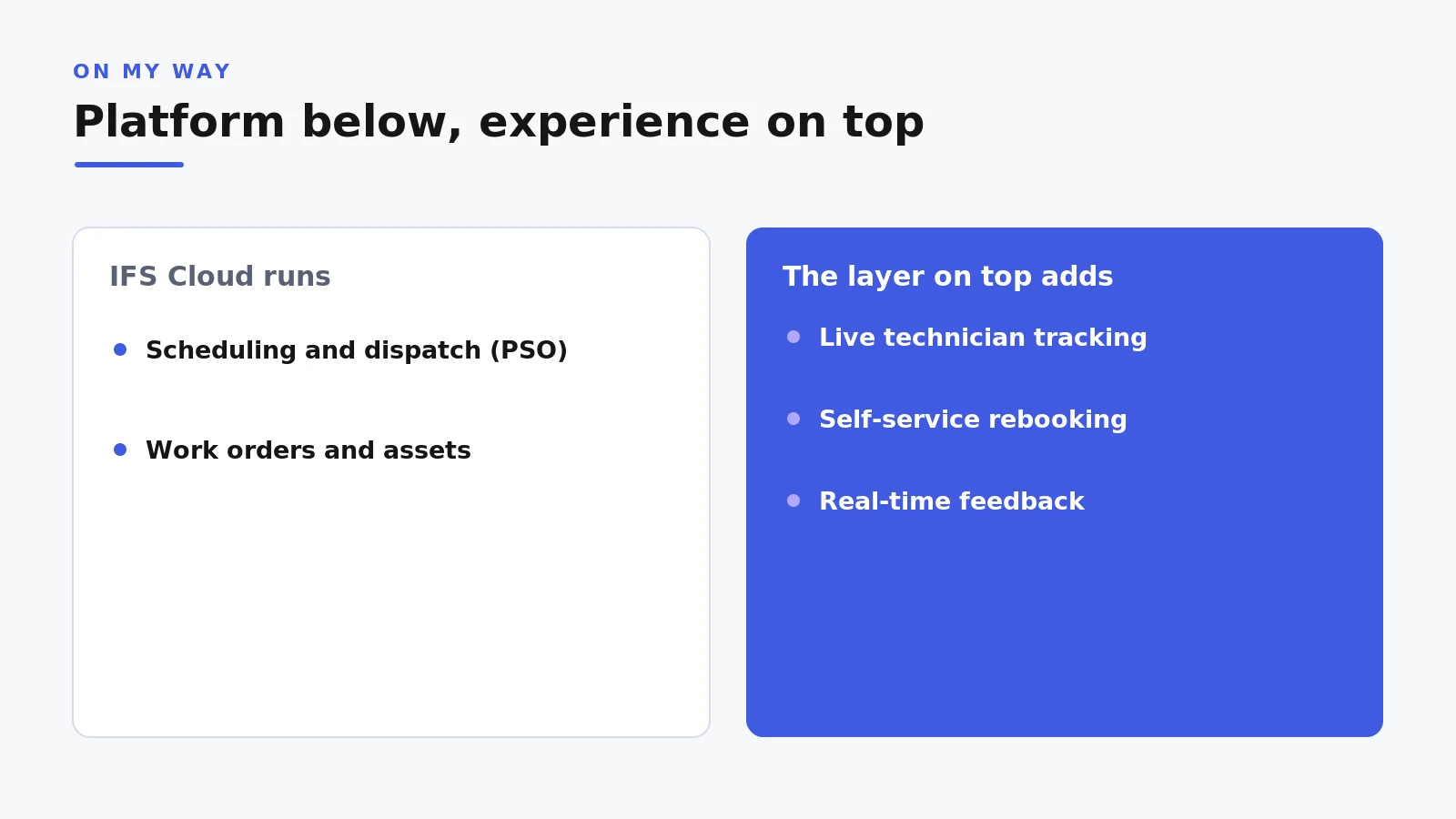
The distinction that matters most is this: IFS Cloud, like every enterprise workforce management system, is built to run the operation. Scheduling, dispatch, work orders, assets, parts, mobile execution: that is the job, and IFS does it with real depth. The experience your customer has while they wait sits outside that scope. Live technician tracking a customer can open on their phone, customer self-service for rebooking and cancellation, feedback captured in the moment: these belong to a layer above the WFM, whichever WFM you run.
The gap matters because appointments move. Across On My Way’s enterprise deployments, roughly one appointment in three changes in some way between booking and the day of service, and each change becomes a phone call unless customers can see and manage the appointment themselves. Expectations keep rising too: Salesforce’s 2024 research found 88% of customers say good service makes them more likely to buy again.
On My Way provides that layer, and it is deliberately WFM-agnostic: the same product runs on Oracle Field Service, SAP, Salesforce Field Service, Microsoft Dynamics 365 and IFS. The proof is specific: Bosch’s European operation cut ETA-related calls 35% after adding On My Way over its existing IFS-based scheduling. Nothing changed in the PSO deployment; the customer layer changed. The connection itself is described on the IFS integration page.
Adding the layer on top of IFS scheduling
On My Way connects to the IFS schedule through APIs and leaves the optimisation logic alone. Customers get a browser-based experience with nothing to install: appointment confirmations by SMS and email (via Twilio, Boomerang or the Leadent SMS Gateway), live tracking with a realistic ETA on the day, and self-service booking, rebooking and cancellation that flows back into the schedule rather than into your call queue. Real-time NPS and CSAT capture close the loop while the visit is still fresh. The mechanics are set out on the how it works page.
Two details tend to matter for enterprise buyers. The whole customer side is white-label, so the brand on the tracking page is yours. And Contact Centre View, available on the Premium tier, gives contact centre agents the same live picture customers see without consuming extra WFM licences. Security follows the enterprise checklist: single sign-on through Microsoft Entra ID, role-based access control, encryption, regional data residency options and GDPR compliance.
Deployment is measured in weeks rather than quarters: a typical go-live takes 4–6 weeks, and a 6-week pilot is available for teams that want to prove the case on their own data first. Pricing works on a request-a-quote basis.
Frequently asked questions
What is the difference between IFS Cloud and IFS FSM?
IFS FSM is the long-standing standalone field service management product; IFS Cloud is the unified platform that now carries IFS’s service capability forward alongside ERP and asset management. Plenty of organisations still run FSM, but IFS positions IFS Cloud as the flagship, so FSM customers should plan the move on their own timetable rather than under pressure.
What is IFS PSO?
PSO stands for Planning and Scheduling Optimisation, IFS’s dynamic scheduling engine, acquired with 360 Scheduling in 2010. It continuously re-optimises technician schedules against skills, travel, parts and SLAs, and it runs either embedded in IFS Cloud or standalone alongside another system of record.
How often is IFS Cloud updated?
IFS Cloud follows an evergreen model: two feature releases a year plus monthly service updates. Customers plan when to adopt each release, and the model is designed to keep every deployment reasonably current rather than letting versions age for years.
Is IFS Cloud only for field service?
No. IFS Cloud spans ERP, enterprise asset management and service management, aimed at asset- and service-intensive industries such as utilities, energy, telecoms, aerospace and defence, and manufacturing. Field service is a strength within a broader platform rather than the whole product.
Does On My Way work with IFS Cloud?
Yes. On My Way is WFM-agnostic and runs on IFS Cloud, IFS FSM and standalone PSO deployments. It reads the schedule via API, adds live tracking, self-service and feedback for customers, and typically goes live in 4–6 weeks, with a 6-week pilot available.
The bottom line
IFS Cloud is a serious platform with genuine field service pedigree. PSO remains one of the strongest scheduling engines available, the unified data model suits asset-heavy service organisations, and the evergreen cadence takes the dread out of upgrades for teams prepared to manage it. Go in with clear eyes about implementation scale, and it will run your operation well. What it will not hand you out of the box is the appointment experience your customers actually see. That layer is a separate decision, and one you can take without touching the platform underneath.
See it on your WFM. Book a demo and we will show On My Way running against an IFS schedule, or start with the detail on the IFS integration page.
References
- IFS — IFS Cloud platform overview (2025)
- MarketsandMarkets — Field Service Management Market forecast (2025)
- Aquant — Field Service Benchmark Report (2024)
- Salesforce — Customer Service Statistics (2024)
- On My Way / Leadent Digital — enterprise deployment data (appointment-change volume; client outcomes).

Keep your WFM. Upgrade what your customers experience.
On My Way is the customer-experience layer for field service: live arrival tracking, self-service rebooking, notes and photos, and feedback — added on top of the scheduling system you already run. No rip-and-replace, live in 4–6 weeks.