Oracle Field Service: How to Add Customer Self-Service and Tracking
Quick answer: Oracle Field Service (OFS) is one of the strongest scheduling and routing engines in enterprise field service — AI-driven dispatch, real-time route optimisation, geofencing and a capable mobile app for technicians. What it isn’t built to be is a consumer-grade customer-experience product. Its native customer communication is a notification add-on, not a branded, fully self-service portal where the person waiting at home can track, reschedule and rate their own visit. You don’t need to replace OFS to close that gap. On My Way reads your appointment data through Oracle’s APIs and adds the customer-facing layer on top — live tracking, self-service rebooking, proactive notifications and feedback — typically live in four to six weeks, with the scheduling engine left exactly as it is.
Key takeaways
- Oracle Field Service is a leading dispatch and routing platform; the gap is on the customer side of the appointment, not the operational side.
- OFS does have a “Where’s My Technician” notification and a customer-communication module — but they sit short of the branded, end-to-end self-service customers now expect from every other service they use.
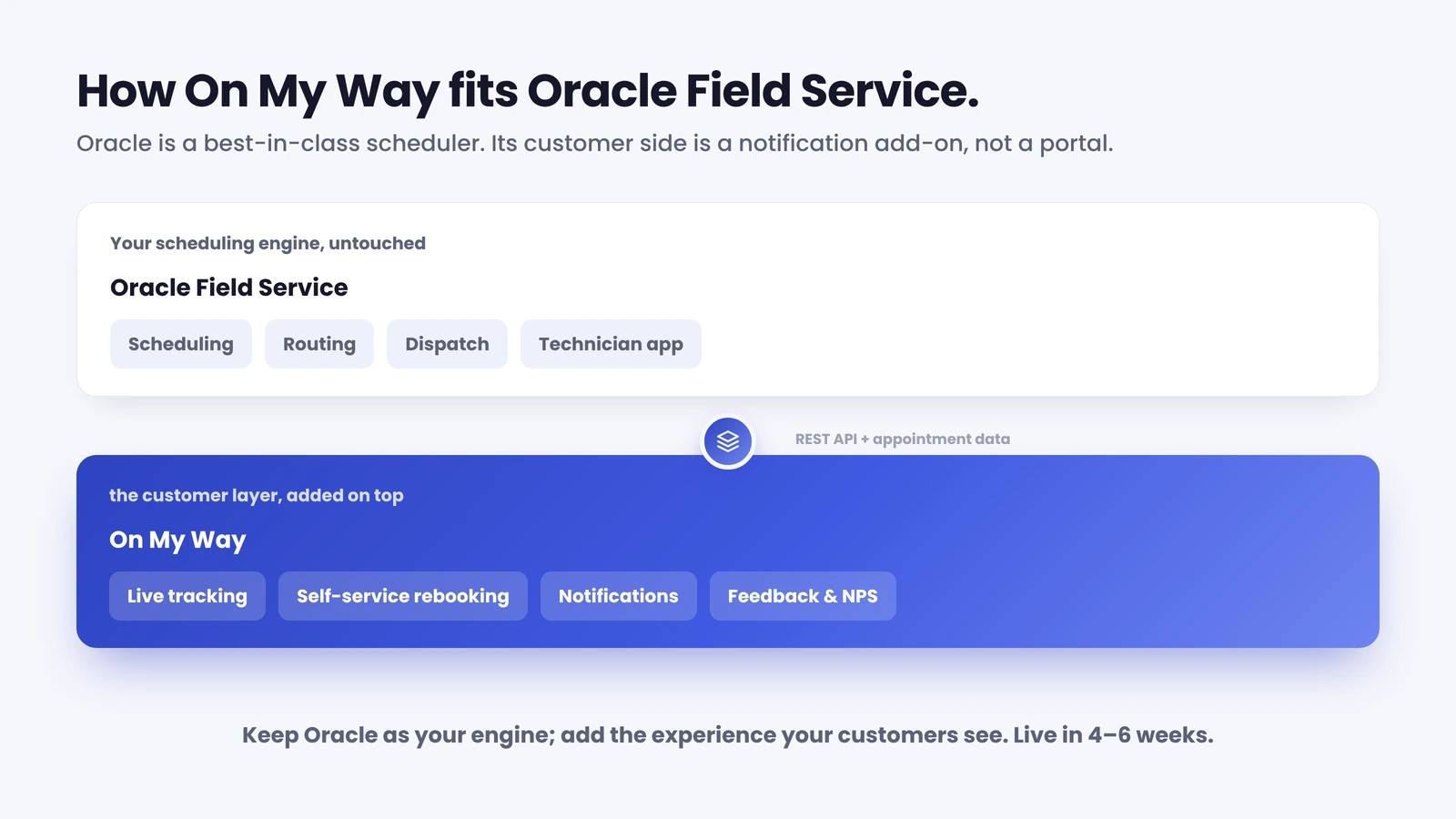
- On My Way is WFM-agnostic: it sits on top of OFS via Oracle’s public REST APIs and reads appointment data, with no change to scheduling, routing or dispatch.
- A typical go-live is four to six weeks, because there’s no rip-and-replace — you’re adding a layer, not migrating a system.
- One enterprise rollout on an existing WFM cut ETA-related calls to the contact centre by 53% and reached 79% engagement with appointment communications.
Most enterprise field-service teams running Oracle Field Service didn’t buy it for the customer experience. They bought it because it schedules thousands of jobs a day across a large, mobile workforce and gets the right engineer, with the right skills, to the right address by the most efficient route. On that job, OFS is genuinely good. The friction shows up one step removed from the schedule: at the customer’s front door, and in the contact centre that fields their calls.
This guide is for teams who want to keep Oracle Field Service and fix the customer side of the appointment without touching the engine underneath. It covers what OFS does well, where the customer-experience gap actually sits, and how a dedicated layer such as On My Way fills it, including the integration architecture and a realistic go-live timeline.
What Oracle Field Service does well
Oracle Field Service is, at its core, an optimisation engine, and a mature one. Its scheduling and routing are driven by embedded AI that Oracle includes at no additional charge, weighing technician skills, certifications, geolocation, travel time and shifting priorities to assign and sequence work automatically (Oracle, 2025). For a utility dispatching crews across planned work and emergency call-outs, or a manufacturer running hundreds of engineers, that is exactly the hard problem you want solved well.
The platform is strong in three areas in particular. Scheduling and dispatch: predictive AI matches each job to the technician whose skill set and availability fit best, then optimises their route — reducing distance driven and eliminating unnecessary truck rolls (Oracle, 2025). Routing and location: OFS tracks field workers along their routes, uses geofencing to verify on-site work and trigger alerts, and gives technicians turn-by-turn directions that account for real road conditions. The mobile worker app: technicians pull job data, customer details, knowledge articles and parts information on their phones, with digital-assistant support in the field.
None of that is in question. If you run OFS, you’re running a capable operational core. The point of this article isn’t to replace it; it’s to add what sits outside its remit.
The customer-communication gap
Here is the gap, stated fairly. Oracle Field Service is built to optimise the operation; it is not built, out of the box, to be the branded, consumer-grade experience the customer interacts with. OFS does include a “Where’s My Technician” capability that sends customers email or SMS updates and an arrival link, and Oracle offers a broader customer-communication module. Those are real, and worth using. But there’s distance between a notification feature and the end-to-end self-service customers now treat as table stakes.
That expectation has moved, and it moved everywhere else first. Research highlighted across field-service trends work for 2025 found that 74% of mobile-service workers say customer expectations are higher than they used to be, and that customers increasingly want the same experience they get from retail — self-service options, real-time tracking and proactive updates as standard. On the self-service point specifically, around 61% of customers would rather use self-service for simple issues than contact a live agent (FieldConnect / Document360, 2025). Someone who can move a parcel delivery in two taps does not see why rebooking an engineer means a phone call.
That distance has a cost, and it lands in the contact centre. In a typical enterprise operation, a third to two-fifths of booked appointments are changed by the customer and around a tenth are cancelled, with each change tending to generate a five-to-seven-minute agent call, often after hours (On My Way deployment research). Add the customers who simply ring to ask where the engineer is, and a large slice of contact-centre volume turns out to be questions the customer could have answered themselves, given the right self-service tools. OFS schedules the work beautifully; the calls about that work are a separate problem, and that’s the problem the customer experiences directly.

How On My Way fills the gap
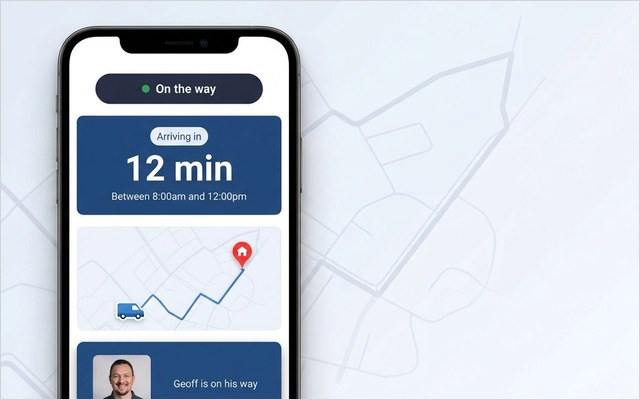
On My Way is a dedicated customer-experience layer that sits on top of your existing workforce-management system — including Oracle Field Service — and turns the appointment from an operational record into a transparent, self-serve experience. It doesn’t reschedule jobs inside OFS or touch the optimisation engine. It gives the customer a branded, browser-based front end (no app to download) for the moments OFS isn’t designed to own.
Four capabilities do most of the work:
- Real-time tracking — a live ETA and “your engineer is on the way” view, branded as yours, so the customer can see exactly when to expect the visit.
- Self-service rescheduling and cancellation — the customer moves or cancels their own appointment in seconds, online, without phoning anyone.
- Proactive notifications — confirmations, reminders and on-the-day updates over SMS and email, tuned to cut the no-show and the “where are you?” call together.
- Feedback and NPS — a quick rating captured immediately after the visit, while the experience is fresh and any problem is still recoverable.
The distinction from the OFS-native notification is depth and ownership. This is a fully branded portal the customer can act in — not just be messaged by — covering the whole journey from booking confirmation to post-visit feedback. It’s also where On My Way’s commercial promise lives: the platform underwrites a 35% reduction in appointment-related calls within 90 days, or the work continues at no extra cost until that’s hit. For a deeper view of the discipline behind this, see our guide to field service customer experience; for the build itself, the Oracle integration page covers it in detail.
The integration architecture: read appointment data, change nothing in OFS
The reason this is a four-to-six-week project and not a platform migration is the architecture. On My Way is API-first and read-oriented against your scheduling system. It connects to Oracle Field Service through Oracle’s own public REST APIs, which expose the appointment, resource and activity data third-party applications need, with standard token-based authentication (Oracle, 2025). On My Way uses those to read what it needs: who’s booked, for when, with which engineer, and where that engineer is on the day.

What it deliberately doesn’t do is rewrite your scheduling logic. Routing, optimisation, dispatch rules and the technician mobile app all stay inside OFS, untouched. When a customer reschedules through the On My Way portal, the change is passed back through the supported integration path so the operation stays in sync — without anyone re-architecting the OFS configuration that took months to tune. The principle is the one that runs through every On My Way deployment: it sits on top of your existing WFM, it doesn’t replace it. That’s also what keeps the IT risk low: no core-system change, standard authentication, your data residency and access controls intact.
Typical go-live: four to six weeks
Because there’s no migration, the timeline is short and predictable. A typical On My Way go-live on an existing WFM runs four to six weeks, with a six-week pilot option for teams who want to prove it on a slice of their operation first. The phases are straightforward: connect to the OFS APIs and confirm the appointment-data flow; configure the branded portal, notification templates and self-service rules; run a controlled pilot on one region or job type; then roll out. There’s no engineer retraining on a new scheduler, because the scheduler doesn’t change. You can see the full sequence on how On My Way works.
The table below is the plain-English version of what’s native to OFS versus what the On My Way layer adds — the comparison most teams are actually trying to make:
| Capability | Oracle Field Service (native) | With On My Way on top |
|---|---|---|
| AI scheduling, routing, dispatch | Yes — core strength | Unchanged (OFS keeps doing it) |
| Technician mobile app | Yes | Unchanged |
| Customer arrival notifications | Yes — “Where’s My Technician” SMS/email | Branded, real-time tracking portal |
| Self-service rescheduling/cancellation | Limited | Yes — customer self-serves online |
| Post-visit feedback / NPS | Add-on | Yes — captured at the moment of truth |
| Performance guarantee | n/a | 35% fewer appointment calls in 90 days |
What the result looks like
The payoff from adding a customer layer to a strong scheduler is measurable, and it shows up on both the experience and the cost line. Bosch UK, a UK HVAC field operation running around 350 engineers on an enterprise WFM, added this kind of self-service and tracking layer and cut ETA-related calls to its contact centre by 53% while reaching 79% engagement with its appointment communications.
The mechanism is the same one every time, and the operation underneath never changes: the scheduler was already good, so what moved the numbers was simply letting the customer see and act on the work it produced. The routine calls, the anxiety and a chunk of the no-shows go with it. If you’re running Oracle Field Service and recognise the call-volume pattern, the fastest test is to see it on your Oracle stack in a 30-minute working session: no slide deck, your data, your scenarios.
Frequently asked questions
Can you add customer self-service to Oracle Field Service without replacing it? Yes. On My Way is a customer-experience layer that sits on top of Oracle Field Service through Oracle’s public REST APIs. It reads appointment data and adds a branded tracking and self-service portal, while OFS continues to handle all scheduling, routing and dispatch. Nothing in the OFS configuration is replaced or re-architected.
Doesn’t Oracle Field Service already have a customer portal? OFS includes a “Where’s My Technician” notification (SMS/email arrival updates) and a customer-communication module. Those are useful, but they stop short of a fully branded, end-to-end self-service experience — where the customer can reschedule, cancel, track live and leave feedback themselves. On My Way adds that depth on top of what OFS already sends.
How does On My Way integrate with Oracle Field Service? Through Oracle’s documented public REST APIs, using standard token-based authentication for third-party access. On My Way reads the appointment and resource data it needs and passes customer-initiated changes back through the supported path, so the operation stays in sync. The integration is read-oriented by design: it doesn’t rewrite your scheduling logic.
How long does it take to go live on Oracle Field Service? Typically four to six weeks, because it’s an added layer rather than a system migration. There’s a six-week pilot option to prove it on one region or job type first. Engineers don’t need retraining, as the scheduling system they use doesn’t change.
Will adding On My Way disrupt our existing OFS scheduling or dispatch? No. Routing, optimisation, dispatch rules and the technician mobile app all stay inside Oracle Field Service. On My Way operates as a customer-facing layer on top, which is what keeps the IT risk, and the implementation time, low.
References
- Oracle — Field Service Management | CX.
- Oracle — Field Service: Capacity, Scheduling & Routing Optimization.
- Oracle — How can Oracle field service solutions help your utility?
- Oracle — Understanding Field Service APIs / REST endpoints (Fusion Field Service).
- FieldConnect — 15 Hot Field Service Trends Shaping 2025.
- Document360 — Top 2025 Self-Service Statistics & its Importance.
- On My Way / Leadent Digital — enterprise deployment data (appointment-change volume; client call-reduction and engagement outcomes).

Keep your WFM. Upgrade what your customers experience.
On My Way is the customer-experience layer for field service: live arrival tracking, self-service rebooking, notes and photos, and feedback — added on top of the scheduling system you already run. No rip-and-replace, live in 4–6 weeks.